QIGONG & YANGSHENG · 气功与导引

Tapping the Teeth and Swallowing the Jade Fluid (Kou Chi Yan Jin): Classical Salivary Alchemy in the Huangting Jing and Yangxing Yanming Lu 叩齿咽津:《黄庭经》与《养性延命录》玉池生津导引指南

An authentic textual and practical guide to the Taoist morning hygiene and Neidan method of Tapping the Teeth (Kou Chi), Stirring the Sea with the Red Dragon (Chilong Jiaohai), and Swallowing the Jade Fluid (Yan Jin), grounded in the Huangting Jing and Tao Hongjing's Yangxing Yanming Lu.


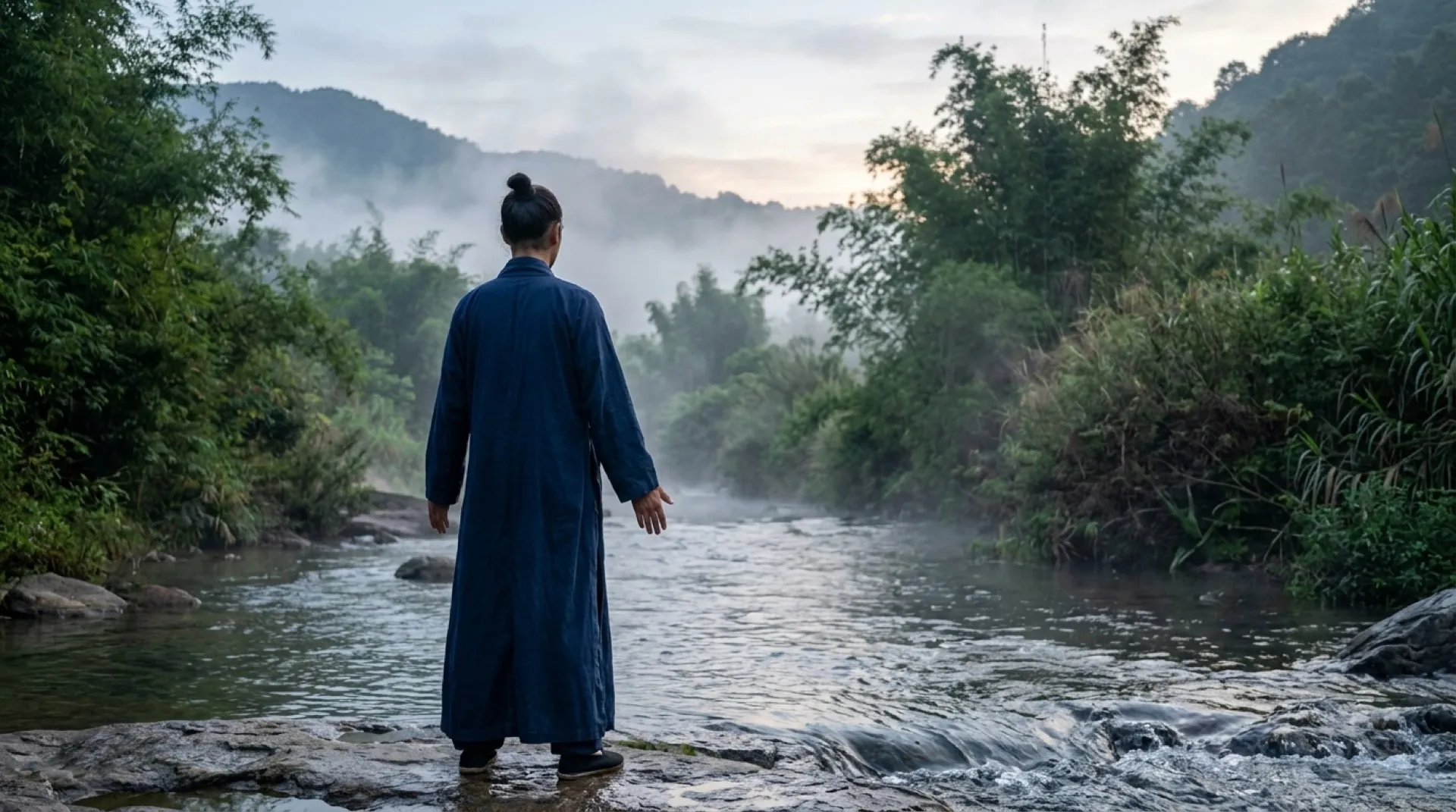
A figure in a long indigo robe with hair tied in a topknot, seen from behind, standing at the edge of a shallow misty mountain stream among bamboo.

1. Primary Textual Foundations: The Jade Pool (Yu Chi) in the Huangting Jing and Yangxing Yanming Lu

In classical Taoist longevity literature and Wudang morning cultivation, the oral cavity is known as the 'Jade Pool' (玉池, Yu Chi) or the 'Palace of Supreme Harmony' (太和官, Taihe Guan), and clear, unhurried saliva generated during quiet meditation is prized as 'Jade Fluid' (玉液, Yu Ye) or 'Golden Fluid' (金津, Jin Jin). The early medieval Taoist scripture Huangting Neijing Jing (《黄庭内景经》, Inner Landscape Scripture of the Yellow Court) states: 'The mouth is the Jade Pool, the official of Supreme Harmony; rinsing and swallowing the numinous fluid keeps misfortune at bay, bringing luster to the form and fragrant breath (口为玉池太和官,漱咽灵液灾不干,体生光华气香兰).' Likewise, Tao Hongjing's (陶弘景, 456–536 CE) Yangxing Yanming Lu (《养性延命录》, Records on Nourishing Nature and Extending Life) records the daily practice of 'tapping the teeth at dawn and dusk' (朝夕琢齿 / 叩齿, Kou Chi) paired with 'stirring the sea with the Red Dragon' (赤龙搅海, Chilong Jiaohai—circling the tongue around the gums and palate) and swallowing the gathered fluid in three mindful portions down to the Lower Dantian.

2. Traditional Physiological Rationale: Kidney Essence, the Two Wells (Jinjin & Yuye), and Digestive Harmony

Within classical Chinese physiological theory, the teeth are understood as the 'surplus of the bones' (齿为骨之余), which are governed by Kidney Water (肾主骨), while the Spleen and Stomach open into the mouth and lips. Underneath the tongue on either side of the lingual frenulum lie the two extraordinary points Jinjin (金津, 'Golden Fluid' on the left) and Yuye (玉液, 'Jade Fluid' on the right), through which Kidney Water ascends along the Ren and Kidney channels to moisten the upper palate. Rather than spitting out or ignoring this clear secretion during standing meditation (Zhan Zhuang) or seated quietude, gently tapping the teeth awakens the periodontal ligaments and cranial meridians, while circling the tongue stimulates a warm, sweet, watery secretion that moistens the throat and supports calm digestive harmony in the Middle Burner. This traditional self-cultivation practice is a daily mindfulness and wellness discipline and never a substitute for professional dental or medical care.

3. Step-by-Step Morning Practice: Gathering the Spirit, Thirty-Six Taps, Red Dragon Stirring, and Three Swallows

As taught in traditional morning classes connected to Wudang Mountain's UNESCO World Heritage ancient Taoist temples and at Lee Wudang International Pte. Ltd., perform Kou Chi Yan Jin upon waking or at the close of Qigong practice: (1) Close the lips softly, relax the jaw and shoulders, and breathe quietly through the nose for three breaths to gather the spirit (凝神); (2) Gently tap the upper and lower molars together twelve or thirty-six times (叩齿三十六通) with an even, rhythmic cadence—firm enough to resonate softly in the jawbone without clenching or striking the enamel harshly; (3) Slide the tip of the tongue ('the Red Dragon', 赤龙) slowly around the outer surface of the upper and lower teeth and gums eighteen times clockwise and eighteen times counterclockwise, then repeat along the inner surface of the teeth; (4) Rest the tongue tip against the upper palate (搭鹊桥, 'Building the Magpie Bridge') until the mouth fills with clear, sweet fluid, rinse softly around the cheeks, and divide the fluid into three swallows—guiding each swallow with calm intention down the centerline into the Lower Dantian.

4. Integration with Daily Wudang Qigong & Cross-References

Kou Chi Yan Jin requires only three to five minutes and serves as the traditional closing seal after any Wudang standing posture, Daoyin sequence, or weapon session. To explore related practices across our curriculum, visit our Wudang Wellness & Qigong Overview, pair this morning method with evening breath work in Wudang Triple Burner (Sanjiao) Harmonization & Xi-Breath Daoyin, study the philosophical foundation of returning to the Infant in Know the Male, Keep to the Female (Tao Te Ching Chapter 28), and review Wudang Straight Sword Eight Mother Techniques (Ba Mu Jian).

Seeker’s Q&A · Frequently Asked Questions

What is the core takeaway of Tapping the Teeth and Swallowing the Jade Fluid (Kou Chi Yan Jin)?

An authentic textual and practical guide to the Taoist morning hygiene and Neidan method of Tapping the Teeth (Kou Chi), Stirring the Sea with the Red Dragon (Chilong Jiaohai), and Swallowing the Jade Fluid (Yan Jin), grounded in the Huangting Jing and Tao Hongjing's Yangxing Yanming Lu.
