
TAOIST PHILOSOPHY · 道家哲学

A Good Traveler Leaves No Tracks (Shan Xing Wu Zhe Ji): Knotless Skill and 'Following Brightness' (Xi Ming) in Tao Te Ching Chapter 27 善行无辙迹:《道德经》第二十七章的无结之巧与“袭明”之道

An analytical examination of Laozi's Chapter 27, exploring the five 'knotless skills' (Shan Xing, Shan Yan, Shan Shu, Shan Bi, Shan Jie), the ethic of 'no abandoned people or things' (Wu Qi Ren, Wu Qi Wu), and 'Following Brightness' (Xi Ming) in Wudang footwork and self-cultivation.


A stone bench at a bend in a stone-paved mountain path beneath a pine, overlooking a misty green valley.

1. Textual Foundation: The Five Knotless Skills of Chapter 27

Chapter 27 of the Laozi (Tao Te Ching) opens with five concrete images of consummate skill that leave no mechanical residue or forced contrivance behind: 'Good traveling leaves no wheel-ruts or tracks (善行无辙迹, shan xing wu zhe ji); good speech leaves no flaw to be faulted (善言无瑕谪, shan yan wu xia zhe); good reckoning uses no counting-tallies (善数不用筹策, shan shu bu yong chou ce); good closing uses no bolt or bar yet cannot be opened (善闭无关楗而不可开, shan bi wu guan jian er bu ke kai); good binding uses no rope or cord yet cannot be untied (善结无绳约而不可解, shan jie wu sheng yue er bu ke jie).' In early Chinese material culture, wheel-ruts (辙迹) were deep grooves cut into earthen roads by heavy axle-carts, tallies (筹策) were bamboo counting-rods arranged on a board, bolts and bars (关楗) were wooden horizontal and vertical door-locks, and cords (绳约) were knotted hemp bindings. Wang Bi (王弼, 226–249 CE) explains that each of these five skills succeeds precisely because it conforms to the natural propensity (自然之性) of things rather than imposing an external mechanical instrument upon them. When action aligns completely with the Dao, it neither gouges ruts into the terrain nor depends on artificial knots that can later be pried open or untied.

2. No Abandoned People, No Abandoned Things (Wu Qi Ren, Wu Qi Wu) and Following Brightness (Xi Ming)

From the five knotless skills, Chapter 27 draws a direct ethical and pedagogical conclusion: 'Therefore the sage is always good at saving people, and so no person is abandoned (常善救人,故无弃人); always good at saving things, and so no thing is abandoned (常善救物,故无弃物). This is called Following Brightness (是谓袭明, shi wei xi ming).' Unlike rigid legalist or utilitarian standards that measure everyone against a single fixed mold and discard those who do not fit, the Taoist sage recognizes the distinct capacity of every person and material. In Heshang Gong's (河上公) commentary, 'Following Brightness' (袭明)—where xi (袭) means both to inherit/follow seamlessly and to cloak or conceal outer glare—describes an inward illumination that sees how each temperament and circumstance can be guided back to balance without coercion. Chapter 27 concludes by noting that the good person is the teacher (师, shi) of the not-good, while the not-good person is the raw material or mirror (资, zi) for the good; failing to honor one's teacher or failing to cherish one's material, however clever one considers oneself, is called 'great delusion' (大迷, da mi).

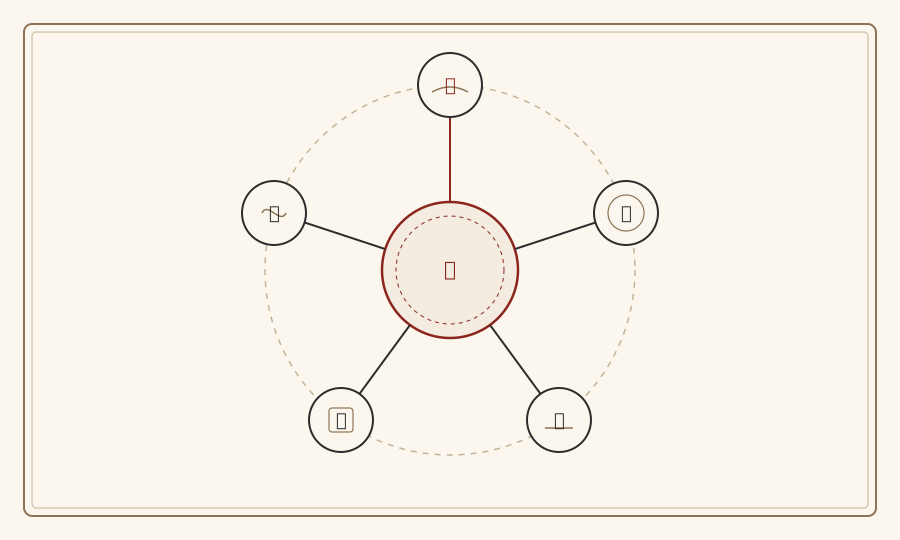
Classical diagram of Tao Te Ching Chapter 27: The Five Knotless Skills (Shan Xing, Shan Yan, Shan Shu, Shan Bi, Shan Jie) converging into 'Following Brightness' (Xi Ming — No Abandoned People, No Abandoned Things).

Classical diagram of Tao Te Ching Chapter 27: The Five Knotless Skills (Shan Xing, Shan Yan, Shan Shu, Shan Bi, Shan Jie) converging into 'Following Brightness' (Xi Ming — No Abandoned People, No Abandoned Things).

  1. ① Good traveling leaves no tracks (善行无辙迹)
  2. ② Good speech leaves no flaw (善言无瑕谪)
  3. ③ Good reckoning uses no counting-tallies (善数不用筹策)
  4. ④ Good closing uses no bolt or bar (善闭无关楗)
  5. ⑤ Good binding uses no rope or cord (善结无绳约)
  6. ⑥ Following Brightness (袭明, Xi Ming): no person abandoned, no thing abandoned

3. Wudang Martial & Neidan Embodiment: Traceless Stepping and Knotless Sealing

In Wudang internal martial arts (Neijiaquan) and internal alchemy (Neidan), the five phrases of Chapter 27 serve as precise diagnostic standards for physical movement and energetic guarding. 'Good traveling leaves no tracks' (善行无辙迹) is the classical motto for Wudang stepping methods—such as Mud-Wading Stepping (趟泥步, Tangni Bu) in Baguazhang and Cat-Walking (猫行步, Maoxing Bu) in Taijiquan—where the root transfers smoothly through the Yongquan (涌泉, KI-1) wellspring without stamping, skidding, or telegraphing weight shifts into the floor. Similarly, 'good closing uses no bolt yet cannot be opened' (善闭无关楗而不可开) and 'good binding uses no cord yet cannot be untied' (善结无绳约而不可解) describe guarding the Three Passes (三关) and sealing Original Qi (元气) within the Lower Dantian: if a practitioner clenches the chest, holds the breath with muscular force, or locks the joints rigidly, that artificial 'bolt' creates structural tension that an opponent can uproot or that stagnates Qi; when the spirit (神, Shen) and breath (息, Xi) naturally cohere, the frame is sealed from within without a single knot of muscular stiffness.

4. Cross-References & Practice Integration Across the Wudang Canon

To integrate Chapter 27 into daily study, compare its ethic of traceless action with Chiseling Doors and Windows: Utility of the Empty Room (Tao Te Ching Ch. 11) and Tip-Toe Standing Is Not Firm: QiZhe BuLi and KuaZhe BuXing (Tao Te Ching Ch. 24), which warn against over-striding and forced display. On the training courtyard, pair the principle of 'Following Brightness' (袭明) and traceless stepping with Wudang Staff Fundamentals: Xuanwu Gun and Taiji Gun Guide and Soothing the Triple Burner (Sanjiao) and Twilight Xi-Breath Daoyin Guide.

Seeker’s Q&A · Frequently Asked Questions

What is the core takeaway of A Good Traveler Leaves No Tracks (Shan Xing Wu Zhe Ji)?

An analytical examination of Laozi's Chapter 27, exploring the five 'knotless skills' (Shan Xing, Shan Yan, Shan Shu, Shan Bi, Shan Jie), the ethic of 'no abandoned people or things' (Wu Qi Ren, Wu Qi Wu), and 'Following Brightness' (Xi Ming) in Wudang footwork and self-cultivation.
