WUDANG TAIJIQUAN · 武当太极拳

Golden Rooster Stands on One Leg (Jinji Duli) in Wudang Taijiquan: Single-Leg Rooting, Sinking the Supporting Hip and Safe Balance Progression 武当太极拳“金鸡独立”详解:独立步生根、松胯虚领与单腿平衡进阶练法

Why standing steadily on one leg in Taijiquan comes not from locking the ankle, but from suspending the crown, sinking the supporting hip crease, and pairing downward root with upward buoyancy.

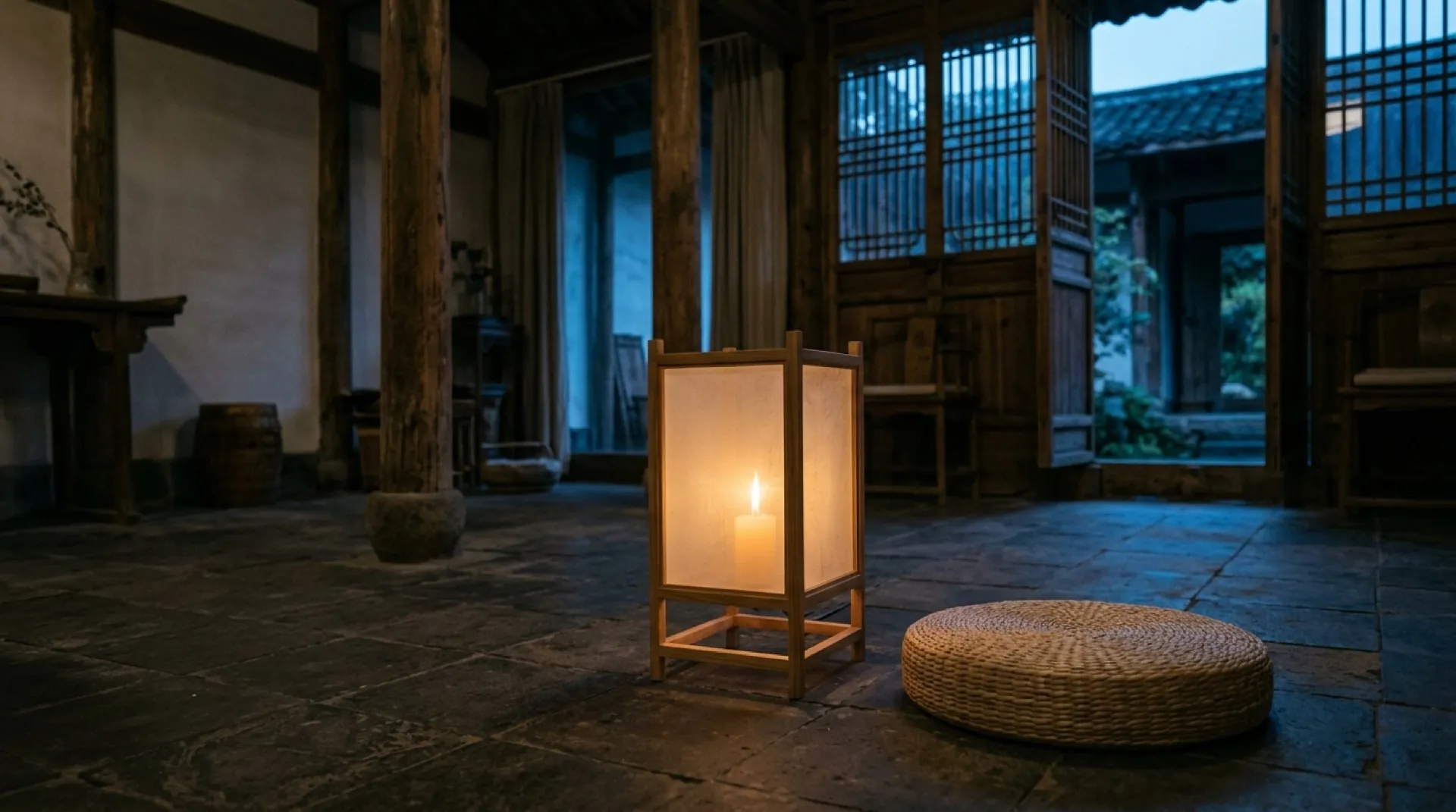
A single paper lantern with a lit candle and a round woven straw cushion on the stone floor of a dim timber hall with lattice windows at dusk.

Few postures in Wudang Taijiquan reveal the truth of your structural alignment as immediately as “Golden Rooster Stands on One Leg” (金鸡独立, Jinji Duli). In a wide two-footed stance, you can sometimes disguise a leaning spine or a tense shoulder; the moment one foot leaves the floor, however, even a one-inch deviation from Central Equilibrium (Zhongding) makes the ankle wobble.

Why do beginners often struggle to hold Jinji Duli calmly for three seconds? Because our instinctive reaction when lifting one leg is to hold our breath, shrug our shoulders, and lock the standing knee stiffly—which raises our centre of gravity into the chest (Tao Te Ching (Dao De Jing) Chapter 24: “One who stands on tiptoe does not stand firm”). In authentic Wudang mechanics, single-leg stability comes from two-way vertical opposition: sinking the supporting hip down into the heel while suspending the crown and lifted knee upward.

1. Four Biomechanical Keys of “Golden Rooster Stands on One Leg”

Whether you enter Jinji Duli after Low Single Whip (下势) or practice it as a standalone balance drill following Crane-Step Walking Qigong, four structural alignments lock the posture into quiet equilibrium:

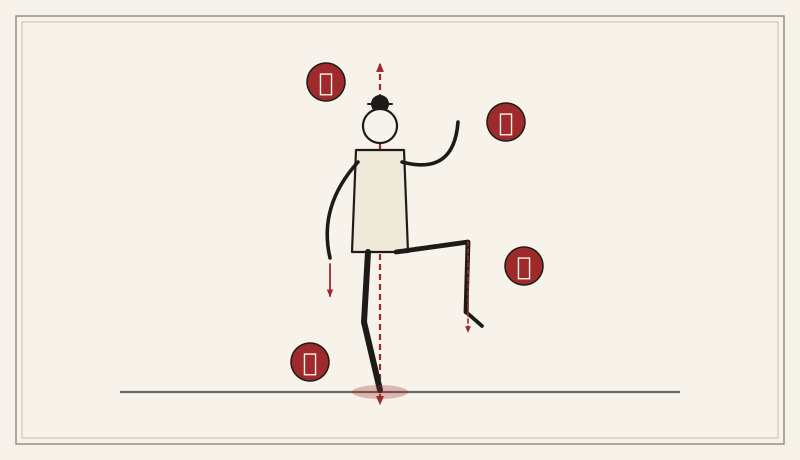
Classical ink-and-cinnabar diagram of Wudang Taijiquan Golden Rooster Stands on One Leg (Jinji Duli) showing the rooted supporting leg and folded hip crease, the vertical crown-to-heel plumb line, the raised knee with naturally hanging calf, and the opposing upper guarding palm and lower pressing hand

The four-point equilibrium of Golden Rooster Stands on One Leg (金鸡独立 · 上下对拉、独立生根).

  1. Rooted Supporting Leg & Folded Hip Crease (松胯落踵 · 独立生根): the standing knee stays softly unlocked (never snapped backward) while the supporting hip crease (kua) folds inward-and-downward so weight pours directly into the heel and Yongquan arch (Distinguishing Empty and Full)
  2. Suspended Crown & Vertical Plumb Axis (虚领顶劲 · 立身中正): an invisible vertical thread connects the crown (Baihui), the perineum (Huiyin), and the centre of the supporting heel—as if your head were gently touching a ceiling lantern while your tailbone hangs heavy
  3. Raised Knee with Naturally Hanging Calf (提膝垂足 · 护中守下): lift from the hip flexors and lower abdomen as if a silk thread were drawing the knee upward toward the centerline while the lower leg and foot hang completely relaxed like a bell clapper
  4. Upper Guarding Palm & Lower Pressing Hand (上托下按 · 阴阳相济): as the right knee rises, the right palm curves upward along the centerline to shoulder-or-brow height while the left palm presses calmly beside the left hip (Six Harmonies)

2. Why “Pressing Down to Float Up” Stops Ankle Wobbling

In Wudang pedagogy, teachers give a simple image that transforms Jinji Duli immediately: “Do not try to pull the empty leg up with your shoulders; press the standing foot down into the earth so the empty knee floats up by itself.”

  • As you exhale (Natural Abdominal Breathing), imagine the standing leg growing three inches deeper into the stone beneath your heel while your left palm presses gently downward beside your hip.
  • By reaction, the right knee and right palm rise effortlessly along the centerline without lifting your ribs or tightening your neck (Chenjian Zhuizhou).
  • Rest your gaze softly on a stationary point on the horizon (Mingmu Yunjing)—never looking down at the floor, which immediately tips the head and cervical spine forward.

3. A Safe 3-Stage Progression for Beginners and Seniors

In line with Zhuangzi’s principle of “neither too loose nor too tight”, build your single-leg root gradually:

  1. Stage 1 — Empty-Step Touch (虚步点地): Practice the arm and waist coordination in an Empty Step (like White Crane Spreads Its Wings), keeping the big toe of the front foot lightly touching the floor while 90% of your weight roots in the standing leg.
  2. Stage 2 — Low Ankle-to-Calf Lift (低提三寸): Lift the empty foot just three to four inches off the floor for one calm breath cycle, focusing 100% on keeping the standing hip crease soft and the pelvis level, then step down heel-first and switch sides.
  3. Stage 3 — Full Waist-Height Jinji Duli (成势独立): Once your ankle and hip remain quiet at low height, allow the knee to float to waist height for two or three slow breaths on each side, linking Left and Right Golden Rooster smoothly.
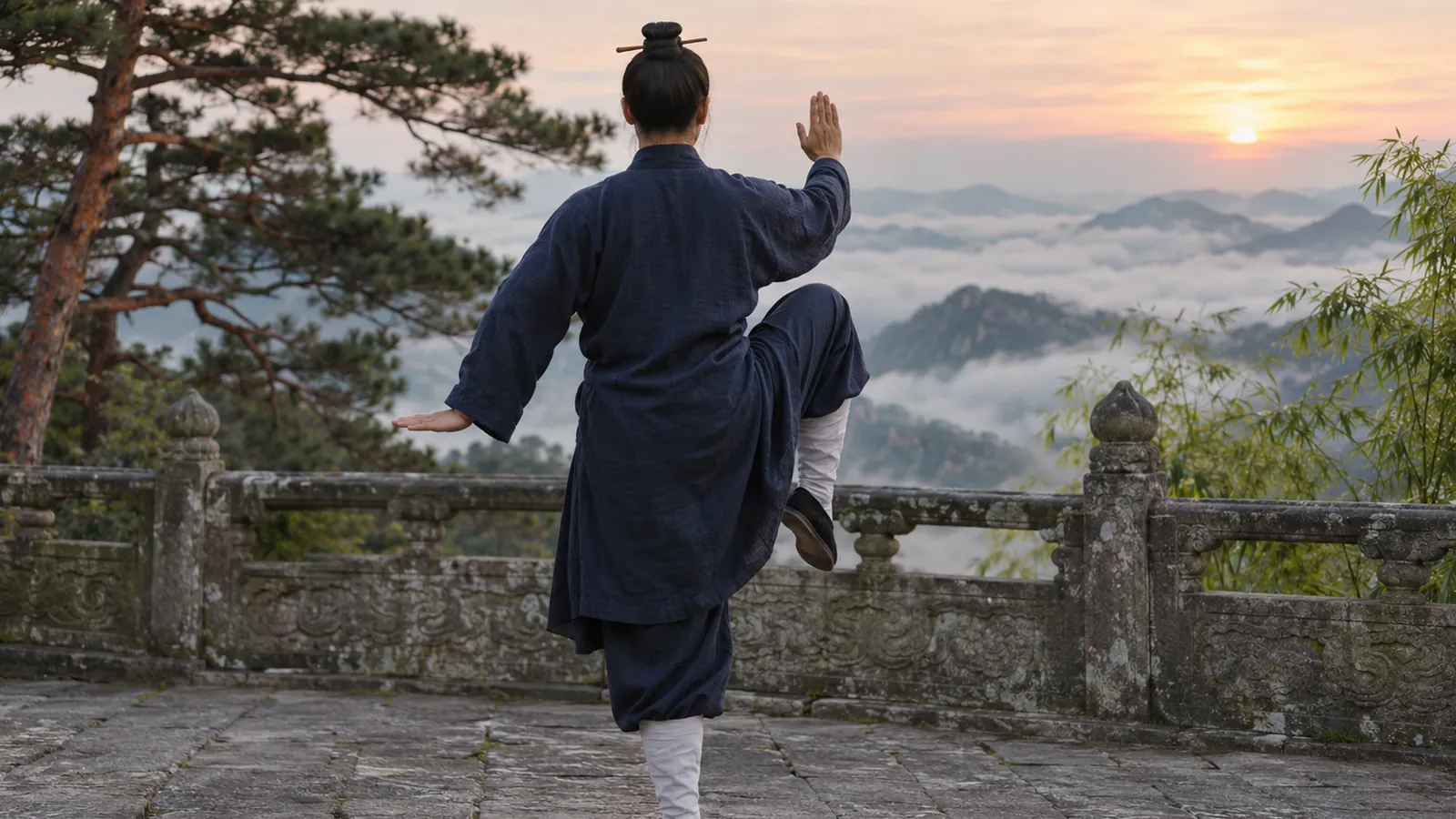
A practitioner in dark indigo Taoist robes and white cotton leg wraps seen from behind balancing on one leg in Wudang Taijiquan’s Golden Rooster Stands on One Leg (Jinji Duli) on a stone mountain terrace above morning clouds.

Golden Rooster Stands on One Leg (Jinji Duli) at dawn: the standing leg stays rooted and softly bent while the raised knee and the pressing hand keep the body balanced.

4. Training Balance Between Wudang Mountain and Singapore

Connecting the living martial heritage near Wudang Mountain’s UNESCO World Heritage ancient Taoist temples with our regular classes in Singapore, Wudang.Org helps students build resilient, age-friendly balance and coordination. Begin with Wudang Tai Chi for Beginners, visit Start Here, or join our Singapore Tai Chi Retreat Camp.

Safety note: Practice near a wall, chair back, or wooden balustrade if your balance is still developing, never hyper-extend (lock) the standing knee joint, and avoid eyes-closed single-leg standing; traditional martial training does not replace medical or physiotherapy care.

Seeker’s Q&A · Frequently Asked Questions

Why should the lifted foot hang naturally rather than pointing or flexing stiffly in Jinji Duli?

Stiffly flexing or pointing the lifted foot tenses the calf and raises the center of gravity. Letting the lower leg and foot hang heavy and relaxed below the raised knee acts like a pendulum weight that stabilizes your whole posture.


Why does locking the standing knee make it harder to balance in Golden Rooster Stands on One Leg?

Snapping the standing knee joint into a rigid lock cuts off communication between the hip, ankle, and sole, forcing tiny balance corrections to tip the whole torso. Keeping the standing knee softly unlocked with a folded hip crease (kua) lets the foot absorb micro-adjustments smoothly.

Should I practice Golden Rooster Stands on One Leg with my eyes closed?

In traditional Wudang Taijiquan, Jinji Duli is practiced with the eyes open, level, and calmly gazing toward the horizon so Shen (spirit) and postural alignment remain clear and safe—especially for beginners and older adults.
