
TAOIST PHILOSOPHY · 道家哲学

The Tao Is Like an Empty Vessel (Dao Chong): Inexhaustible Openness and 'Softening the Glare' in Tao Te Ching Chapter 4 道冲而用之或不盈:《道德经》第四章的冲虚之道与“和光同尘”内修心法

Explore Tao Te Ching (Dao De Jing) Chapter 4 ('The Tao is like an empty vessel, yet in its use it is never exhausted') and its fourfold cultivation method: blunting sharpness, untangling knots, softening the glare, and mingling with the dust.


A small clay teapot and two cups on a flat wet stone beside a thin spring trickling from mossy rocks in a bamboo forest.

1. 'The Tao Is Hollow, Yet Its Use Never Overflows' (Dao Chong Er Yong Zhi Huo Bu Ying)

Chapter 4 of the Tao Te Ching (Dao De Jing) opens with the image of a ritual vessel whose power lies in its hollowness: 'The Tao is empty (or surging in hollowness, chong 冲), yet when you use it, it never needs to be filled to overflowing (dao chong, er yong zhi huo bu ying 道冲,而用之或不盈). Abyssal (yuan xi 渊兮), it seems the ancestor of the ten thousand things.'

In early Chinese texts and received commentaries (explored on our Tao Te Ching Chapter 4 study page and in our essay on You and Wu: Empty Space), the character chong (冲/盅) evokes both an empty cup and the gentle, rhythmic eddy of water circulating inside an open basin. A cup stuffed solid with stones cannot receive a single drop of tea; a mind or body stuffed solid with rigid opinions and muscular tension cannot respond to the living moment.

2. The Fourfold Cultivation Formula: Blunt Sharpness, Untangle Knots, Soften Glare, Mingle with Dust

How does a practitioner embody the inexhaustible openness of Dao Chong? Chapter 4 gives four concrete directives—lines so foundational to Taoist ethics and inner cultivation that Laozi repeats them verbatim in Chapter 56: 'Blunt its sharpness (cuo qi rui 挫其锐); untangle its knots (jie qi fen 解其纷); soften its glare (he qi guang 和其光); mingle with its dust (tong qi chen 同其尘).'

Notice the progression. 'Blunting sharpness' means letting go of the urge to win every argument or force every technique. 'Untangling knots' means allowing emotional and physical tangles to loosen through patience rather than yanking on the cord. 'Softening the glare' and 'mingling with the dust' (heguang tongchen 和光同尘) describe the mature sage who hides inner clarity inside ordinary, unpretentious warmth—echoing Knowing the White, Keeping to the Black.

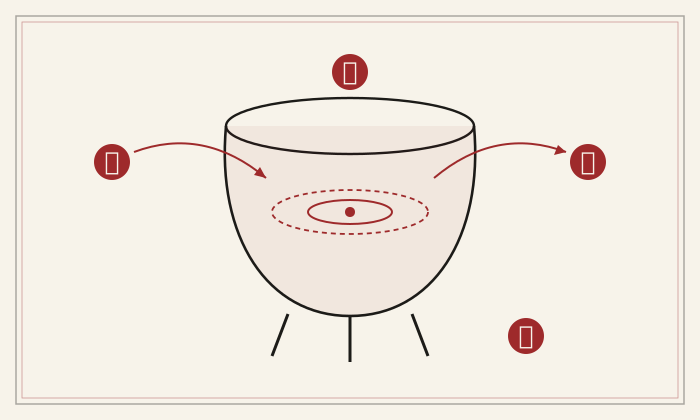
Classical diagram of the empty ritual vessel (Dao Chong) of Tao Te Ching Chapter 4 showing the hollow vortex within and the fourfold harmonization of sharpness, knots, glare, and dust

Tao Te Ching Chapter 4: The hollow vessel (① Dao Chong) whose abyssal depth (④ Yuan Xi) blunts sharpness (② Cuo Qi Rui) and softens the glare (③ He Qi Guang).

  1. ① Dao Chong (The Hollow Vessel): The open, unstuffed interior whose function never runs dry because it clings to nothing.
  2. ② Cuo Qi Rui, Jie Qi Fen (Blunt the Sharpness, Untangle the Knots): Releasing aggressive edges and mental tangles.
  3. ③ He Qi Guang, Tong Qi Chen (Soften the Glare, Mingle with the Dust): Tempering outward display into grounded humility.
  4. ④ Yuan Xi Si Wanwu Zhi Zong (Abyssal Ancestor of the Ten Thousand Things): The quiet root from which vitality continually renews.

3. 'Heguang Tongchen' and Hollow Receptivity in Wudang Taijiquan

On the Wudang training courtyard, a beginner often wants their martial skill to 'shine' outwardly—showing sharp edges, dramatic stances, or forceful resistance. Yet in Push Hands (Tuishou) and solo form, any outward 'sharpness' (rui 锐) gives your partner a rigid handle to uproot you.

When you practice 'hollowing the chest and rounding the upper back' (hanxiong babei) and releasing the hip creases (Songkua), your torso becomes like the hollow vessel of Chapter 4. Incoming force enters an empty, spiraling center (chong) where its sharpness is blunted and its knots are untangled without collision.

4. Daily Reflection: Practicing the 'Empty Cup' in Conversation and Standing

Before entering a difficult meeting or stepping into Standing Post (Zhan Zhuang), recall the four phrases of Chapter 4: soften your voice and gaze (he qi guang), relax the sharp defensive edges in your shoulders (cuo qi rui), and leave 30 percent of your attention open and unscheduled like an unfilled celadon bowl.

Safety note: this philosophical study guide is for educational and contemplative reflection and is not a substitute for medical or psychological care.

Seeker’s Q&A · Frequently Asked Questions

What is the core takeaway of The Tao Is Like an Empty Vessel (Dao Chong)?

Explore Tao Te Ching (Dao De Jing) Chapter 4 ('The Tao is like an empty vessel, yet in its use it is never exhausted') and its fourfold cultivation method: blunting sharpness, untangling knots, softening the glare, and mingling with the dust.
