WUDANG TAIJIQUAN · 武当太极拳

Closing Posture (Shoushi) and Returning Qi to the Original Root (Yin Qi Gui Yuan) in Wudang Taijiquan: Merging Taiji Back into Wuji Stillness 武当太极拳“收势”与“引气归元”详解:由动归静、合太极复归无极

Learn the step-by-step biomechanics of the Closing Posture (Shoushi) and Returning Qi to the Original Root (Yin Qi Gui Yuan) in Wudang Taijiquan, completing the circle from Cross Hands back to Wuji stillness.


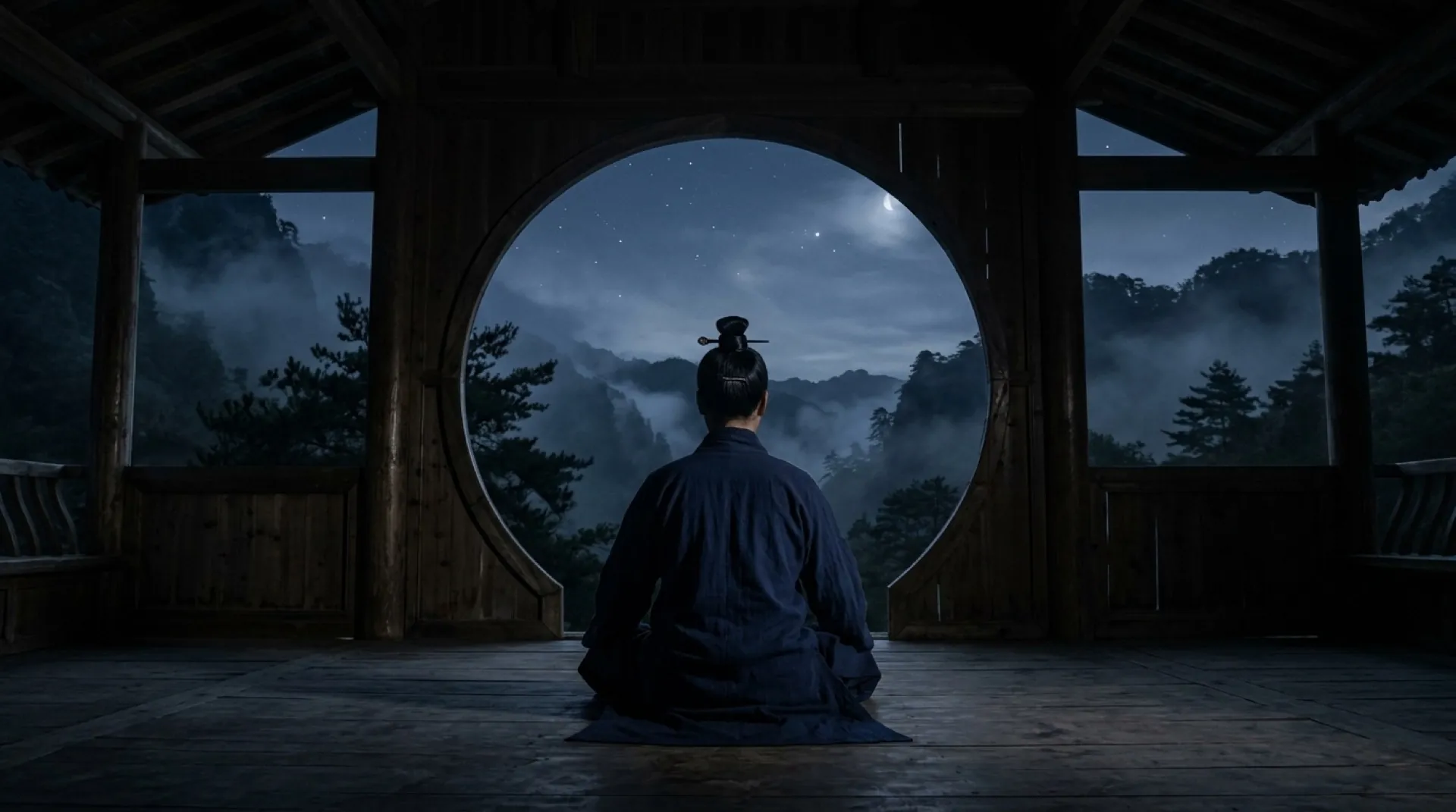
A figure in a dark robe with hair in a topknot, seen from behind, seated before the round opening of a timber pavilion that looks onto misty mountains under a starry night sky.

1. Completing the Cosmological Circle: 'In Stillness, It Merges' (Jing Zhi Ze He)

Every traditional Wudang Taijiquan routine is a complete cosmological cycle. In our guide to the Opening Posture (Qishi) and Embracing the Taiji Sphere (Baoqiu), we saw how the practitioner steps out from undifferentiated Wuji stillness to awaken the first wave of Yin and Yang. At the end of the solo form, after the final Apparent Close-Up (Rufeng Sibi) and Cross Hands (Shizishou), the Closing Posture (Shoushi 收势, accompanied by Yin Qi Gui Yuan 引气归元, 'Guiding Qi Back to the Original Root') completes the second half of Wang Zongyue's Taijiquan Lun maxim: 'In movement, it separates; in stillness, it merges' (dong zhi ze fen, jing zhi ze he 动之则分,静之则合).

As Chapter 16 of the Tao Te Ching (Dao De Jing) observes, 'All things flourish in abundance, and each returns to its root. Returning to the root is called stillness; stillness is called returning to life-mandate' (explored in our Returning to the Root (Guigen) essay). Without a deliberate, unhurried closing posture, the heightened circulation awakened during form practice remains dispersed in the limbs and upper chest.

2. Step-by-Step Biomechanics: Unfolding from Cross Hands and Guiding Qi Downward

Entering Shoushi from Cross Hands (Shizishou) with feet shoulder-width apart, allow your wrists—which are crossed before the chest—to rotate gently so the palms turn outward and downward while separating horizontally to shoulder width at shoulder height. Keep the collarbones wide and the shoulder blades heavy so the separation comes from the back and elbows rather than pinching the neck.

Next comes the core downward wave of Yin Qi Gui Yuan: soften the knees and hip creases (Kua) slightly and let the elbows drop first, drawing the forearms and palms slowly downward in front of the chest and upper abdomen on a long, quiet exhale. Imagine the palms smoothing clear water down the front of the body—from the crown and throat through the chest to settle deep inside the lower abdomen (dantian)—until the hands come to rest naturally beside the outer thighs.

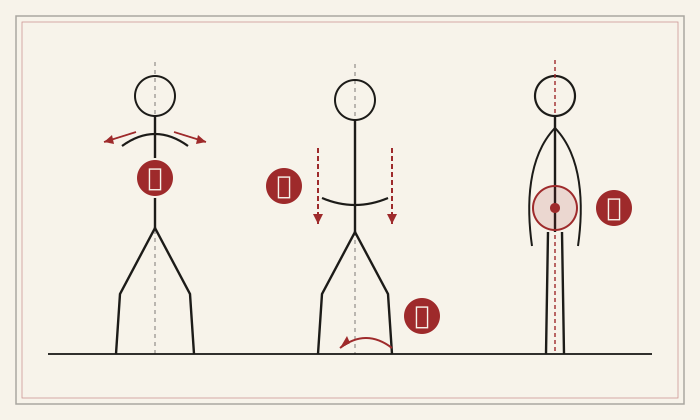
Three-phase diagram of Wudang Taijiquan Closing Posture (Shoushi) showing unfolding from Cross Hands, downward Yin Qi Gui Yuan palm press, left foot closing step, and quiet Wuji consolidation

How Shoushi and Yin Qi Gui Yuan complete the Taijiquan form: unfolding from Cross Hands, guiding breath to the lower dantian, closing the step, and resting in Wuji.

  1. ① Unfolding from Cross Hands (Shizishou): The crossed wrists separate outward to shoulder width as palms turn softly toward the ground.
  2. ② Returning Qi to the Origin (Yin Qi Gui Yuan): Elbows sink and palms press gently down past the chest, guiding breath and warmth into the lower dantian.
  3. ③ Closing the Step Without Swaying: The left foot draws smoothly back beside the right foot while the crown remains vertically suspended.
  4. ④ Merging into Wuji Stillness: Standing quietly for three breaths so circulated vitality settles into the bones before walking.

3. Closing the Left Foot and the Three-Breath Wuji Consolidation

Once the palms settle beside the thighs (or, in the Yin Qi Gui Yuan variation, after one slow gathering arc that brings the palms softly over the lower abdomen), shift weight quietly onto the right leg without tilting the head or shoulders sideways. Allow the left heel and sole to peel lightly off the ground and draw the left foot smoothly inward to stand parallel beside the right foot, returning weight evenly to both soles.

Do not break posture or speak the moment your feet touch! The traditional rule of Wudang practice is 'three breaths of stillness after closing' (shoushi sanxi 收势三息): remain standing in quiet Wuji with the crown suspended, tongue touching the upper palate, and awareness resting in the lower abdomen for at least three natural breaths, then pair with standing-post closing and self-massage (Shougong) or walk slowly for half a minute.

4. Common Closing Mistakes & Joint Alignment Check

Watch out for three frequent habits that weaken Shoushi: first, dropping the arms rapidly as if 'the form is already over,' which disconnects mind from breath; second, leaning the upper torso to the right when pulling the left foot in, which betrays a loss of central equilibrium (Zhongding); third, locking the knees rigid when straightening the legs at the end of the form.

Keep a subtle micro-softness behind the knees even when standing tall in final Wuji. Safety note: this instructional guide is for educational martial arts and movement study; practice smoothly within a comfortable range of motion and avoid holding the breath.

Seeker’s Q&A · Frequently Asked Questions

What is the core takeaway of Closing Posture (Shoushi) and Returning Qi to the Original Root (Yin Qi Gui Yuan) in Wudang Taijiquan?

Learn the step-by-step biomechanics of the Closing Posture (Shoushi) and Returning Qi to the Original Root (Yin Qi Gui Yuan) in Wudang Taijiquan, completing the circle from Cross Hands back to Wuji stillness.
