WUDANG TAIJIQUAN · 武当太极拳

Opening Posture (Qishi) and Embracing the Taiji Sphere (Baoqiu) in Wudang Taijiquan: From Wuji Stillness to the First Wave of Peng Energy 武当太极拳“起势”与“抱球”详解:由无极静定生发第一道掤按之机

Learn the step-by-step biomechanics of the Opening Posture (Qishi) and Embracing the Taiji Sphere (Baoqiu) in Wudang Taijiquan, grounded in Wang Zongyue's Taijiquan Lun on how Taiji arises from Wuji stillness.


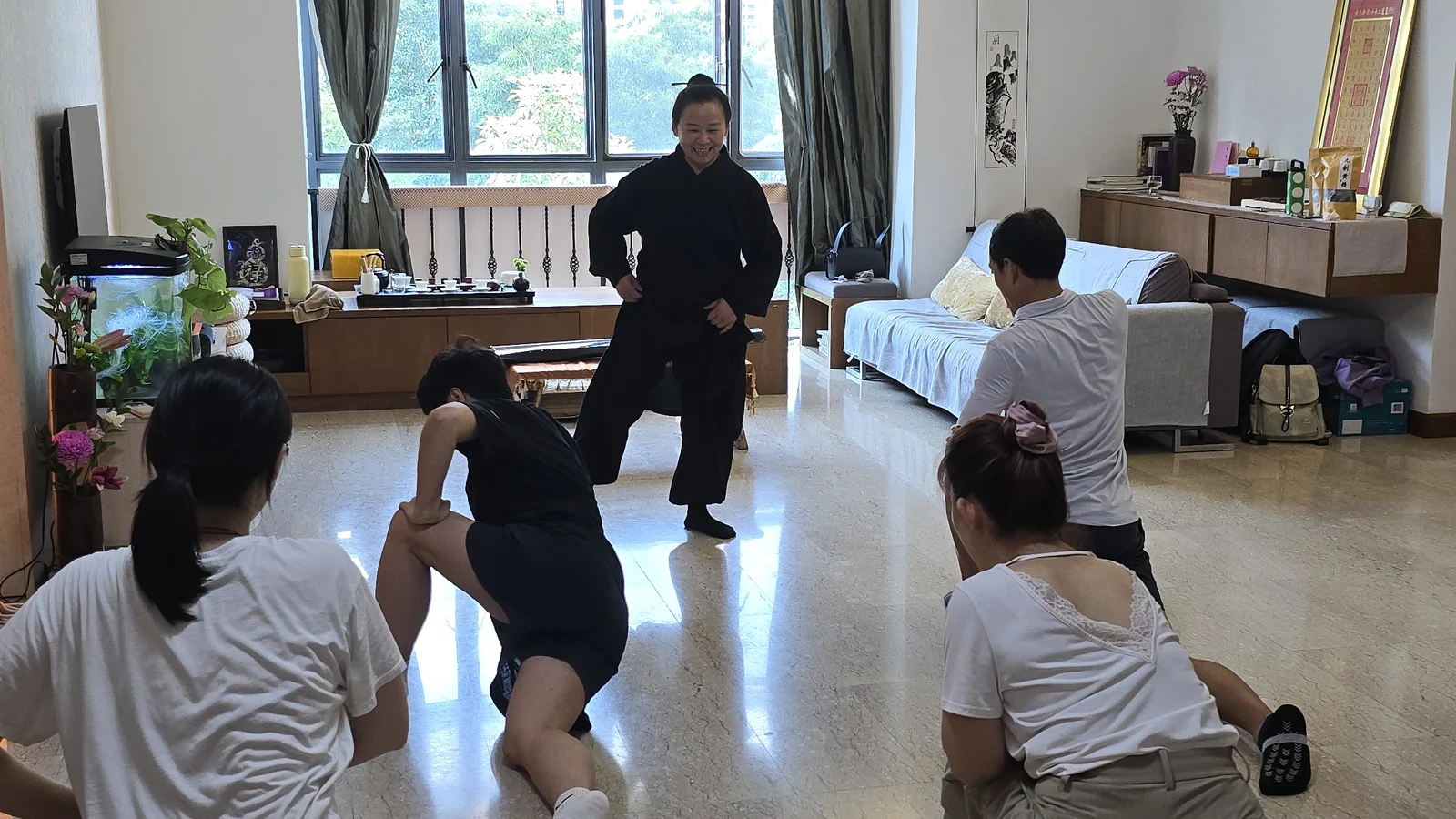
A Wudang taijiquan lesson in a sunlit room: students seen from behind kneel into deep lunges to open the hips while a teacher in black Taoist-style clothing stands in a wide stance, smiling, with an ink-painting scroll on the wall behind.

1. Why the Opening Posture Embodies the Entire Taijiquan Classic

In Wudang Taijiquan, teachers often observe that a practitioner's entire level of internal coordination is visible within the first ten seconds of the form—before a single ward-off, strike, or kick has occurred. Wang Zongyue's Taijiquan Lun (Treatise on Taijiquan) opens with the foundational cosmological premise: 'Taiji is born from Wuji; it is the pivot of movement and stillness, and the mother of Yin and Yang. In movement, it separates; in stillness, it merges.' The Opening Posture (Qishi 起势) and the transition into Embracing the Sphere (Baoqiu 抱球) are the physical enactment of that opening sentence.

When you stand quietly at the start of practice, body and mind rest in undifferentiated Wuji (the nameless origin explored in our Wuji and Taiji cosmology essay). The moment the intention (Yi 意) stirs to open the left step and float the arms, Yin and Yang differentiate into empty and full, rising and sinking, Peng (buoyant expansion) and An (downward settling). Approaching Qishi as a living dialogue between stillness and motion transforms a routine warm-up gesture into deep internal work.

2. Step-by-Step Biomechanics of Qishi: Stepping Out, Floating Up, and Sinking Down

Begin in quiet Wuji alignment with the feet together or slightly angled, the crown gently suspended (Xuling Dingjin), and the breath calm in the lower abdomen. Before moving the arms, shift weight quietly onto the right leg without leaning the shoulders, allow the left heel and sole to peel lightly off the ground, and place the left foot out to shoulder width—touching ball-first and then settling the whole sole evenly so weight returns to 50/50.

As the feet root into the flagstones, initiate the upward wave of Qishi: let the shoulder blades melt downward along the ribcage while the wrists and forearms float forward and up to shoulder height, palms facing down as if resting on rising water. Never hike the upper trapezius muscles to lift the arms. At shoulder height, initiate the downward wave from the knees and elbows first: soften the hip joints (Kua) and elbows (Zhuizhou), allowing the wrists to settle softly (Zuowan 坐腕) as the palms press gently down toward the lower abdomen on a calm exhale.

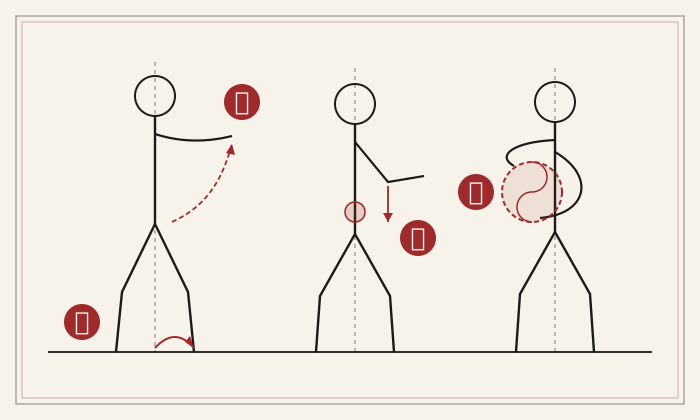
Four-stage diagram of Wudang Taijiquan Opening Posture (Qishi) and Embracing the Sphere (Baoqiu) showing root rebound, rising Peng wave, sinking An wave, and spherical palm alignment

The four structural phases of Qishi and Baoqiu: stepping out from Wuji, floating on Peng, settling on An, and rounding the Taiji sphere.

  1. ① Wuji to Open Step (Kaibu): Weight settles softly into the right root as the left foot peels and steps out to shoulder width without swaying the crown.
  2. ② Rising Peng Wave: Ground rebound from the soles floats the wrists and forearms up to shoulder height while the shoulder blades drop.
  3. ③ Sinking An Wave: Knees soften and elbows sink first, drawing the palms down in front of the abdomen as breath settles to the lower dantian.
  4. ④ Embracing the Sphere (Baoqiu): The waist turns slightly as the upper and lower palms face each other across the centerline, forming a buoyant hollow sphere.

3. Embracing the Taiji Sphere (Baoqiu): Preparing Ward-Off and Grasp the Sparrow's Tail

At the bottom of the downward press, rather than letting the arms collapse dead against the thighs, the waist turns subtly and gathers the two arms into Baoqiu (Embracing the Ball)—the gateway into Parting the Wild Horse's Mane (Yema Fenzong), Grasp the Sparrow's Tail (Lanquewei), and Single Whip (Danbian). When holding the ball on the right side, the right palm rests above at chest height facing downward, while the left palm curves below at lower-dantian height facing upward, as if cradling a buoyant sphere between them.

Three structural details protect the joints and preserve Peng elasticity inside Baoqiu: first, keep a fist's width of hollow space in both armpits so the chest remains gently concave (Hanxiong); second, align the center of the sphere with your own centerline rather than twisting the arms behind the shoulder plane; third, coordinate the waist turn with empty-and-full stepping so the unweighted foot can step out lightly like a cat without dropping weight.

4. Solo Practice Drill & Joint Safety Check

You can practice Qishi and Baoqiu as a standalone five-minute morning or evening drill even in a small apartment room. Stand in Wuji for three breaths, step out to shoulder width, and repeat the rising-and-sinking wave of Qishi six times—inhaling naturally as the arms float up to shoulder height and exhaling slowly as the elbows and palms settle toward the lower abdomen. On the sixth repetition, gather into Baoqiu on the right, shift weight smoothly to transition into Baoqiu on the left, and alternate slowly from the waist for six cycles before closing back to Wuji.

Check your kneecaps throughout the drill: when the knees soften during the sinking phase and waist turns, the kneecaps must point strictly in the direction of the toes without collapsing inward, and the lower back should lengthen downward rather than arching. Safety note: this instructional guide is for educational martial arts and movement study; practice within a comfortable, pain-free range of motion and consult a qualified clinician if you have acute knee or shoulder injuries.

Seeker’s Q&A · Frequently Asked Questions

What is the core takeaway of Opening Posture (Qishi) and Embracing the Taiji Sphere (Baoqiu) in Wudang Taijiquan?

Learn the step-by-step biomechanics of the Opening Posture (Qishi) and Embracing the Taiji Sphere (Baoqiu) in Wudang Taijiquan, grounded in Wang Zongyue's Taijiquan Lun on how Taiji arises from Wuji stillness.
