Inside the Chinese Book Page: Frames, Columns, Fishtails and the Centre Fold
中国古籍版式导读:版框、界行、鱼尾与版心
A page is an organised field
Describe the witness before naming a style
Traditional Chinese manuscripts and printed books arrange writing inside physical limits: edges, ruled columns, printed borders, blank margins and, in many codex formats, a central fold. These features guide production and reading, but their names and combinations vary. Record what is present in one copy before calling the layout Song, Ming, official or commercial. The guide to Chinese thread-bound books follows the binding history; here the unit of attention is the designed sheet.
Layout belongs to both production and use
A frame can regularise carving, copying or printing; columns control line length; margins leave room for handling or annotation; the centre channel can carry navigational data. Yet trimming, rebinding and repair may alter all of them. The Council on East Asian Libraries’ Chinese rare-book cataloguing guidelines therefore describe block format through measurable, repeatable fields. A page should be read as evidence, not as decoration.
Manuscript ruling came before the printed frame
Jielan names boundaries made in more than one way
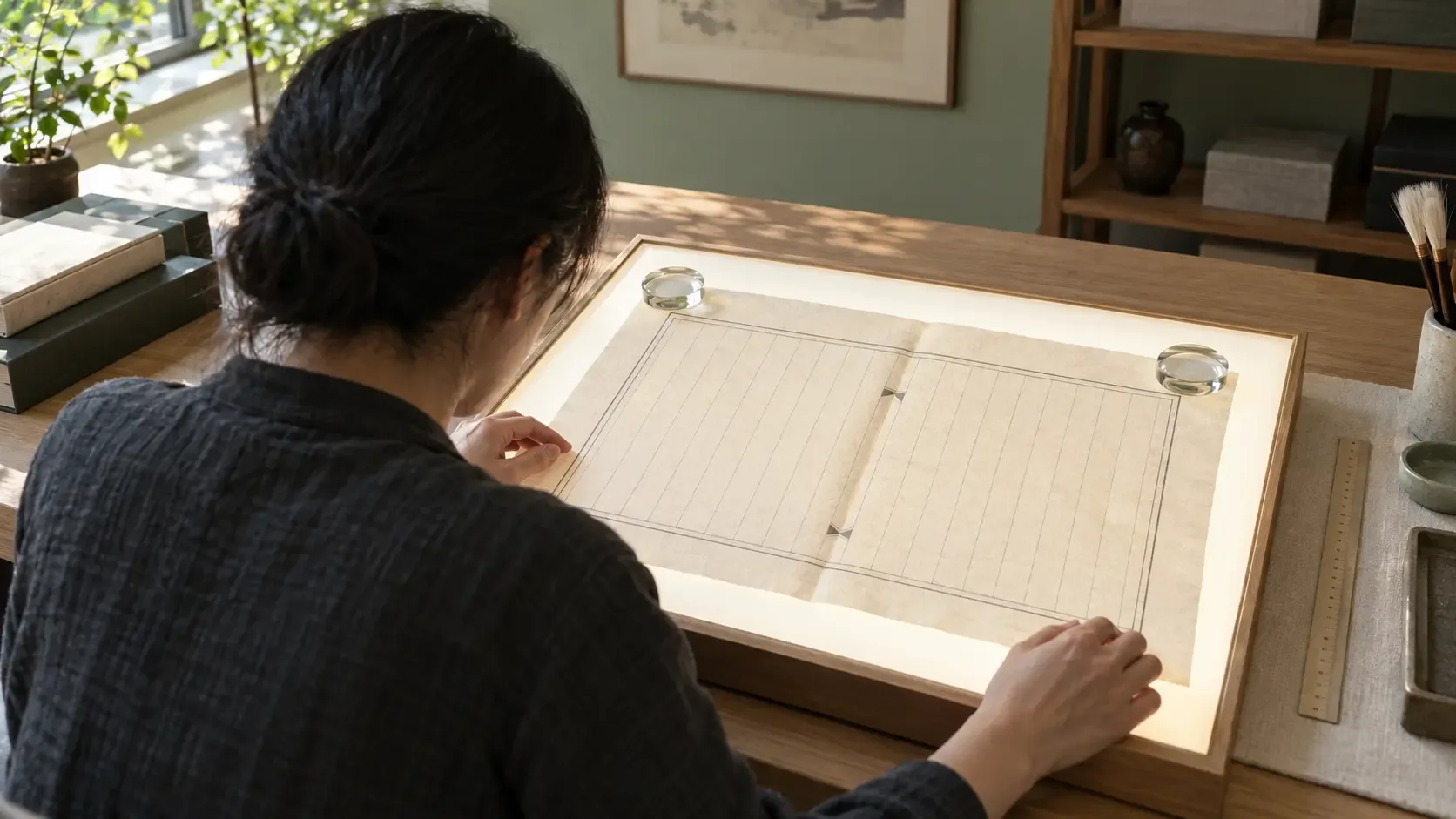
In manuscripts, jielan 界栏 or jiege 界格 can refer to ruled boundaries that organise vertical writing. Lines may be drawn, impressed, folded, printed or supplied on prepared stationery; their colour and method matter. Fang Guangchang’s study of jielan in Dunhuang manuscripts classifies borders through how they were produced. It cautions against treating every ruled sheet as one timeless type.
Printing inherited forms without simply copying them
Woodblock pages often preserved borders and column divisions familiar from manuscripts, but a carved frame belonged to the block and repeated with each impression. The National Library of China’s overview of traditional book layout traces continuities from slips, silk and handwritten paper into print. Continuity of form does not mean continuity of function: the same line can organise copying, guide carving, structure reading or help compare impressions.
Read the printed field from outside inward
Frame, margins and column rules are separate observations
The printed field is bounded by a bankuang 版框 or border. Outside it lie the upper margin, often called tiantou 天头, and the lower margin, dijiao 地脚. Inside, vertical rules divide text columns. The Peking University introduction to ancient-book page layout distinguishes single and double borders, column rules, margins and the centre. A cropped digital image can hide the very edges needed for that description.
Count by the half-folio and state what is counted
Cataloguers usually measure the frame and record columns and characters per half-folio, noting small-character double columns where relevant. A formula such as ‘ten columns, twenty characters’ is incomplete unless its counting unit and exceptions are clear. Layout can also rank voices: main text, commentary and gloss may use different sizes or paired narrow columns. Continue with the guide to punctuation and reading marks for signs added within or beside this architecture.
The centre channel joins navigation and folding
Banxin, bankou and shukou depend on context
The central column of a woodblock is often called banxin 版心 or bankou 版口; after the printed sheet is folded and bound, related vocabulary can refer to the book mouth or fold. Usage is not perfectly uniform, and banxin can carry a broader meaning in some descriptions. The IFLA paper on Chinese rare-book bibliographic description diagrams the text frame, writing columns and central column so that cataloguing terms stay attached to visible structure.
Fishtails are fold guides, not dates
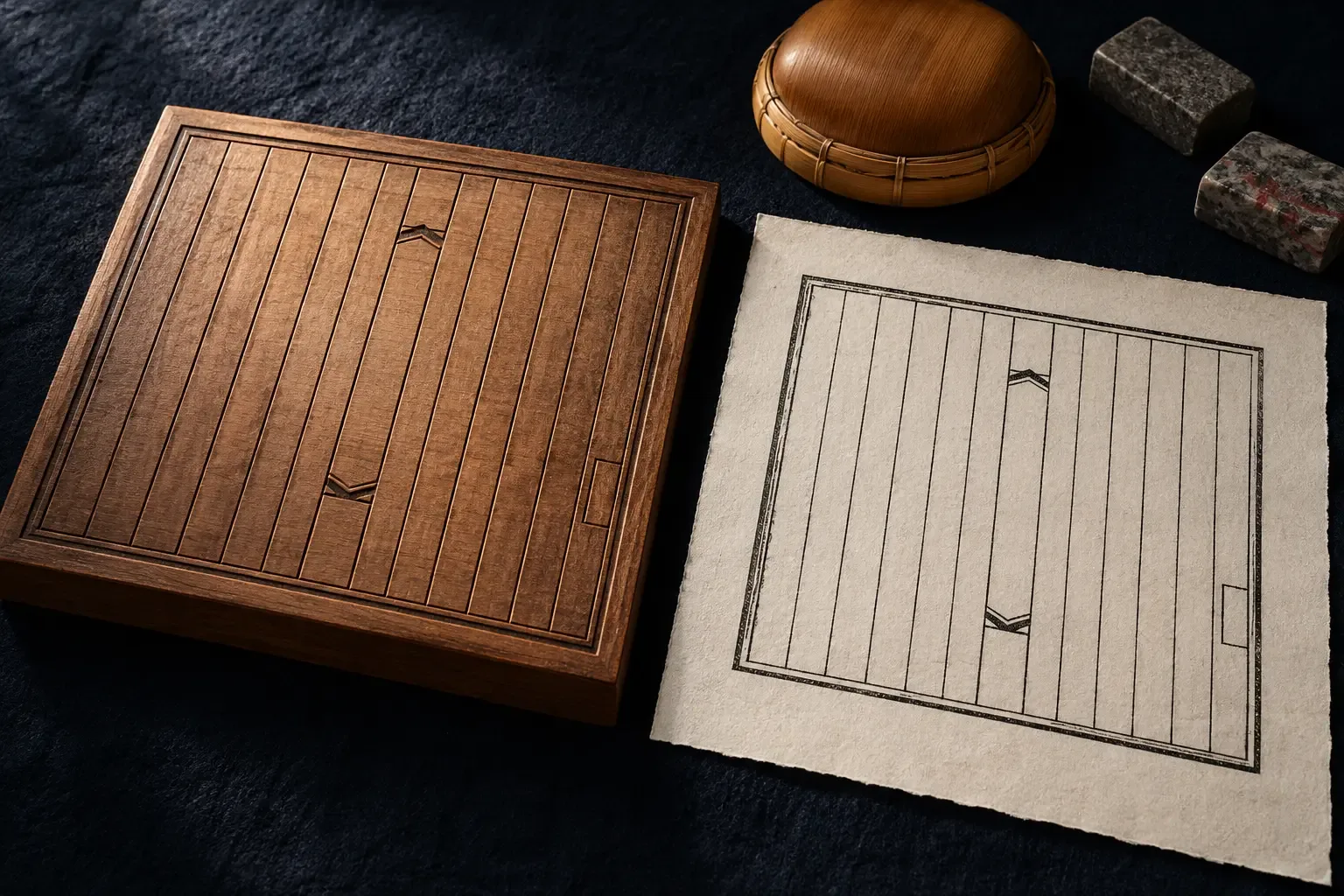
One or two yuwei 鱼尾—chevron-like ‘fishtails’—may mark the central channel, while black lines called ‘elephant trunks’ can create what cataloguers describe as a black mouth; their absence gives a white mouth. Variants include black, white, single and double forms. These features help describe and compare pages, but no fishtail type alone proves a dynasty, region, printer or authentic edition.
The centre can carry small but important data
Titles, fascicles and leaf numbers aid navigation
The centre channel may print an abbreviated title, fascicle number, section and leaf number. Such data help folders align sheets and readers locate passages after binding. A small shuer 书耳, or ‘book ear’, attached near a frame can also hold a section title. The Academia Sinica Chinese rare-book linked-data examples show how border measurements, line counts, characters and fishtails become structured description rather than casual visual impressions.
Carvers and publishers sometimes entered the page
Some impressions preserve a block-cutter’s name, printer’s mark or other production information in the centre or margins. Placement must be recorded because trimming or rebinding can remove it, and a name on one leaf may not govern the entire book. Prefaces, colophons and printer’s statements offer different kinds of evidence; the guide to Chinese prefaces and afterwords explains why their claims still require corroboration.
Layout helps compare editions, but cannot decide alone
Build a bundle of comparable features
Compare frame height and width, columns, characters, border pattern, centre treatment, fishtails, centre text, type style, illustrations and known defects. The University of Hong Kong’s structural notes for a Chinese printed book model this object-specific approach by describing single and double lines, a white centre and the absence of a common fishtail. A meaningful comparison uses equivalent leaves, not a title page from one copy and main text from another.
Reprints and recut blocks complicate resemblance
An edition can be reimpressed from the same blocks, repaired with replacement blocks, recut in imitation or reproduced photographically. Similar layout may show dependence without proving identity; a changed leaf may belong to a repair rather than a new edition. Link page architecture to paper, ink, printing, textual variants and provenance. The guides to paper evidence and textual collation keep the material and textual comparisons explicit.
Images and digital records can distort the page
Crop, scale and sequence affect interpretation
A scan may omit outer borders, flatten a fold, hide translucency or present two half-folios as separate pages. Colour correction can make red ruling look brown or black. Always record repository, shelfmark, volume, leaf and image number, then check whether the viewer shows the complete sheet. Lucille Chia’s study of text and image on Chinese block-printed pages demonstrates that spatial arrangement participates in reading; the guide to illustrated Chinese books develops that relationship for pictures.
Catalogue formulas are evidence maps, not substitutes for objects
A well-made record lets another reader identify the described edition and know which leaf supplied the measurements. It cannot guarantee that every fascicle is uniform or every volume original. Compare the catalogue with the digitised sequence and note discrepancies. The guide to Chinese bibliographies distinguishes a work-level entry from edition and copy; page-layout notes belong to that more specific chain of identification.
Read page architecture with eight questions
First map what is physically visible
Ask: 1) is the item manuscript, printed or mixed; 2) what complete sheet or half-folio is visible; 3) what are the frame, margins, column rules and line count; and 4) what appears in the centre channel, including folds, fishtails and text? Give measurements and exact leaf locations. Distinguish missing from merely cropped or hidden.
Then test what the layout can support
Ask: 5) which features repeat across the book; 6) which changed through damage, trimming, rebinding or repair; 7) which independent evidence links this layout to an edition or production history; and 8) what alternative remains? The strongest conclusion describes a pattern, names its limits and leaves chronology open when comparison is insufficient.