How Chinese Woodblock Printing Worked: Writing, Carving, Inking and Impressions
中国雕版印刷工艺导读:写样、上版、刻版、刷墨与印纸
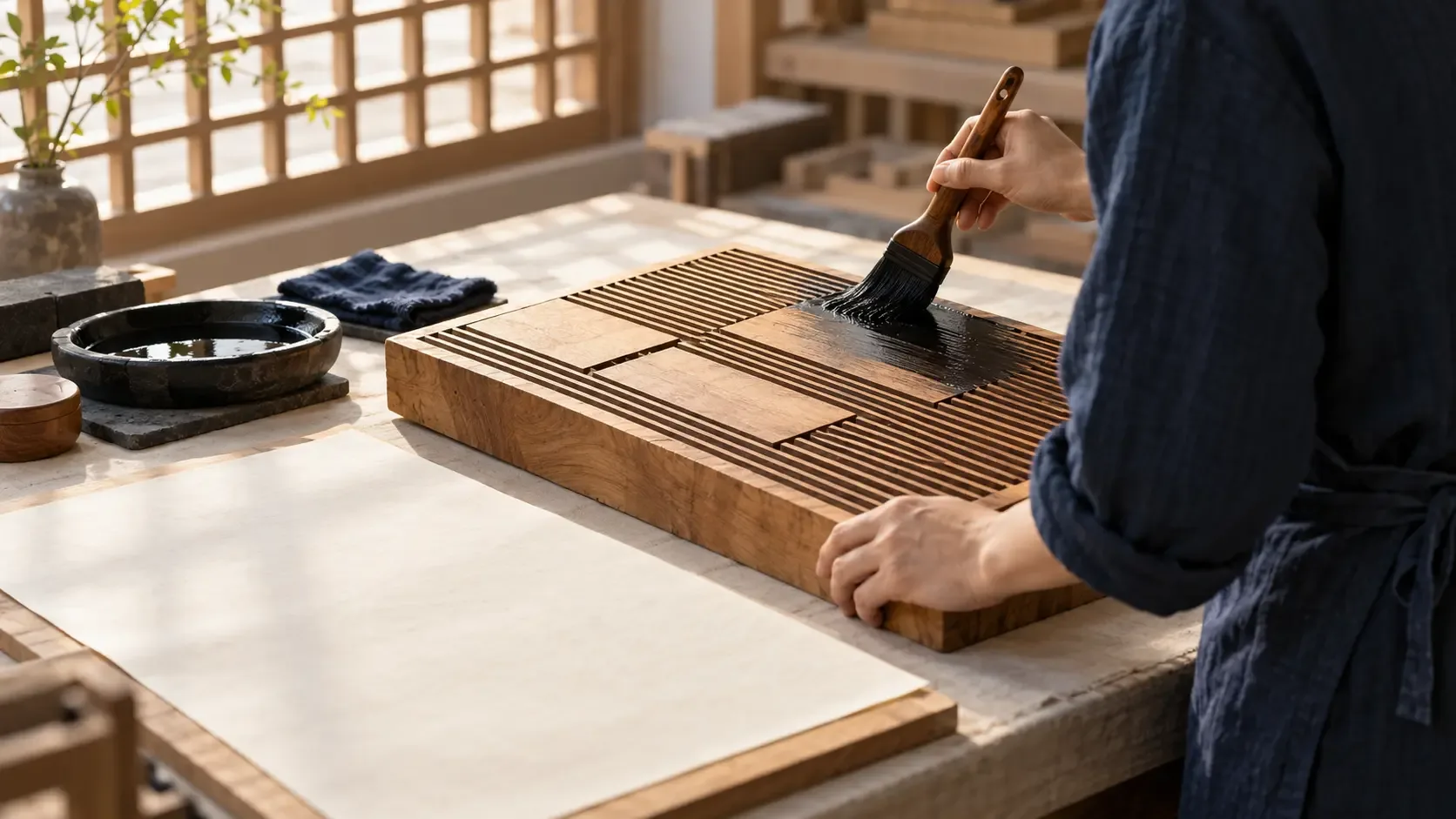
A printed page began as a planned page
The copy had to be complete before it touched the block
Woodblock printing reproduced a whole page, not a loose sequence of characters. A scribe prepared a clean fair copy with the intended columns, text sizes and blank spaces already settled. The guide to Chinese book-page architecture explains why the frame, centre fold and fish-tail belong to this planning stage. The Metropolitan Museum’s technical account describes the copy being written with brush and carbon ink before its paper was dampened and placed face down on wood.
Transfer reversed the writing without asking the carver to rewrite it
Because the written face was pasted against the block, the carver saw the strokes through the back of the thin sheet in reverse. Cutting around those visible strokes left their mirror image standing in relief; printing reversed them again into readable order. This two-step reversal matters. It distinguishes an accurately transferred copy from the romantic but misleading idea that every carver freely redrew each page backward.
Wood, paste and surface preparation shaped the result
A block was a prepared tool, not simply a slice of timber
Institutional introductions from the Asian Art Museum mention pear or date wood, while living workshops use materials selected and seasoned for local practice. Historical production was never uniform across all regions and centuries. Whatever the species, the working face had to be sufficiently flat and stable to accept the transferred sheet, survive close cutting and meet paper evenly when inked.
Thin paper carried both the model and its planned destruction
Paste fixed the fair copy face down. Once dry enough, the back could be thinned or rubbed so the inked strokes remained legible. The copy then became a sacrificial guide: carving removed blank ground and usually destroyed much of the pasted sheet. The page on fibres, sizing and repairs in Chinese book paper helps separate this transfer paper from the paper later chosen for an edition’s impressions.
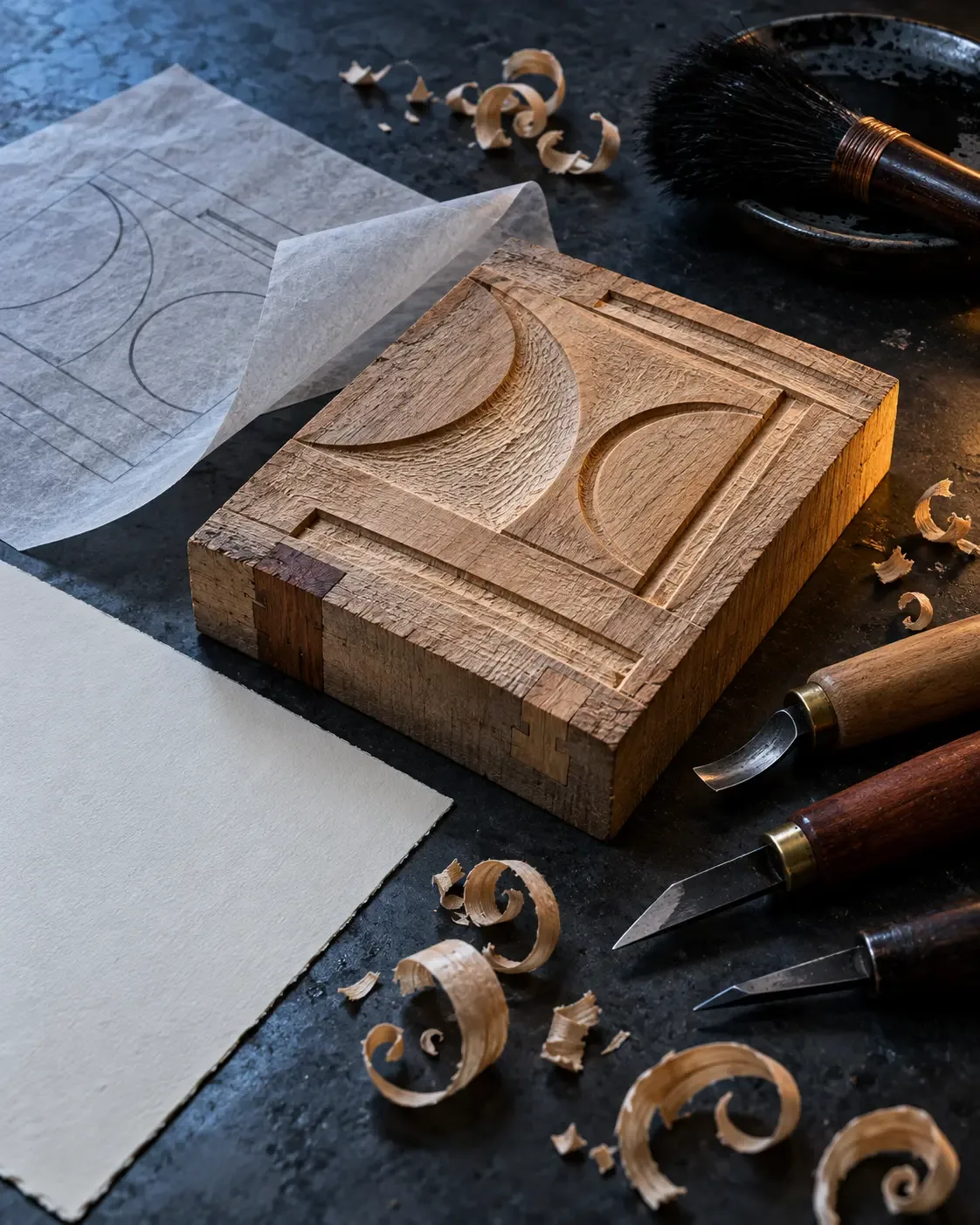
Carving made a relief surface
The carver removed everything that should not print
The principle is relief printing: intended strokes remain high while surrounding wood is cut lower. Fine knives define edges; broader tools clear open ground. The UNESCO living-heritage record treats writing, block engraving, printing and binding as connected expertise carried by a team. Skill lay not only in following a stroke, but in judging depth, corners, narrow counters and wood grain so the raised lines would neither fill with ink nor break under repeated brushing.
Calligraphy was interpreted through another worker’s hand
A carved line is not identical to a brushstroke. The engraver translated thick and thin turns, hooks and pressure changes into cut edges around a raised shape. Excellent work can preserve the character of a model hand, but it remains a technical interpretation. That is why a printed script should not automatically be treated as direct physical evidence of the named calligrapher’s brush.
Proofing turned carving into an editorial loop
A first impression exposed omissions, filled spaces and wrong cuts
After preliminary cutting, the block was inked and proofed. A proof made small faults legible to editors and artisans: a missing stroke, an uncut patch, a character damaged by over-cutting, or a column that printed unevenly. The fuller UNESCO nomination dossier records testing and correction within the transmitted craft. Proofing should therefore be understood as part of manufacture, not as a ceremonial final check.
Correction might subtract wood, insert wood or replace a passage
An uncut speck could be carved away. A wrongly removed stroke required a more difficult repair: a small plug could be fitted into the block and recut, or a larger rectangular area replaced. Such interventions may later appear as local differences in line, grain or wear. Compare multiple pages and copies through the guide to Chinese textual collation before deciding whether a difference records authorial revision, workshop correction or later repair.
Inking and taking an impression were skilled work
The printer brushed a controlled film onto the raised surface
Traditional book printing did not require a Western screw press. A printer spread a thin, even film of water-based ink with a brush, avoiding pools in low areas and dry patches on the relief. The Peking University Library demonstration lists pouring, dipping, applying ink, brushing and lifting the paper as distinct operations. Ink consistency, brush loading, room conditions, block wear and paper absorbency all affected the result.
Paper was laid and brushed from the back
A sheet was placed over the inked block and gently brushed or rubbed so it contacted the raised lines, then lifted to dry. The Met description of monochrome printing notes this soft-pad impression method. Pressure had to be enough for clarity but not so forceful that thin paper shifted, tore or picked up ink from recessed areas. Variation among impressions can therefore reflect the printer’s rhythm as well as the block itself.
One block could preserve a page for later runs
Storage converted carving labour into a reusable asset
Once corrected, a block held the full page—text, commentary and sometimes image—in a stable reusable surface. It could be cleaned, labelled and stored for another run without recomposing characters. That helps explain why whole-block printing remained important beside the systems surveyed in the guide to Chinese movable type. The Columbia Asia for Educators overview emphasizes that each block could carry an entire page of text and illustration.
Reuse still demanded inspection, cleaning and repair
Blocks could warp, crack, lose fine strokes or accumulate repairs. A later impression from an old block is not automatically the same edition as an earlier impression, and an old block can also produce a modern facsimile. Printers and custodians had to distinguish serviceable surfaces from pieces needing plugs or replacement. This is a material history of maintenance, not a promise that every stored block remained unchanged.
The workshop joined specialized labour
Writer, carver, corrector and printer were different responsibilities
UNESCO’s account describes a coordinated practice requiring expertise, dexterity and team spirit. Historical arrangements varied—from court and monastery projects to commercial and family workshops—but the production sequence could divide copy preparation, engraving, proofreading, printing and binding among specialists. Peter Kornicki’s comparative history of printing in East Asia is useful here because it treats labour, institutions and economics rather than technology as a single ladder of progress.
Names in a book are claims that need material support
A publication statement may name a patron, publisher, engraver or workshop, but it does not always identify every hand in the process. Read it with the guide to printer’s marks and publishing claims. Then compare its wording with paper, carving, proof corrections and other copies. Attribution is strongest when text, object and documented production history agree.
How to read a block-printed page responsibly
Ask which stage produced the feature you see
An elegant stroke may begin with the scribe but reach the reader through transfer, carving, inking and impression. A pale gap may come from a damaged relief, dry ink, poor contact or later abrasion. A local mismatch may be a repair rather than a new edition. Use the guide to woodblock images and page design when pictures share the surface, and resist assigning one visible feature to one worker without testing alternatives.
Keep technique connected to circulation
The Library of Congress survey places paper, religious copying, state needs and book production in a long Asian history, while the guide to Chinese bookshops and book markets follows works into circulation. Before describing a book, ask: what was transferred, what remained in relief, where was it proofed, how was it inked, which impression or copy survives, and does the evidence belong to the original cutting or a later use of the block?