How Chinese Poems Changed: Drafts, Variants and Editorial Layers
中国古典诗歌怎样改定与流传:草稿、异文与编辑层次
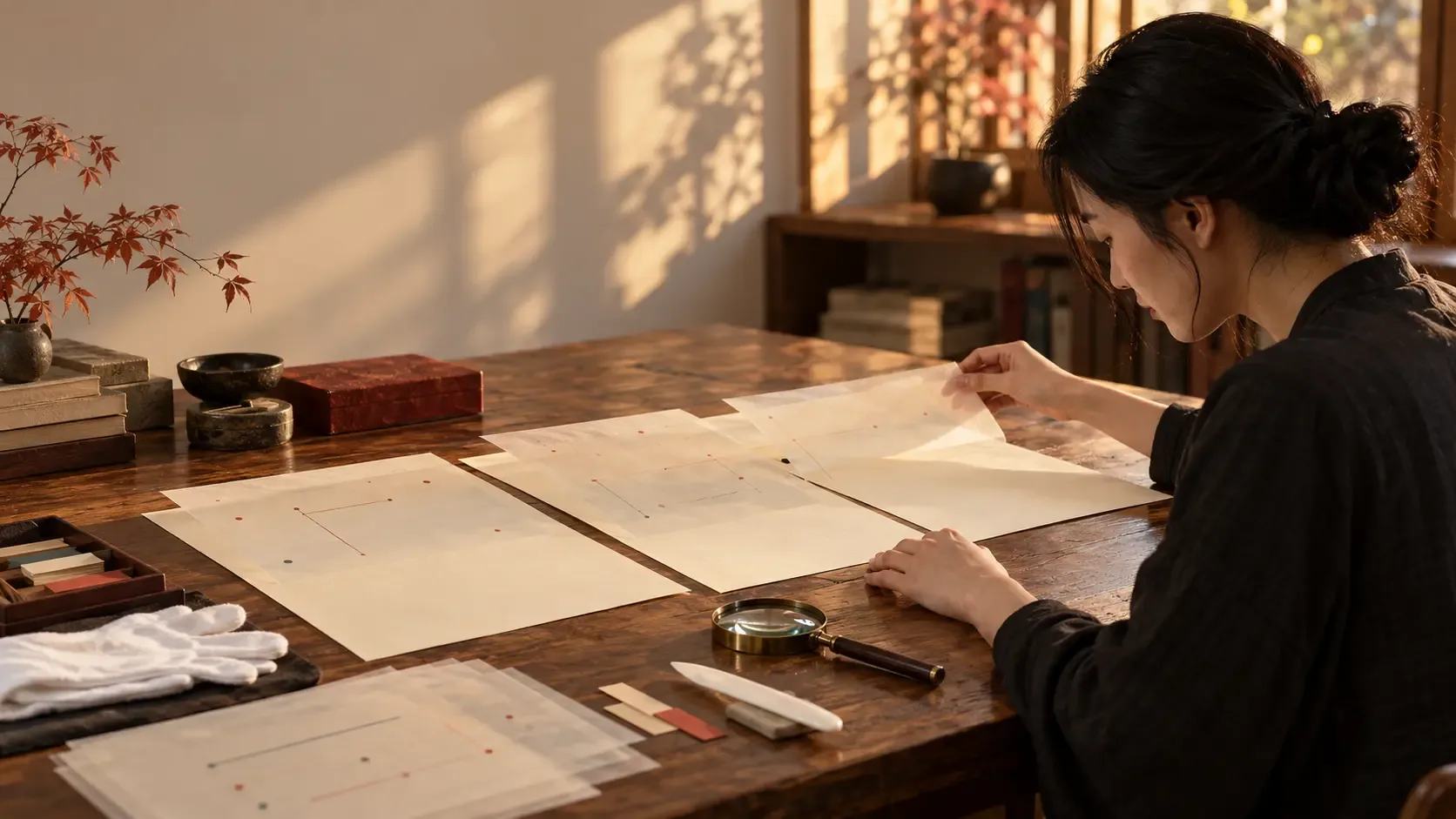
A poem does not reach us from one moment
Composition and transmission leave different kinds of change
A poem may begin as a spoken line, a working draft, a corrected leaf or a clean copy made for another reader. It can then be copied, excerpted, arranged in a collection, cut onto printing blocks, punctuated and reset in modern type. Each stage can alter wording, title, order or surrounding explanation. The guide to the origins and changing forms of Chinese poetry supplies the longer history; here the task is to distinguish changes made during composition from those introduced while a poem travelled.
The version we read is a witness, not the vanished act of writing
A modern edition presents a usable text, but it is not a transparent window onto the author’s desk. Christopher Nugent’s survey of Chinese manuscript culture stresses that handwritten reproduction repeatedly required individual decisions, while oral and written circulation remained intertwined. The safest starting point is therefore modest: identify the particular witness before asking whether one reading is early, late, authorial, scribal or editorial.
Draft, fair copy and presentation copy are not synonyms
A draft can preserve decisions in motion
Crossed-out wording, insertions, transpositions, overwritten characters, changes of rhyme or a replacement title may reveal work in progress. Yet a correction does not explain itself: the same hand may return much later, another reader may intervene, or damage may imitate erasure. The University of Hong Kong guide to manuscripts and transcripts distinguishes rough drafts, fair copies and copies checked by an author or other scholar, while also noting how rare authorial manuscripts can be. Physical sequence, ink, handwriting and provenance must support any claim about revision order.
A clean copy may still be provisional
A fair copy usually removes visible hesitation, but clean appearance does not guarantee final intention. It might be prepared for a friend, patron, gathering, archive, anthology editor or carver, and the poet could revise again elsewhere. Nor is every neat handwritten poem an autograph. Before using labels such as ‘author’s final version’, establish whose hand made the copy, when it was made and what role it played.
Revision can happen before and after circulation
Words, line order and framing can all change
Revision may replace one character, recast a line, change rhyme, remove a stanza, reorder a sequence or rewrite a title and preface. Those are not equivalent acts: a lexical substitution affects the line, while a new title can redirect the occasion through which the whole poem is read. The documented study of Tan Xian’s repeated revision of his ci collections shows a late-Qing writer selecting, deleting and rewriting across multiple compilations and manuscript drafts. It is a strong case, not permission to invent similar stages for every poet.
Social use can precede the collected version
A poem first offered at a farewell, sent in reply or composed at a meeting could later enter a personal collection in altered form. The page on Chinese poetry gatherings separates the occasion, the texts produced around it and their later memory. When two versions differ, ask whether one served an immediate exchange and another a durable collection—but treat that explanation as a hypothesis until titles, prefaces, letters, dates or surviving copies support it.
Copying creates variants without revealing intention
A difference may be an error, normalization or deliberate choice
Copyists can confuse graphically similar characters, omit repeated phrases, anticipate a later word, modernize an unusual form or silently repair what seems wrong. They may also preserve a defensible alternative. Nugent’s study of Tang poetry’s material circulation follows poems from oral or written beginnings through long manuscript paths and warns against assuming that stable modern texts simply reproduce an origin. Record a variant before classifying it; ‘different’ is evidence, whereas ‘mistake’ is already an argument.
Memory and performance can reshape a line
A poem copied from recitation or remembered after circulation may change differently from one copied visually. Parallel syntax, rhyme and familiar phrases can help preserve a passage, but they can also invite substitution or smoothing. Stephen Owen’s study of the Tang manuscript legacy shows that different manuscript copies could carry different selections as well as different readings. The boundary between a newly composed variant and a copying variant is not always recoverable.

Collected works turn poems into an ordered corpus
Selection and arrangement are editorial acts
An individual collection may be assembled by the writer, family members, pupils, later scholars or several of them in succession. Poems can be grouped by genre, date, topic, office or an editor’s reconstruction; titles may be standardized and duplicates removed. The guide to Chinese individual collected works explains why the book called an author’s collection is both a carrier of writings and a historical editorial object.
An authorial collection and a posthumous collection require different claims
If a poet supervised a collection, its selection and ordering may offer evidence of self-presentation. A posthumous compilation instead reveals what descendants, pupils or editors could find and wished to preserve. The guide to Chinese poetry anthologies shows more broadly how selection shapes a canon. Neither type automatically preserves the last wording of every poem, and absence from a collection does not prove that a poem never existed.
Print stabilizes one version while creating new layers
A base manuscript becomes visible because alternatives recede
Printing can multiply the wording chosen for a base copy and make it seem inevitable. The Oxford Handbook section on collecting, editing and transmitting notes that widely circulated printings could obscure other manuscript recensions. The guide to Chinese woodblock printing follows the practical move from writing to carved blocks and impressions. Stability belongs to a production history, not necessarily to an author’s final decision.
Reprints, punctuation and commentary continue to change reading
Blocks can be repaired or replaced; a new edition can choose another base text, add commentary or normalize graphs. Modern punctuation then divides clauses and voices even when the characters remain unchanged. The guide to punctuating Chinese texts explains why sentence division is interpretation. A modern reader should therefore cite edition and, where relevant, punctuation—not merely an author and title.
Case studies reveal possibilities, not universal laws
Tao Yuanming survives as multiple historically produced texts
Xiaofei Tian’s Tao Yuanming and Manuscript Culture shows how copying, editorial change and later interpretation helped produce different textual Tao Yuanmings. The publisher’s description and contents emphasize variant words and phrases that did not enter standard readings. This does not mean every variant is equally early or equally good; it means that the familiar corpus is the outcome of transmission and must be read with its witnesses.
Tan Xian preserves an unusually traceable revision history
Tan Xian’s diary drafts and successive ci compilations allow scholars to compare deletion, replacement, retitling and reordering over decades. Because that evidence is unusually rich, it teaches method as much as biography: claims about intention become stronger when draft, date, handwriting and successive authorized collections align. It would be a mistake to project this recoverable sequence onto authors for whom only late copies or printed editions survive.
Compare versions without forcing a single story
Build a witness table before naming a revision
For every version, record physical object or digital surrogate, date or date range, provenance, hand or edition, title, poem order, wording, punctuation, notes and relation to other witnesses. Mark whether a reading is directly attested, supplied by an editor or conjectured. The guide to Chinese textual collation provides the wider method, while the page on marginalia in Chinese books helps keep later reader marks separate from the transmitted text.
End with the smallest defensible claim
A sound conclusion might identify an earlier and later authorial state, a copying variant shared by related witnesses, or an editor’s preferred reading. It should not claim an autograph, a complete revision sequence or final authorial intention without matching evidence. By separating composition, copying, collection and edition, we can see poems as living textual histories without reducing every difference to either genius at work or careless error.