Printer’s Marks in Chinese Books: Reading Paiji, Kanji and Publishing Claims
中国古籍牌记与刊记导读:怎样辨认刊刻、藏版与书坊信息

A publication mark is a claim inside a book
The modern copyright-page analogy helps—but only at first
A paiji 牌记 or related publication statement may name a title, producer, place, date, block keeper or seller. It can therefore resemble a modern copyright page, yet it belongs to a different production world. Information may be distributed among the inner cover, prefaces, chapter ends, centre fold and final leaves. The National Library of China’s guide to the book label or shupai calls the analogy useful while also noting forms that advertise, explain source texts or describe editorial work.
Paiji, shupai, kanji and muji overlap rather than form a perfect taxonomy
Terms such as paiji 牌记, shupai 书牌, kanji 刊记 and muji 木记 can refer to framed labels, colophons or statements about cutting and printing. Historical usage and modern cataloguing practice are not fully uniform. Begin by transcribing the wording, shape and location, then explain the term used by the repository. Do not decide from the English word ‘imprint’ that every mark had the same legal or commercial function.
Location and form are part of the evidence
A mark can stand before, within or after the text
Publication information may appear on an inner title leaf, after a preface or table of contents, at the end of a fascicle, on the final leaf or in another part of the book. The Chinese national standard for bibliographical description of ancient books treats title pages, publication leaves, paiji, centre columns, prefaces and chapter openings or endings as possible information sources. Record the exact volume, leaf, side and position rather than saying only ‘the book states’.
Shape, colour and framing can carry a commercial voice
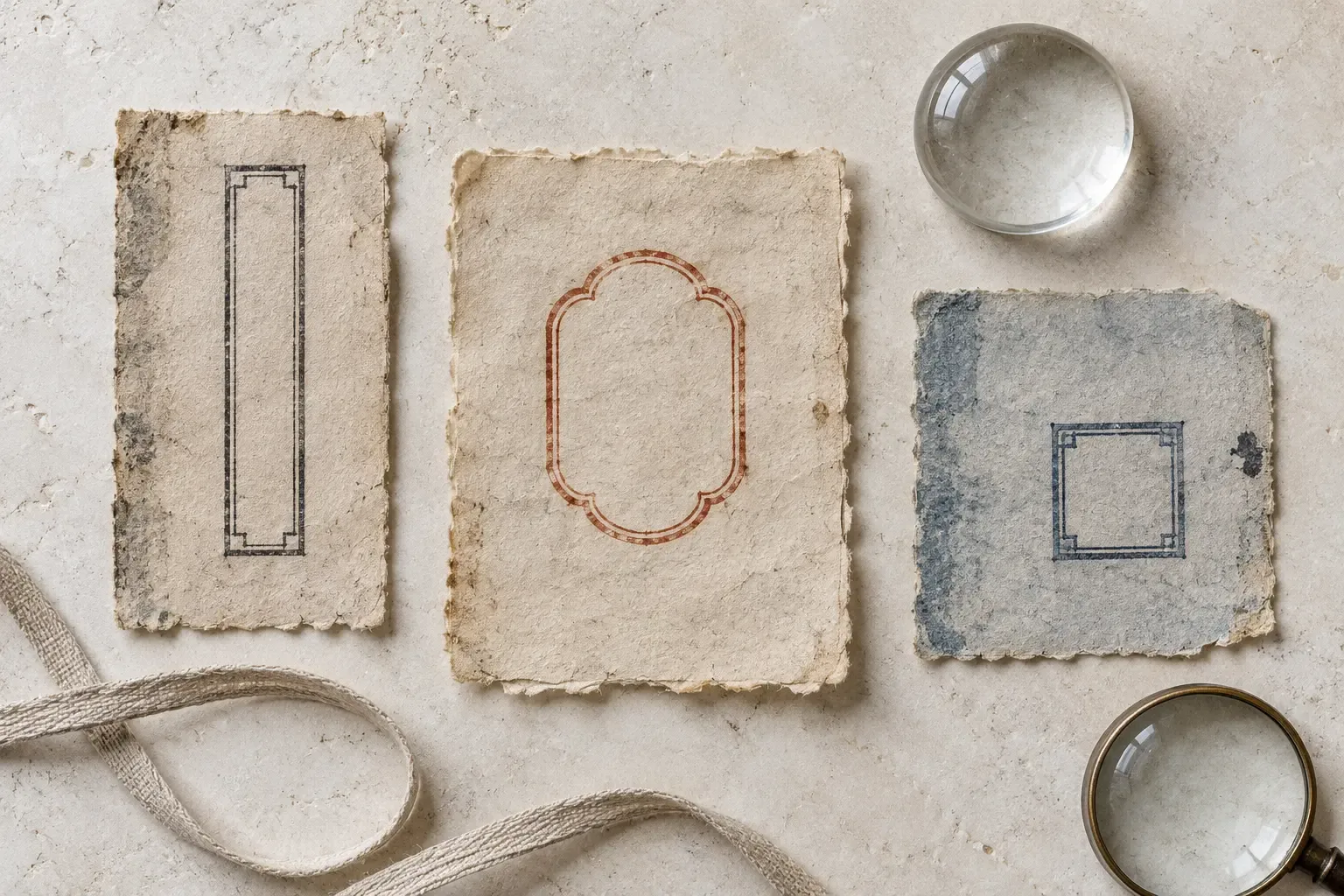
Marks range from plain lines of text to rectangles, tablets, bells, vessels and other shaped frames; some were printed on coloured paper. A 2024 study in the Zhejiang Library journal traces how paiji combined information, decoration and promotion. Design can attract attention or distinguish a shop, but visual richness does not by itself identify a printer, date an impression or prove that the leaf is original to the copy.
Separate the people and institutions named
Author, editor, cutter, publisher and seller are different roles
A statement may name an author, commentator, collator, sponsor, person who supervised cutting, block cutter, printer, issuing bookshop or distributor. One person or studio can occupy several roles, but the reader should not merge them without evidence. The guide to Chinese bookshops and book markets follows circulation and sale; a publication mark is narrower evidence about what this book claims happened in its production or issue.
Cangban identifies custody of blocks, not automatically publication
Phrases such as cangban 藏板 or ban cun 板存 say that printing blocks were kept by a named person, office, studio or shop. The Council on East Asian Libraries’ rare-book cataloguing guidelines explicitly separates the keeper of blocks from the publisher when they differ. A block keeper may enable later printing without having cut, financed or issued the first edition. Translate the role instead of turning every studio name into ‘publisher’.
Read names, places and dates as transcribed statements
Preserve the original chronology before converting it
A mark may use a reign year, cyclical date, season or festival rather than a Western year. Transcribe it exactly, identify the calendar convention and explain any conversion. An undated shop name or place may still be useful, but only when corroborated by other records. The national standard requires cataloguers to identify the source of supplied publication data and to signal uncertainty; a neat converted date should not conceal an incomplete or ambiguous inscription.
Production verbs matter
Words equivalent to newly cut, recut, reprinted, printed, stored, issued or distributed describe different actions. ‘Cut in’ dates the making of blocks; ‘printed in’ may date an impression; ‘blocks kept at’ locates custody; ‘sold at’ concerns distribution. Prefaces and afterwords may narrate the same project from another viewpoint. Read them with the guide to Chinese prefaces and afterwords, but do not let a later narrative silently replace the wording on the publication leaf.
Blocks can outlive the first impression
Cutting date and printing date may diverge
Woodblocks could be printed again years after they were cut. The Peking University-hosted metadata standard distinguishes the entity responsible for publication from the printer of a later impression and records printing place and date separately. It also allows the history of repeated repair and printing to be described as dixiu 递修 when individual interventions cannot all be separated. The mark may survive from an earlier state while the paper impression is later.
Transfer, repair and recutting change what one mark can prove
Blocks could pass to another keeper, receive replacement pieces or be recut in imitation. A new owner might add, erase or alter a mark; an old statement might remain even after custody changed. Compare damaged characters, repaired rules and changed leaves across copies. The guide to Chinese textual collation helps distinguish recurring variants from copy-specific accidents, while the page-layout guide records physical block features.
A mark can inform, advertise, omit or deceive
Printer’s colophons also belonged to the history of commerce
William E. Henthorn’s study of thirty Song-dynasty printer’s colophons shows that their wording, design and placement can reveal printers, locations, working practice and an increasing commercial element. Such evidence is valuable precisely because the mark is interested speech: it may praise a text, announce careful correction or promote the printer’s wares. Record the claim before deciding whether it is confirmed.
Absence and alteration require equal caution
A missing mark does not prove that the book was never commercially issued: the leaf may be lost, replaced, trimmed or omitted from the surviving copy. Conversely, a surviving mark can be altered, transferred with a leaf or created to imitate an earlier edition. Compare paper, ink, page dimensions, sewing and neighbouring leaves. The guide to paper evidence in Chinese books explains why colour or fibre alone cannot settle the date.
Compare the whole copy, not a floating image
Catalogues turn a claim into a documented chain
A useful record distinguishes work, edition, impression and copy; it identifies where publication data came from and notes conflicts. The Library of Congress Chinese Rare Book Digital Collection combines digitised books with catalogue descriptions, while an individual record for an 1817 woodblock edition separates the named cutter, block repository and page format. Read the image sequence beside the record, not as a decorative thumbnail.
Page architecture and provenance test the statement
Check whether the publication leaf matches the book’s frame, columns, centre fold, paper, printing and damage. Ownership seals concern later custody, not original production; continue with the guide to book-ownership seals. Compare bibliographies and edition records through the guide to Chinese bibliographies. Agreement among independent features strengthens an identification; disagreement should remain visible.
Use an eight-question reading method
First map the statement
Ask: 1) where exactly does the mark appear; 2) what does it say, transcribed before translation; 3) what shape, colour, paper and printing method does it use; and 4) which roles, places, dates and production verbs are named? Photograph or cite the complete leaf, not only the cartouche. State what is illegible, missing or supplied by a catalogue.
Then test the claim
Ask: 5) does the leaf materially belong with its neighbours; 6) do other copies preserve the same or a changed statement; 7) do catalogues, prefaces, block format, paper and textual variants agree; and 8) what later printing, transferred block, replacement leaf or deliberate alteration could also explain the evidence? The best conclusion identifies the claim, its support and its remaining limits.