How Classical Chinese Poetry Was Heard: Recitation, Chanting and Historical Sound
古典诗歌怎样被听见?诵读、吟咏与历史声音
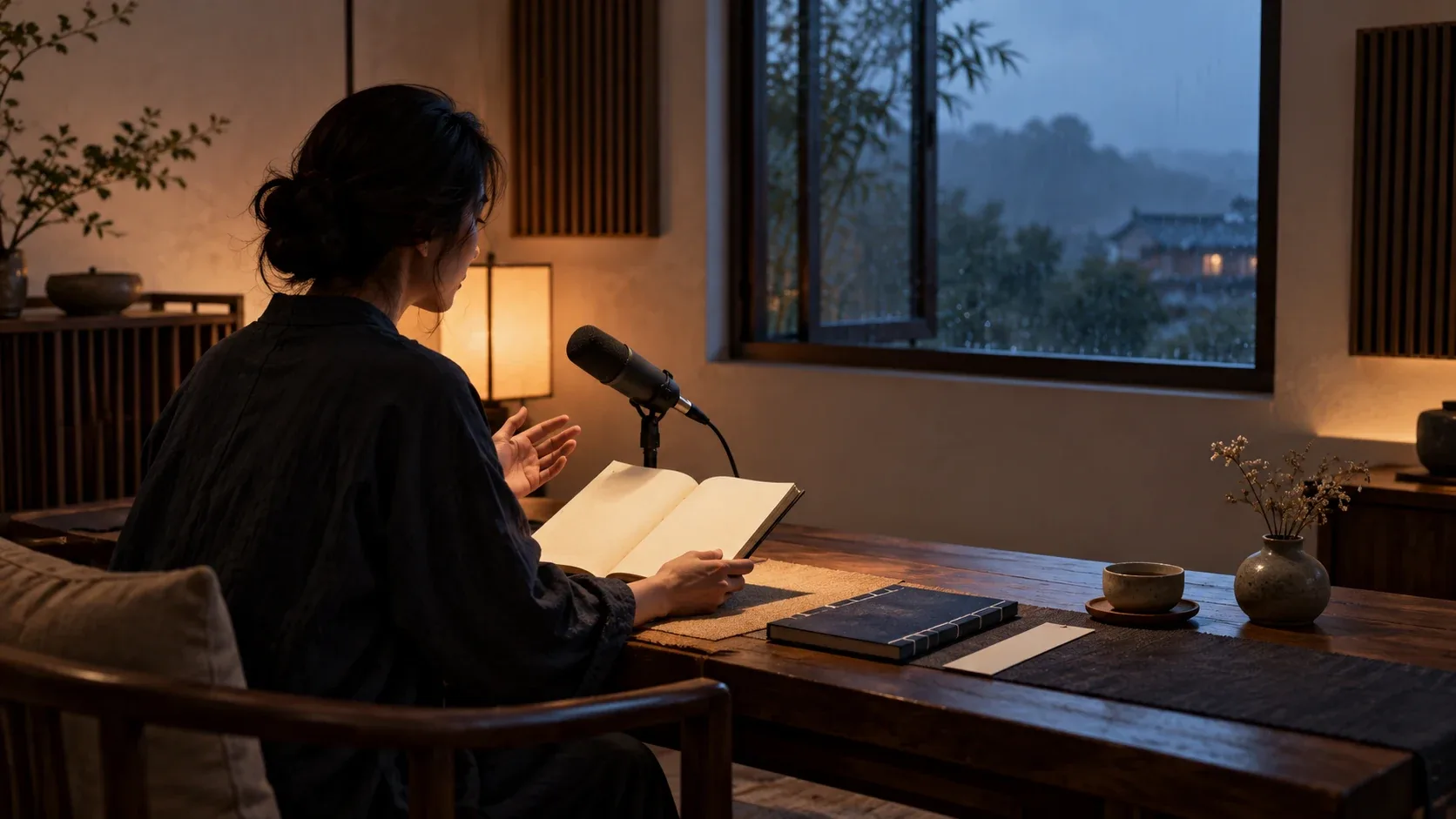
Poetry existed on the page and in the voice
Reading silently is only one historical possibility
Classical Chinese poems reached readers as writing, memory, speech, chant and song. These modes could overlap without being identical. The technology-and-media section of the Oxford Handbook of Classical Chinese Literature places literature in a world where oral recital and musical performance remained important beside manuscript and print. The guides to the origins of Chinese poetry and the Book of Songs offer the longer background; this article asks what changes when a poem is heard.
There was no single timeless Chinese way to recite
A court performance, a banquet song, a teacher's lesson, private study and a modern recording answer different needs. Period, region, genre, training and audience all matter. Terms translated as recite, chant, intone or sing also changed meaning. A responsible history therefore describes a documented practice before calling it 'the traditional pronunciation' or 'the ancient melody'.
Vocal terms named overlapping practices
Yin, song, yong and ge should not be flattened into synonyms
The words 吟 yin, 诵 song, 咏 yong and 歌 ge can point toward reciting, cantillating, voicing or singing, but their ranges shift across texts and periods. Liu Chunxiao's study of the rise of yin and Tang poetic aurality follows yin as a concept connecting composition, performance, reception and poetic identity. Translate the action required by the passage, not the graph in isolation.
Cantillation occupied a space between ordinary speech and fixed song
Some performance heightened pitch, length, cadence and pause without using a stable melody in the modern sense; other poetry was genuinely sung with music. The boundary was porous, not absent. The concept of chanting with feeling preserves the association among cadence, repeated voicing and interpretation, while literary anecdotes and technical descriptions must still be dated and read in context.
Form organized what listeners heard
Line length and pauses made structure audible
Four-, five- and seven-syllable lines create different spans of breath and expectation. Performers may group a line into semantic or rhythmic units, but a convenient modern pause pattern is not automatically an ancient rule. Parallel clauses can sound balanced even before every allusion is understood. The guide to regulated verse explains how line, couplet and parallelism interact on the page.
Rhyme and tonal categories were relations, not a modern tune
Rhyme marks recurrence across line endings; level and deflected tonal categories help organize regulated verse. They do not prescribe one universal pitch contour for performance. Pronunciations changed, and modern Mandarin tones are not the same system as Middle Chinese categories. Use the guide to dictionaries and rhyme books to separate historical classification from present-day sound.
Performance belonged to particular settings
Poems moved through courts, banquets and musical entertainment
Some shi poems were performed musically, and anecdotes about quatrains sung by entertainers show poetry participating in social display. Such stories illuminate an expectation that verse could circulate through voice and music; they do not supply the lost melody or prove that every poem was sung. The overview of Tang poetry places these practices beside written circulation, examination culture and later canon formation.
Study and sociability also required the voice
Teachers and students recited, readers tested phrasing aloud, friends exchanged compositions and memorized lines returned in conversation. Repetition could support memory, but performance was not merely a storage device: pace, breath and stress offered an interpretation. The Columbia University Press poetry recordings demonstrate a modern pedagogical choice by pairing texts with sound; they should be heard as present-day readings, not recovered historical audio.
Voice shaped memory and interpretation
Vocalization could make patterned language bodily
Rhythm, recurrence and breath turn a text into an event extended through time. A study of the soundscape of the Huainanzi argues that densely patterned language could enable oral performance and embodied philosophical practice. That case concerns a particular early text, not all poetry, but it reminds modern silent readers to attend to audible pattern as a mode of thought.
Every performance adds choices
A performer decides where to pause, which word to lengthen, how strongly to mark rhyme, whether to use speech, cantillation or melody, and how much emotion to project. Modern punctuation influences those decisions even though premodern copies may divide sentences differently. Compare the guide to punctuation and reading marks before treating one recording's phrasing as the poem's only syntax.

Living cantillation traditions are evidence, not time machines
Regional traditions preserve skilled practices
Twentieth- and twenty-first-century performers in Taiwan and other regions transmit learned ways of cantillating classical texts. David Prager Branner's analysis of Taiwanese cantillation and the sound of the Tang respectfully tests what a living performance preserves and where it departs from historical reconstruction. Such traditions deserve documentation on their own terms, not value only as replicas of antiquity.
A lineage of performance does not freeze pronunciation
Teachers adapt to local speech, schooling, individual voice and new audiences; recordings preserve a moment, not an unchanging essence. Modern Mandarin, Cantonese, Taiwanese and other Sinitic varieties each reveal some distinctions and obscure others. Saying that one variety preserves certain older features is more defensible than declaring that it simply 'is Tang Chinese'.
Historical sound can be reconstructed only indirectly
Rhyme books, transcriptions, dialects and poetic patterns provide different clues
Philologists compare rhyming practice, tone categories, fanqie spellings, foreign transcriptions and modern varieties. No single source yields a complete performance. Reconstruction proposes systems and contrasts; notation such as an asterisk marks a scholarly hypothesis, not a recoverable recording. The page on the Wenxin Diaolong shows why early criticism of sound must also be read through its own vocabulary and textual history.
Historical pronunciation and performance style are separate questions
A proposed sound value does not tell us tempo, melody, loudness, breathing or gesture. Conversely, a living cantillation melody can survive while pronunciation changes. Liu's study and the Lingnan University demonstration of regulated-verse recitation offer useful, different kinds of evidence; combining them requires stating which element each actually supports.
Listen with a method that preserves uncertainty
Identify the text, form, date, voice and purpose
Before comparing recordings, establish the poem's textual version, genre, line pattern and punctuation. Then record who performs, in which language variety or reconstruction, under whose teaching, for what audience and with what declared method. For ci, the lost or transformed musical history requires separate care; begin with the guide to ci tune patterns and transmission rather than treating every lyric as regulated shi.
Compare several readings instead of crowning one authentic voice
The Columbia workbook recordings place original poems beside modern Chinese translations and make comparison possible. Listen for pause, duration, rhyme, pitch movement and emphasis, then ask what belongs to the text, the language variety, the performer or the teaching goal. A useful conclusion is precise—'this reading highlights the couplet break'—rather than absolute: 'this is exactly how the Tang heard it'.