Paper in Chinese Books: Fibres, Sizing, Repairs and the Limits of Dating
中国古籍用纸导读:纤维、施胶、修补与断代边界
Paper is an artefact within the book
Begin with the sheet, not a prestigious name
A leaf is evidence before it is a label. Describe colour, thickness, translucency, surface, edge and present position before calling it xuan, bamboo or mulberry paper. Fine paper was made from many plant fibres and mixtures, while trade names changed across places and periods. For brush response and the place-linked history of xuan, use the separate guide to Chinese calligraphy paper; this article asks what a sheet can reveal inside one book.
Copy-specific evidence differs from a work's text
Two copies of the same title may use different paper, contain replacement leaves or preserve different repairs. Paper therefore belongs to the history of an object, not simply to the abstract work. Agnieszka Helman-Ważny's study of fibre and paper analysis in Chinese Silk Road manuscripts combines material study with codicology and textual evidence, while warning that chronological reference material remains incomplete. Observation becomes useful only when joined to book structure and documentary context.
Fibres and sheet formation leave traces
Fibre identification requires comparison
Bast fibres, grasses, bamboo and recycled textile fibres can share visual features once pulped. Specialists may use transmitted light, microscopy, staining or other analytical methods to compare fibre length, nodes, vessel cells and contaminants with reference samples. The Library of Congress TAPPI Standard Paper Reference Collection demonstrates why known samples and fibre atlases matter. A naked-eye guess is a provisional description, not a botanical identification.
Mould patterns are one part of manufacture
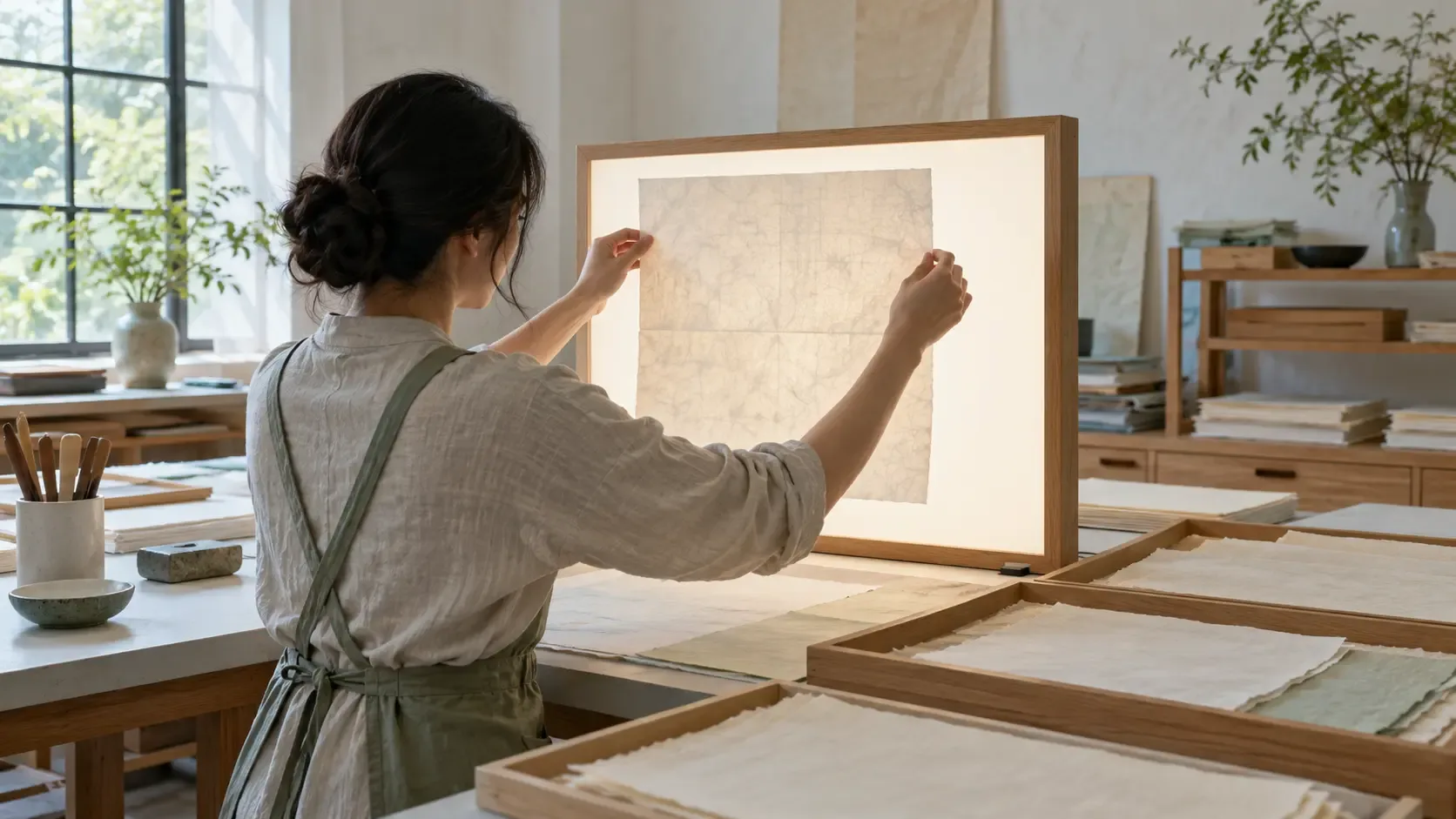
Held to light, a sheet may show fibre clouds, laid lines, chain lines, clumps, thin areas or several laminated layers. The International Dunhuang Programme's project on the materials of Turfan and Dunhuang manuscripts records fibres, fibre distribution, thickness, layers, texture and mould traces with non-destructive examination. These features can distinguish sheets or manufacturing habits, but they do not by themselves name a workshop, place or date.
Surface treatment changes writing and printing
Sizing regulates how liquid enters the sheet
A sized or polished surface can limit feathering, strengthen a weak sheet and alter gloss, colour and touch. Treatments may include starches, animal glue, mineral coatings, dyes or other additives, but appearance alone rarely identifies a recipe. The same material can age differently according to concentration, storage and later washing. Record what the surface does and looks like before proposing what was applied.
Manuscript and printed leaves pose different questions
Brush writing rewards a controlled relation between absorption and movement; printing must also receive an even impression without tearing or excessive spread. A sheet may have been prepared for one use and later reused for another. Compare ink penetration, offset, abrasion and surface disturbance across several leaves. The guide to Chinese ink rubbings treats a different contact process, where paper is pressed onto an inscribed surface rather than printed from a woodblock.
Fold and format connect paper to book structure
A folded leaf is not two independent sheets
In many traditional Chinese printed books, text was printed on one side of a sheet and the sheet folded at the fore-edge so the blank side faced inward. The Bodleian Libraries' account of Chinese book conservation explains how thin, strong paper and fore-edge folds support this structure. Read recto, fold, inner blank face and bound edge as one manufactured unit before calling a blank area a missing page.
Repeated sheets reveal both pattern and exception
Compare dimensions, fold alignment, thickness and transmitted-light features across the whole volume or set. A run of similar sheets may belong to one production phase; a leaf of different size, fibre distribution or fold can signal repair, replacement or another batch. Binding evidence is treated more fully in the guide to Chinese thread-bound books. Paper evidence is strongest when it agrees with sewing, pagination, printing and textual sequence.
Damage records use, environment and intervention
Separate manufacture from later change
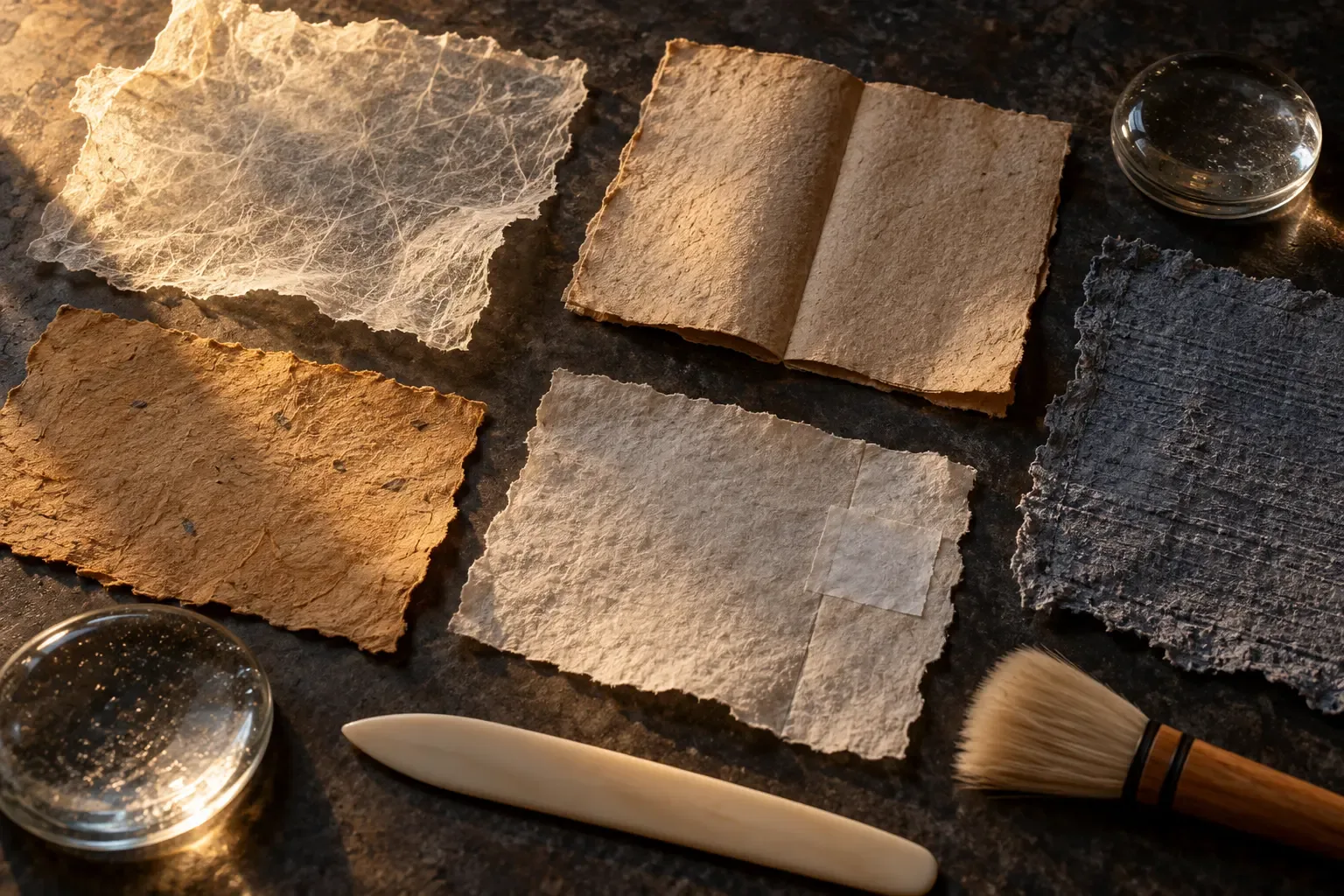
Uneven formation, inclusions and a deckled edge may belong to making; tears, worm channels, tide lines, soot, mould staining and brittle folds developed later. Yet a clean category is not always possible: a weak area can guide a later tear, and washing can reduce an old stain. Map damage across adjacent leaves and volumes before assigning cause. Similar holes that continue through a stack can reveal their sequence at the time of attack.
Damage is historical evidence, not decoration
The International Dunhuang Programme's conservation overview emphasizes stabilizing objects while retaining evidence of their histories and using reversible, visible repairs only where necessary. Dirt, creases and losses should not be romanticized, but neither should they be erased from the account. Digitization can reduce handling after stabilization; it cannot reproduce flexibility, thickness or every feature visible in transmitted light.
Repairs and replacement leaves need their own reading
A repair paper should be compatible, not merely similar in colour
Conservators consider fibre, weight, flexibility, strength, pH, dimensional response and the needs of the damaged sheet. Yan Lin's study of an evaluation system for repair-paper performance includes pH, tensile strength, folding endurance, durability, bulk density and dimensional stability. An opaque, stiff or overly strong patch can conceal evidence or transfer stress to the original. Repairs should be documented rather than made visually invisible.
Replacement leaves can be old without being original
A missing leaf may have been supplied by hand, recut from another copy, reprinted or inserted during modern conservation. Compare paper, format, ruling, ink, type or handwriting, wormholes and trimming at every boundary. Smithsonian guidance on repair paper for ancient books describes bamboo, bast-fibre and xuan-type repair papers and the need to test their properties. Age of the repair material does not establish the date of the book's first assembly.
Paper can support dating, but rarely delivers it alone
A single feature has a long possible life
Fibres, moulds, sizing methods and formats can persist, travel or be revived. The IDP's preliminary paper study of the Diamond Sutra explicitly cautions that mould type alone cannot establish origin or date and calls for fibre analysis and comparative typologies. Treat every proposed date as a range supported by several independent observations, not as a verdict produced by colour or texture.
Corroborate with the whole book
Combine paper evidence with print style, collation, binding, textual variants, dated prefaces, catalogues, handwriting, seals and documented custody. The guides to Chinese bibliographies, book marginalia and ownership seals show how independent records can converge—or disagree. A conclusion should state which observations support it, which alternatives remain and what specialist analysis could test next.
Read book paper with eight questions
Describe before sampling or naming
Ask: 1) where is the sheet in the volume; 2) how do size, fold and edges relate to the format; 3) what colour, thickness, translucency and surface are visible; and 4) what fibre distribution or mould traces appear in transmitted light? Photograph scale and orientation consistently. Do not detach fibres, wet a corner or expose fragile paper to strong light without a conservator and permission.
Make the interpretation testable
Then ask: 5) which features come from manufacture and which from use or repair; 6) how consistent are they across the copy; 7) what independent evidence supports origin, sequence or date; and 8) what uncertainty remains? For a painting's mounting and backing papers, continue with the separate guide to mounting Chinese painting. The most reliable account lets paper narrow possibilities without asking it to prove more than it can.