WUDANG TAIJIQUAN · 武当太极拳

Twin Peaks Pierce the Ears (双峰贯耳 Shuangfeng Guan’er) in Wudang Taijiquan: Post-Kick Gathering, Dorsal Rounding (Babei), and Twin-Arc Pincer Fists 武当太极拳“双峰贯耳”精解:收腿双抹、涵胸拔背与双拳弧形合抱的“背丝劲”枢机

How Wudang Taijiquan flows directly from a single-leg heel kick into a rooted bow stance, using dorsal expansion between the shoulder blades (Babei) to drive two semicircular fists toward the centerline.

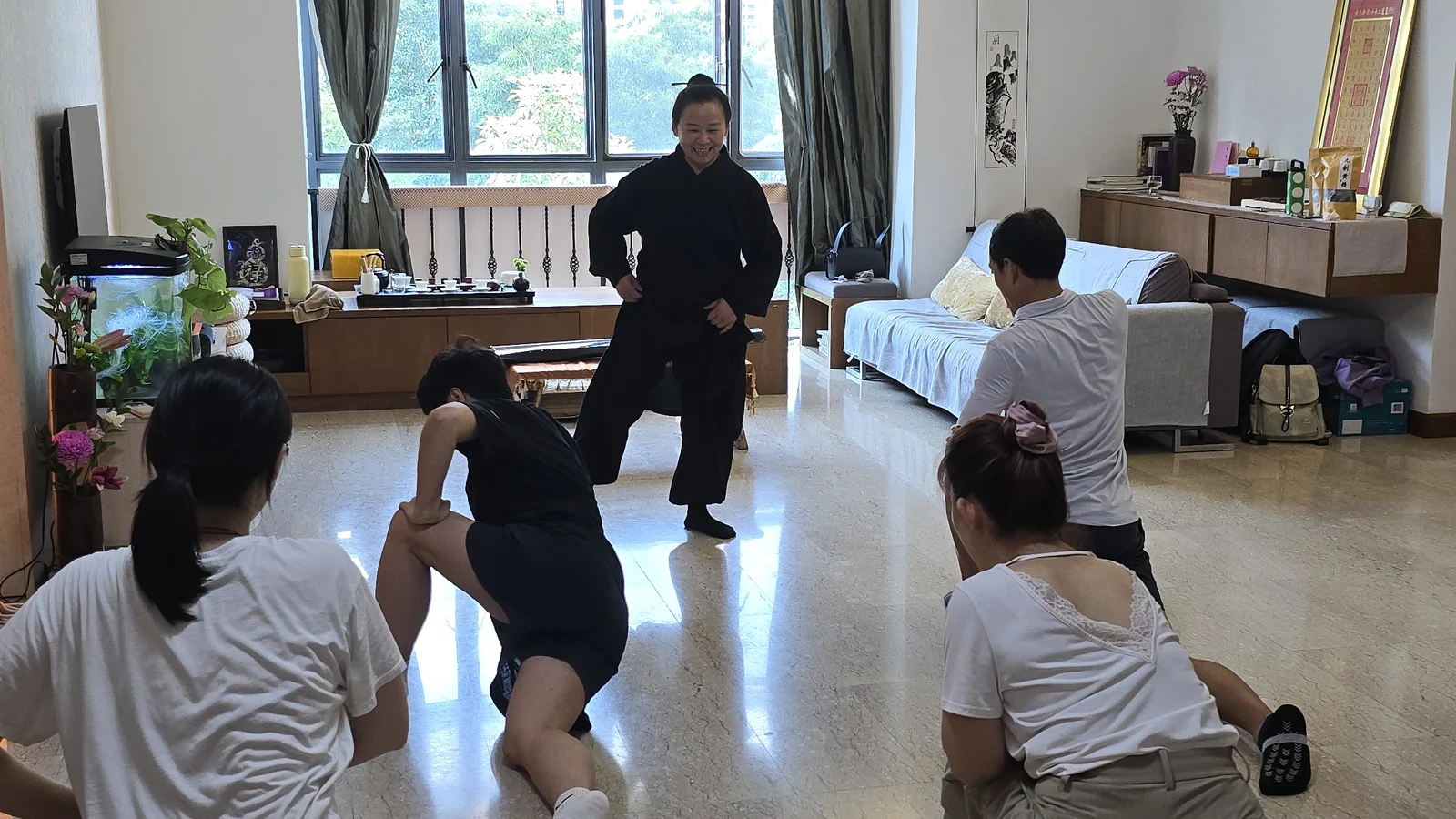
A Wudang taijiquan lesson in a sunlit room: students seen from behind kneel into deep lunges to open the hips while a teacher in black Taoist-style clothing stands in a wide stance, smiling, with an ink-painting scroll on the wall behind.

1. Classical Architecture of Shuangfeng Guan'er (双峰贯耳): Why the Fists Issue from the Upper Back (Li You Ji Fa 力由脊发)

In the traditional Wudang solo form, Shuangfeng Guan'er (双峰贯耳, "Twin Peaks Pierce the Ears") immediately follows the kicking sequence of Separation of Right and Left Feet (Zuoyou Fenjiao) and Heel Kick (Dengjiao). Two classical principles define this posture:

  1. Why Downward Sweeping (Shuang Lu / Xia Mo 下抹) Precedes the Upward Arc: As the kicking leg folds back in, both open palms sweep from shoulder level inward and downward to rest on either side of the lifted knee. Martially, if an opponent ducks under your kick or attempts to strike your midsection as your foot retracts, your descending palms press and seal their arms downward (An / Cai 按采), clearing the upper gate.
  2. Hollowing the Chest and Plucking the Back (Hanxiong Babei 涵胸拔背): As you step out into the bow stance, the two hands curl into loose hollow fists (Kongxin Quan 空心拳) and circle outward, upward, and inward like two mountain peaks (Shuangfeng 双峰) framing a valley. The power does not come from squeezing the pectoral muscles together—which would cramp the chest (violating Chapter 72's Wu Xia Qi Suo Ju)—but from softening the sternum inward (Hanxiong) so the upper thoracic spine between the shoulder blades expands backward and outward into the elbows and fists (Babei).
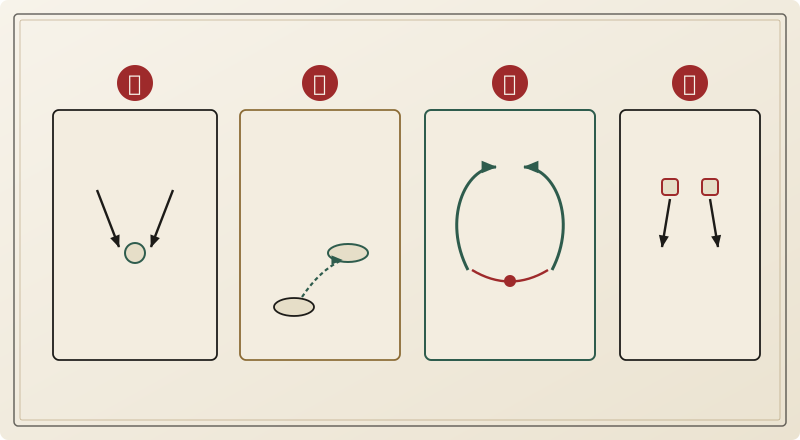
Classical Wudang Taijiquan biomechanical diagram for Shuangfeng Guan'er (Twin Peaks Pierce the Ears) showing post-kick knee gathering, downward palm sweep, dorsal Babei expansion, and semicircular pincer fists
Figure 1 — Biomechanical Progression of Wudang Shuangfeng Guan’er (双峰贯耳): ① Re-chambering the kicking leg while both palms sweep downward beside the lifted knee to seal the middle gate; ② Heel-first bow-stance step while both hands drop to the hips and form hollow fists; ③ Top-down view of the semicircular pincer arc: dorsal expansion at Dazhui/Jiazhi (Babei 拔背) driving both forearms around a rounded circle with Tiger’s Mouths (Hukou) facing each other; ④ Rooted bow-stance alignment with sunk elbows (Chen Zhou) below the fists.

2. Step-by-Step Biomechanical Breakdown

PhaseLower-Body & Stance TransitionDual-Arm Spiral & Fist OrientationInternal Intention (Yi 意) & Breath
1. Folding the Kick & Sweeping Past the KneeKeep the standing leg softly flexed; fold the extended kicking lower leg back toward the standing knee without dropping the thighBring both extended palms inward and downward along an arc until both palms hover on either side of the lifted knee (palms facing down/inward)Inhale as the limbs gather back toward the center; maintain vertical equilibrium
2. Stepping Out & Coiling Fists at the HipsSink the standing Kwa to lower the center of gravity and step the lifted foot forward onto its shoulder-width rail (heel touching first)As the foot steps out, both palms brush past the hips and curl into loose hollow fists (Kongxin Quan, palm-side of fists facing upward at the waist)Complete the inhalation into the lower Dantian (Qihai and Guanyuan); open the space between the shoulder blades
3. Bow-Stance Shift & Twin-Peak Rising ArcPour 60–70% weight forward onto the front leg into a stable bow stance (Gongbu 弓步), rear heel anchoredBoth fists swing outward, upward, and forward along two symmetrical semicircular arcs (forearms rotating inward slightly so the Tiger's Mouths Hukou face obliquely toward each other)Exhale smoothly; feel the force originate from the rear heel, rise through the spine, spread across the upper back (Babei), and wrap into both fists
4. Settling the Pincer Frame (Guan'er 贯耳)Settle the hips and check that the front knee does not pass the front toesBoth fists pause at temple/ear height in front of the forehead, separated by roughly one head-width (15–20 cm), wrists straight and elbows sunk lower than the fistsGaze calmly forward through the space between the two fists; feel the rounded Peng sphere held inside your arms

3. Three Common Structural Errors and Wudang Corrections

  1. Lifting the Elbows Higher Than the Fists (Yang Zhou Song Jian 扬肘耸肩): When swinging the fists in a circle, beginners often raise their elbows wing-like to shoulder height, which shrugs the trapezius and disconnects the back. Correction: Keep the elbows heavy and slightly lower than the wrists throughout the arc (assisted by Quchi and Shousanli Daoyin) so the forearms slope gently upward from elbow to fist.
  2. Pinching the Chest & Colliding the Fists: Bringing the fists too close together squeezes the chest. Correction: Maintain a clear head-width gap between the two fists as if embracing a large pine trunk.
  3. Dropping Out of the Kick Heavily: Falling forward onto the front foot after Dengjiao breaks the root. Correction: Fold the knee first, sweep the palms down to stabilize over the standing leg, and only then step out heel-first.

Practice Reflection for Students

Stand in the final bow stance of Shuangfeng Guan'er for five slow breaths: on each inhale, feel the space between your two shoulder blades widen backward by a few millimeters (Babei); on each exhale, feel that dorsal fullness connect directly to the knuckles of both fists.

Seeker’s Q&A · Frequently Asked Questions

Where does the power come from in Twin Peaks Pierce the Ears (双峰贯耳)?

From the upper back, not from squeezing the chest. In the Wudang form the posture follows the kicks: as the kicking leg folds back, both palms sweep down beside the lifted knee, then you step out heel-first into a bow stance while the hands form loose hollow fists and arc outward, upward and inward. The sternum softens (涵胸) so the back between the shoulder blades widens (拔背) and carries the elbows and fists round. Keep the elbows sunk below the fists and a head-width gap between the two fists, and do not fall forward out of the kick: fold the knee and settle first, then step.


How can I apply this in practice?

Stand in the final bow stance of Shuangfeng Guan'er for five slow breaths: on each inhale, feel the space between your two shoulder blades widen backward by a few millimeters (Babei); on each exhale, feel that dorsal fullness connect directly to the knuckles of both fists.
