QIGONG & YANGSHENG · 气功与导引

Warming Houxi (后溪 SI-3) and Wangu (腕骨 SI-4) Along the Ulnar Palm Edge: Wudang Hand-Taiyang Daoyin for Wrist Suppleness, Scapular Ease, and Spinal Alignment 武当导引“温揉后溪与腕骨”精解:疏通手太阳尺侧双枢、贯通督脉脊梁与落实“坐腕坠肘”的养生法

Why awakening the little-finger edge of the hand releases thumb-and-shoulder gripping, opens the shoulder blades, and anchors Wudang Taijiquan palm and sword postures.

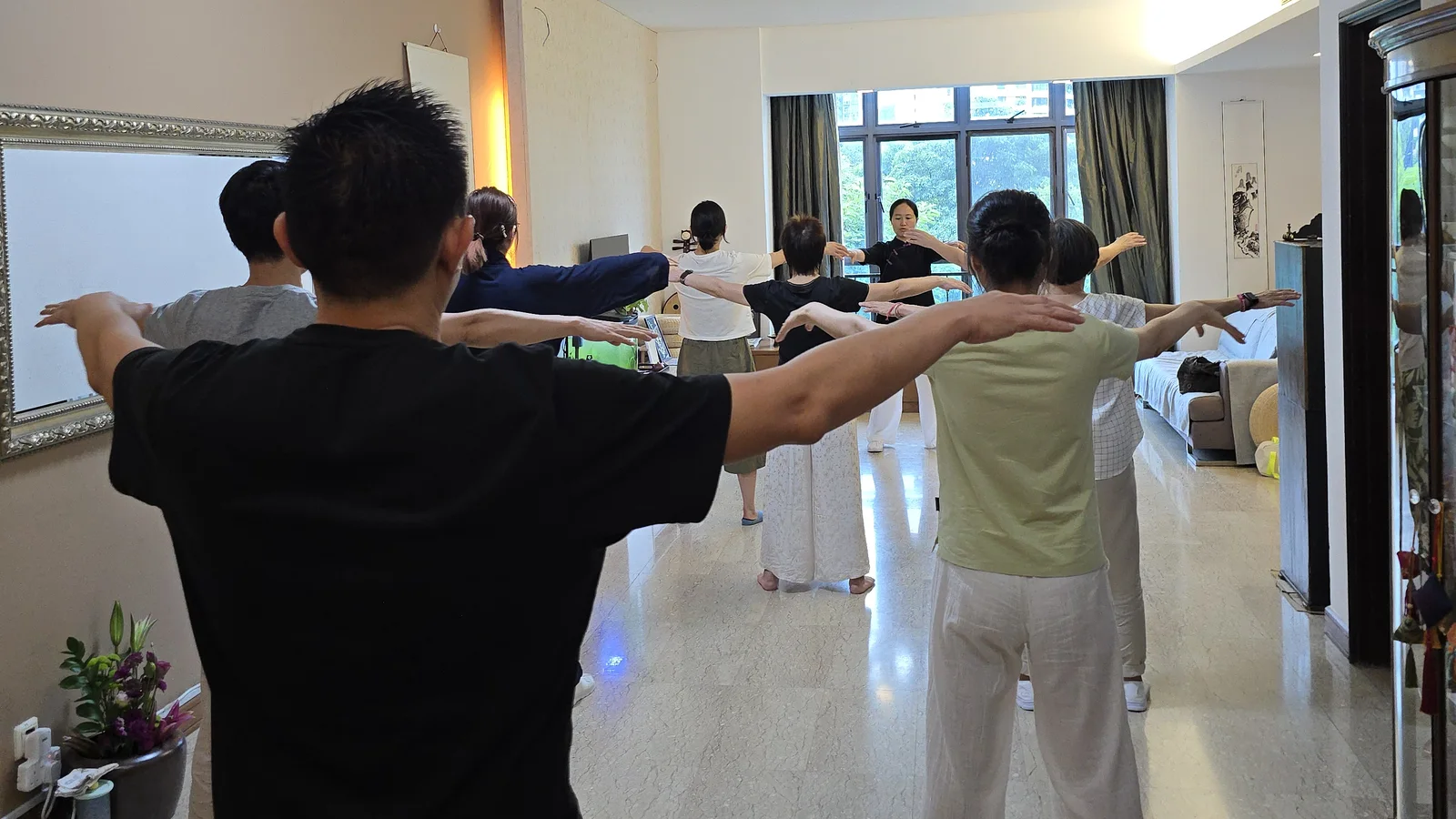
A standing qigong class in a sunlit room: students seen from behind hold both arms open at shoulder height in the same alignment, facing a teacher in dark clothing before a tall window with green trees outside.

1. Classical Meridian Architecture: The Ulnar Ridge Connecting Wrist, Scapula, and Spine

In everyday desk work—typing, gripping a phone, or lifting objects—many people overuse the radial side (the thumb and index finger). When the thumb and index finger clench, tension can travel up the radial forearm into the biceps, anterior shoulder, and upper trapezius, causing the elbows to float outward and the neck to stiffen. In Wudang Qigong and Daoyin hand-conditioning routines, complementing central palm awareness (Laogong PC-8) with the ulnar palm edge (the little-finger border) restores muscular and meridian balance across the entire upper back.

Along the ulnar "red-and-white flesh border" (Chibai Rouji 赤白肉际—the visible seam where dorsal and palmar skin meet) lie two classical points documented in the Lingshu (Spiritual Pivot) and Huangfu Mi's Zhenjiu Jiayijing (针灸甲乙经):

  1. Houxi (后溪, SI-3 — "Back Stream," Shu-Stream Point & Eight-Vessel Confluence Point Opening the Governing Vessel Du Mai): When you curl your fingers into a relaxed, hollow fist, two prominent transverse palmar creases appear on the ulnar edge behind the fifth metacarpophalangeal joint (little-finger knuckle). Houxi sits right at the ulnar tip of the distal transverse palmar crease, just proximal to the head of the fifth metacarpal bone. Because Houxi is one of the eight master confluence points (Bamai Jiaohui Xue 八脉交会穴) directly communicating with the Governing Vessel (Du Mai 督脉) along the spine, warming Houxi refreshes both the posterior neck and the upright thoracic axis.
  2. Wangu (腕骨, SI-4 — "Wrist Bone," Yuan-Source Point of the Hand-Taiyang Small Intestine Channel): Sliding your thumb proximally from Houxi along the ulnar shaft of the fifth metacarpal bone toward the wrist, your fingertip drops into a clear bony hollow between the base of the fifth metacarpal bone and the hamate / triquetral wrist bones along the red-and-white skin border. As the Yuan-Source (Yuanxue 原穴) point of the Small Intestine conduit, Wangu governs supple ulnar deviation, wrist rotation, and fluid circulation along the posterior ulna and shoulder blade.
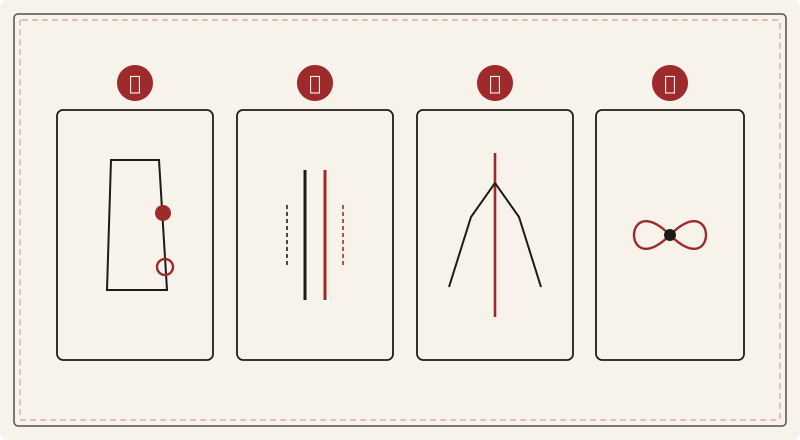
Classical Wudang Daoyin diagram illustrating the ulnar palm border locations of Houxi (SI-3) and Wangu (SI-4), palm-edge warming friction, scapular-spinal pathway, and figure-eight wrist rotation
Figure 1 — Ulnar-Edge Meridian Landmarks and Wudang Daoyin Sequence: ① Anatomical landmarks along the fifth-metacarpal red-and-white border showing distal Houxi (SI-3) behind the knuckle crease and proximal Wangu (SI-4) in the fifth-metacarpal/hamate hollow; ② Bilateral ulnar-edge friction and gentle rhythmic contact warming both points simultaneously; ③ Ascending Hand-Taiyang and Du Mai structural linkage across the ulna, posterior shoulder blade, and cervical-thoracic spine; ④Ulnar-led figure-eight wrist circles settling the elbows downward.

2. Four-Stage Wudang Ulnar-Edge Warming Protocol

Whether practiced as a morning warm-up before Zhan Zhuang or as a restorative break during computer work, perform all four stages with dropped shoulders and unhurried natural abdominal breathing:

StageExact Anatomical Palpation & PostureGentle Daoyin Technique & RepetitionsBreath & Somatic Feedback
1. Palpating Houxi (SI-3) and Wangu (SI-4)Sit upright on the front third of a chair or stand in shoulder-width Wuji; form a loose fist to see the crease tip behind the pinky knuckle (Houxi), then slide toward the wrist into the bony notch before the wrist crease (Wangu)Test both spots gently with the opposite thumb pad to distinguish muscular Houxi from the bony joint hollow of WanguInhale calmly through the nose; soften the jaw and tongue
2. Bilateral Ulnar-Edge Brisk Rubbing (Cuo Chiyuan 搓尺缘)Hold both open palms in front of the lower chest, palms angled upward at 45 degrees so the two little-finger ulnar borders touch lengthwiseRub the two ulnar palm edges briskly back and forth against each other 36 times until clear warmth radiates from Houxi through WanguExhale slowly, letting both shoulder blades slide downward along the ribcage
3. Targeted Thumb Kneading (Anrou Er Xue 按揉二穴)Rest the left forearm comfortably on the lap or abdomen so the ulnar wrist tendons are completely slackPress the right thumb pad into left Houxi (SI-3) for 18 slow clockwise and 18 counterclockwise circles, then move to left Wangu (SI-4) for 18 circles each way; switch handsFeel a pleasant, warm distension along the outer forearm without shrugging the neck
4. Ulnar-Led Figure-Eight Wrist Circles (Xuanwan Songjia 旋腕松胛)Bring the hands loosely in front of the abdomen with elbows heavy and suspended away from the ribsLead with the little-finger ulnar edge to trace 12 slow figure-eight loops inward and 12 outward, feeling the ulna rotate smoothlyObserve how softening the pinky edge allows the lower tips of the scapulae to settle flat

Why do traditional Wudang Taijiquan teachers tell students to "lead subtly with the little-finger edge" (Xiaozhi Ling Jin 小指领劲) during postures such as Single Whip, Cloud Hands, or Twin Peaks Pierce the Ears (Shuangfeng Guan'er)?

  • Anatomical Chain from Pinky to Lower Scapula: Try a simple experiment right now: extend your arm forward and tense your thumb and index finger hard—you will immediately feel your upper shoulder and elbow rise. Now relax your thumb completely and gently lengthen through your little finger, Houxi, and Wangu along the outer edge of the wrist—you will feel the muscles beneath your armpit and lower shoulder blade (latissimus and serratus) engage quietly while your elbow drops effortlessly (Chenjian Zhuizhou 沉肩坠肘).
  • Supple Wrist Articulation in Wudang Swordplay: When holding a traditional straight sword (Jian) or whisk, gripping tightly with the thumb locks the wrist joint into a rigid club. Anchoring the grip lightly in the ring and little fingers near Houxi while keeping the Wangu wrist hollow supple allows smooth figure-eight blade deflections without straining the elbow—embodying the unhurried clarity taught in the Qingjing Jing (Chang Ying Chang Jing).

4. Living Heritage Practice and Everyday Safety Guidelines

Across the morning courtyard routines preserved near the UNESCO World Heritage ancient Taoist temples on Wudang Mountain (No. 72 Jianhe 2nd Road, Wudangshan, Hubei, China; UNESCO World Heritage guide) and the structured wellness curriculum at Lee Wudang International Pte. Ltd. (58A Smith Street (2nd Floor), Singapore 058962; beginner guide), ulnar-edge Daoyin is valued as a safe, practical non-medical self-care habit:

  • Cushion Bone Contact: When rubbing the two ulnar borders together in Stage 2, align the fleshy hypothenar edges smoothly rather than banging the bony pisiform or ulnar styloid processes sharply against each other.
  • Pair With Cervical-Abdominal Settling: After finishing Stage 4, rest both warmed palms over Zhongwan, Qihai, and Guanyuan for six breaths while gently lengthening the back of the neck.
  • Educational Scope: Avoid pressing directly over acute wrist sprains, fractures, or inflamed skin; this traditional Daoyin exercise supports everyday joint mobility and postural relaxation and does not replace clinical medical evaluation.

Practice Reflection for Students

Halfway through your next computer work session today, pause for ninety seconds: rest your hands in your lap, rub the outer little-finger edges together thirty-six times until Houxi and Wangu grow warm, and notice how naturally your shoulders drop away from your ears.

Seeker’s Q&A · Frequently Asked Questions

Where are Houxi (SI-3) and Wangu (SI-4), and why warm the little-finger edge of the hand?

Make a loose fist: Houxi (SI-3) is at the end of the palm crease on the little-finger edge of the hand, just behind the knuckle. Slide toward the wrist along that edge and Wangu (SI-4) is the bony hollow between the base of the fifth metacarpal and the wrist bones. Daily work overuses the thumb and index finger, which tightens the shoulders and neck; warming the opposite, little-finger edge restores balance, and Houxi is one of the eight confluence points, linked with the Governing Vessel along the spine. A simple way is to rub the two little-finger edges together 36 times until they are warm. Do not press over an acute sprain, a fracture or inflamed skin; this exercise does not replace a medical examination.


How can I apply this in practice?

Halfway through your next computer work session today, pause for ninety seconds: rest your hands in your lap, rub the outer little-finger edges together thirty-six times until Houxi and Wangu grow warm, and notice how naturally your shoulders drop away from your ears.
