QIGONG & YANGSHENG · 气功与导引

Wudang Chest-Opening & Pericardium-Soothing Daoyin (Kuoxiong Liqi): Calming the Middle Dantian (Shanzhong) and Inner Gate (Neiguan) 武当“舒胸顺气与内关宽胸”导引术:调畅中丹田膻中穴与手厥阴心包经的静心练习

Learn a gentle five-minute Wudang Daoyin and acupressure sequence to unbind the chest center (Shanzhong CV-17), soothe the Pericardium channel at the Inner Pass (Neiguan PC-6), and guide stagnant upper-body qi smoothly downward.


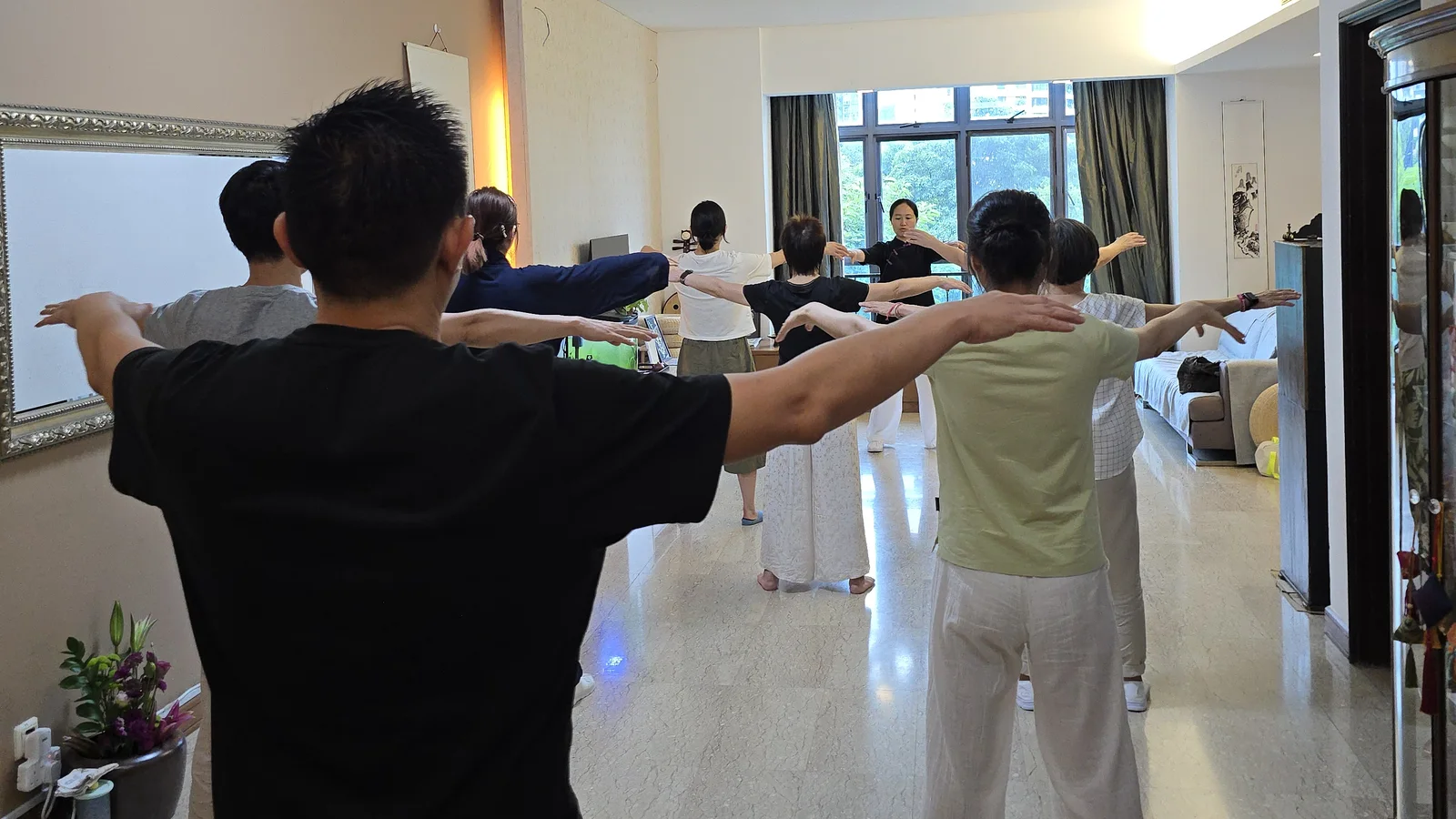
A standing qigong class in a sunlit room: students seen from behind hold both arms open at shoulder height in the same alignment, facing a teacher in dark clothing before a tall window with green trees outside.

1. Classical Foundations: The Chest Center (Shanzhong) as the 'Sea of Qi' and the Pericardium Envoy

In classical meridian physiology (Huangdi Neijing Lingshu Chapter 33, 'Treatise on the Seas' 海论) and Wudang Taoist inner cultivation, the center of the sternum between the two nipples—Shanzhong (膻中, Conception Vessel 17), also read Tanzhong in medical lineages—is revered as both the Middle Dantian (Zhong Dantian 中丹田) and the 'Sea of Qi' (Qihai 气海 of the upper chest).

At the same time, the Suwen ('Treatise on the Twelve Officials' 灵兰秘典论) describes Shanzhong / the Pericardium (Xinbao 心包) as the 'Minister and Envoy from whom joy and gladness emanate' (chenshi zhi guan, xile chu yan 臣使之官,喜乐出焉). Forming a protective wrapping around the Heart (explored in our Summer Heart-Calming He-Breath Daoyin and Autumn Lung-Nourishing Daoyin), the Pericardium channel travels from the chest down the inner arm to the palm center (Laogong PC-8) and middle finger (Zhongchong PC-9).

2. Why Mental Stress and Screen Posture Cause 'Chest Oppression' and Shallow Sighing

When we spend hours hunched over a keyboard or holding back frustration, the collarbones collapse inward and the sternum tightens. Instead of descending smoothly through the diaphragm into the lower abdomen, the breath gets trapped in the upper chest—producing frequent involuntary sighing, tight shoulders, and restless thoughts at night.

In Wudang Taijiquan and Qigong, the remedy is never puffing the chest out like a soldier, which only traps more tension in the upper back; rather, it is 'hollowing the chest to let the qi sink' (Hanxiong Chenqi 涵胸沉气) combined with gentle stroking along the sternum and Pericardium meridian.

3. Three-Step Wudang Shanzhong & Neiguan Soothing Daoyin (5 Minutes)

Practice this five-minute sequence seated upright or standing in a relaxed shoulder-width stance:

1. Stroking the Sternum from Tiantu to the Navel (Shunxiong Jiangqi 顺胸降气): Warm your palms together. Place the heel or fingers of your right palm at the base of the throat (Tiantu), and on a slow, quiet exhale, stroke smoothly down the center of the breastbone past Shanzhong (CV-17) and the solar plexus all the way to the lower abdomen below the navel. Alternate left and right hands for 18 slow downward strokes, feeling trapped warmth in the chest melt downward.

2. Opening the Wing Gates along the Pericardium Line (Zhanchi Shuxin 展翅舒心): Inhale gently through the nose while floating both arms out to the sides at shoulder height with palms facing forward and middle fingers softly extended, feeling a mild elastic stretch across the pectoral fascia, inner biceps, and forearms. Exhale slowly while rounding the arms forward as if embracing a large tree (as in Standing Post Zhan Zhuang), letting the breastbone soften inward 2 millimeters and guiding attention down to the lower dantian. Repeat 9 times.

3. Pressing the Inner Pass (Anrou Neiguan 按揉内关): Place your right thumb two thumb-widths (three finger-breadths) above the inner crease of your left wrist, directly between the two central tendons (Neiguan 内关, Pericardium 6). Make 18 slow, gentle circular rotations while breathing softly into the abdomen, then switch wrists.

4. Closing Stillness & Safety Guidelines

Finish by resting both palms over your lower abdomen for six quiet breaths (combining naturally with our Evening Wind-Down Qigong Routine), noticing how a soft, unforced sternum allows every inhalation to reach the lower ribs and abdomen.

Safety note: this traditional Wudang Daoyin and self-massage routine is for educational relaxation and wellness support only. Anyone experiencing acute chest pain, shortness of breath, dizziness, or cardiovascular symptoms should seek immediate medical care rather than practicing self-massage.

Seeker’s Q&A · Frequently Asked Questions

What is the core takeaway of Wudang Chest-Opening & Pericardium-Soothing Daoyin (Kuoxiong Liqi)?

Learn a gentle five-minute Wudang Daoyin and acupressure sequence to unbind the chest center (Shanzhong CV-17), soothe the Pericardium channel at the Inner Pass (Neiguan PC-6), and guide stagnant upper-body qi smoothly downward.
