QIGONG & YANGSHENG · 气功与导引

Wudang Scapular-Release & Upper-Back Daoyin (Hanxiong Babei & Kaijia): Opening the Shoulder Blades and Gaohuang Region 武当“含胸拔背与开肩活胛”导引术:松开肩胛骨缝(膏肓穴)、贯通背脊整劲的练习

Grounded in the Taijiquan Ten Essentials ('Hollow the chest and pluck up the back') and classical Daoyin manuals, learn a gentle scapular-gliding routine to release upper-back knots around the Gaohuang point.


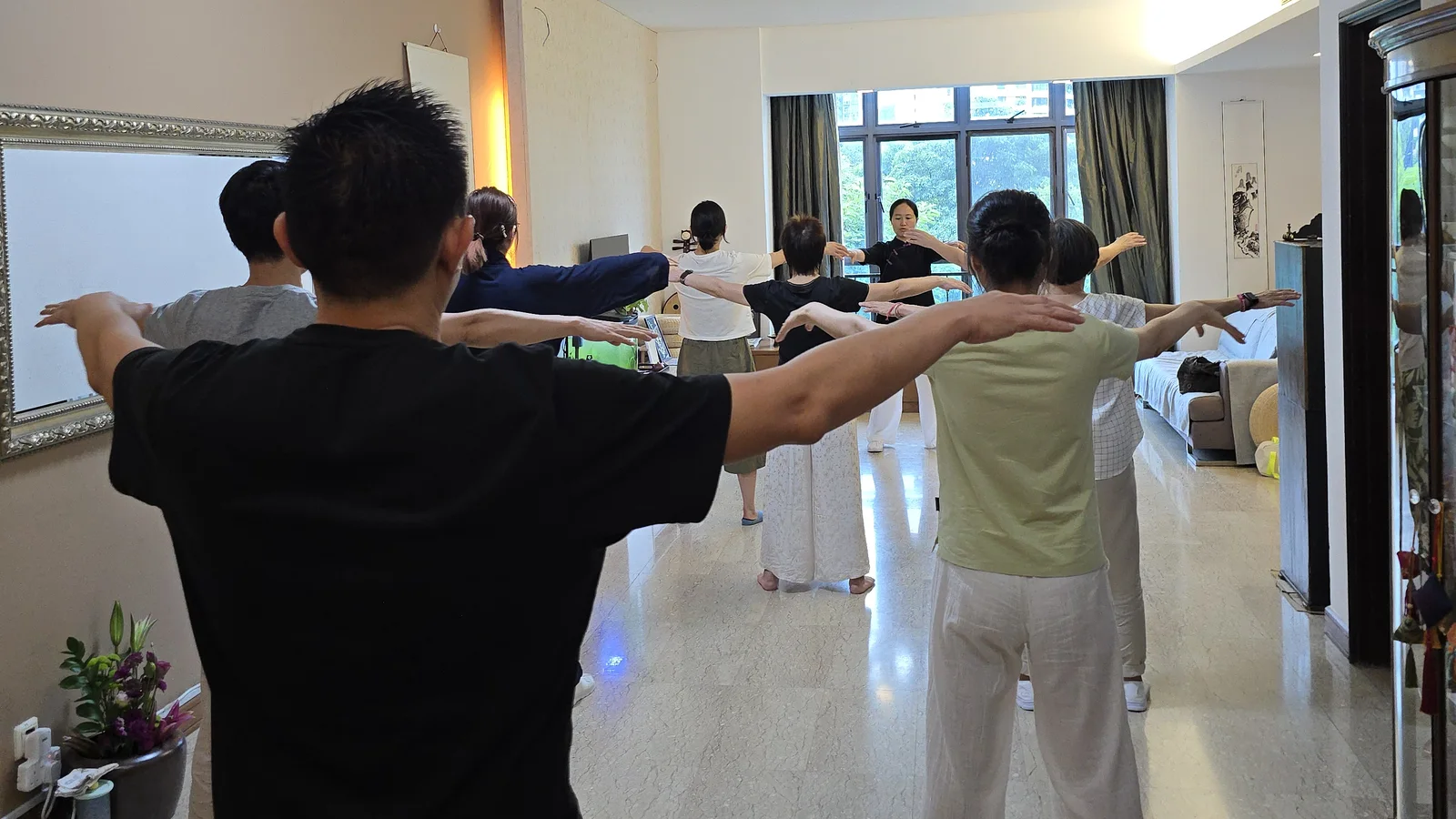
A standing qigong class in a sunlit room: students seen from behind hold both arms open at shoulder height in the same alignment, facing a teacher in dark clothing before a tall window with green trees outside.

1. Classical Foundations: What 'Hollow the Chest and Pluck Up the Back' (Hanxiong Babei) Really Means

Among the Ten Essentials of Taijiquan (Taijiquan Shiyao), few pairings are as misunderstood as Hanxiong Babei (含胸拔背, 'hollow the chest and pluck up the back'). Beginners sometimes misread 'hollow the chest' as slumping the shoulders forward into a stooped posture. In Wudang biomechanics, slumping collapses the lungs; true Hanxiong Babei means allowing the sternum and front ribs to soften inward by just a few millimeters while the space between the two shoulder blades (Scapulae) widens and lengthens upward toward the crown.

In traditional Chinese meridian anatomy, the muscular corridor along the inner border of the shoulder blade—at the level of the fourth thoracic vertebra—houses the famous Gaohuang (膏肓, Bladder 43) point. Classical physicians from Sun Simiao onward noted that when the shoulder blades are glued tight to the ribs by stress or desk work, tension stagnates in the Gaohuang region; when the scapulae glide freely ('opening the Gaohuang'), the upper back feels warm, spacious, and light.

2. Why Pinching the Shoulder Blades Together Blocks Internal Flow

In modern posture advice, people are often told to 'stand up straight by pinching the shoulder blades together and puffing the chest out.' In Wudang Qigong and internal martial arts, pinching the scapulae toward the spine is considered a major structural flaw: it shortens the rhomboids, arches the thoracolumbar junction, lifts the breath into the throat, and disconnects the arms from the back.

Instead, Wudang training cultivates a 'turtle-shell back' (Guibei 龟背) or 'wrapping the scapulae (肩胛) forward around the ribs': the outer edges of the shoulder blades slide gently outward and downward toward the elbows, creating a broad, elastic dome across the upper thoracic spine that links seamlessly with sunk shoulders and dropped elbows (Chenjian Zhuizhou).

3. Three-Step Wudang Scapular-Gliding Daoyin Routine (Kaijia Shubei)

Practice this five-minute sequence seated or standing to unstick tight shoulder blades:

1. Embracing the Tree Scapular Widening (Baoshu Kaijia 抱树开胛): Stand in a relaxed shoulder-width stance and round both arms in front of the chest as in Standing Post (Zhan Zhuang). On a slow inhale, imagine a soft balloon expanding between your spine and the inner borders of your two shoulder blades so your middle fingers drift two centimeters closer together without lifting the shoulders; on the exhale, let the shoulder blades melt downward toward the waist. Repeat nine breaths.

2. Cross-Arm Gaohuang Opening (Shizi KaiGaohuang 十字开膏肓): Cross your forearms lightly in front of your chest and rest your right palm on your left shoulder and your left palm on your right shoulder (a gentle self-embrace). Keeping the neck long, draw three slow horizontal circles with both elbows in front of the heart in each direction, feeling the inner borders of the shoulder blades peel open softly.

3. Crane-Wing Scapular Wave (Heyi Shujia 鹤翼舒胛): Float the backs of the wrists forward and up to chest height with the upper back rounded, then open the arms softly out to the sides at a 45-degree forward angle (never behind the shoulder plane) and let the elbows draw the arms back down, repeating six smooth waves.

4. Breath Pairing & Upper-Thoracic Safety Notes

Pair this scapular-release routine with our ribcage and diaphragmatic lateral-breathing Daoyin and spinal wave Crane-Neck Daoyin: breathing into the posterior ribcage between the shoulder blades often feels remarkably calming.

Safety note: never pull the arms forcefully across the chest if you have rotator cuff injuries, AC-joint pain, or acute cervical radiculopathy. Keep all movements gentle and within a comfortable range; this traditional Daoyin guide is for educational movement wellness and is not a substitute for medical care.

Seeker’s Q&A · Frequently Asked Questions

What is the core takeaway of Wudang Scapular-Release & Upper-Back Daoyin (Hanxiong Babei & Kaijia)?

Grounded in the Taijiquan Ten Essentials ('Hollow the chest and pluck up the back') and classical Daoyin manuals, learn a gentle scapular-gliding routine to release upper-back knots around the Gaohuang point.
