QIGONG & YANGSHENG · 气功与导引

Pressing Through Neiguan (内关 PC-6) and Waiguan (外关 TE-5): Wudang Inner-and-Outer Forearm Pass Daoyin for Chest Ease, Ribcage Suppleness, and Silk-Reeling Rotation 武当导引“透按内关与外关”精解:打通前臂阴阳双关、调谐阴维阳维二脉与松活太极“尺桡旋臂”的养生法

How a three-finger measurement above the wrist unlocks the interosseous pivot between radius and ulna, soothing the chest while freeing spiral forearm rotation.

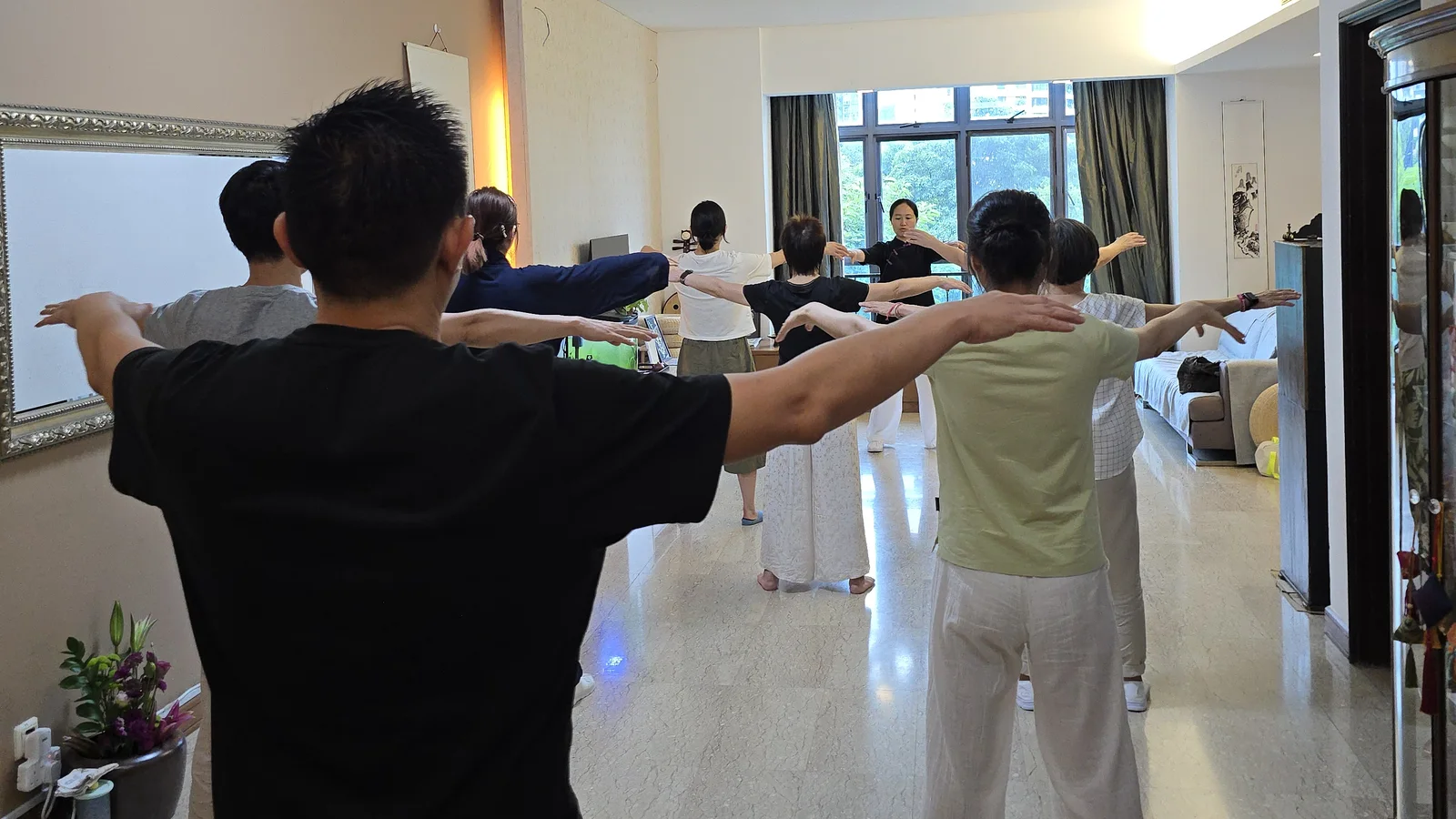
A standing qigong class in a sunlit room: students seen from behind hold both arms open at shoulder height in the same alignment, facing a teacher in dark clothing before a tall window with green trees outside.

1. Classical Meridian Symmetry: Why Neiguan (内关 PC-6) and Waiguan (外关 TE-5) Mirror Each Other Across the Forearm

In the human forearm, two long bones—the radius (thumb side) and the ulna (little-finger side, whose distal wrist gates we explored in warming Houxi SI-3 and Wangu SI-4)—run parallel from the elbow to the wrist, linked by a fibrous sheet called the interosseous membrane. Whenever you turn your palm upward (Yang Zhang 阳掌, supination) or downward (Yin Zhang 阴掌, pronation) in Wudang Taijiquan, the radius rolls smoothly across the ulna. Yet if prolonged keyboard typing, mouse clicking, or emotional stress tightens the deep flexor and extensor compartments of the forearm, that interosseous space jams, the chest feels constricted, and forearm rotation becomes jerky.

Exactly 2 cun (three joined finger-breadths) proximal to the wrist crease, classical meridian theory identifies a remarkable Yin-Yang pair of "Pass Gates" (Guan 关) facing each other directly across the interosseous space between radius and ulna, documented in the Lingshu (Spiritual Pivot) and Huangfu Mi's Zhenjiu Jiayijing:

  1. Neiguan (内关, PC-6 — "Inner Pass," Luo-Connecting Point of the Hand-Jueyin Pericardium Channel & Eight-Vessel Confluence Point Opening the Yin Linking Vessel Yinwei Mai 阴维脉): Located on the palmar (anterior) aspect of the forearm, 2 cun proximal to the distal transverse wrist crease, squarely between the tendons of the palmaris longus (Zhangchang Ji 掌长肌) and flexor carpi radialis (Raocedewan Quji 桡侧腕屈肌). Because the Pericardium (Xinbao 心包) wraps and protects the Heart while Yinwei Mai links all Yin channels of the chest and abdomen, the classical Bamai Ba Xue Ge (Song of the Eight Confluence Points) declares: "Neiguan governs the chest, heart, and stomach" (Neiguan Xiongyu Xin Wei 内关胸与心胃)—calming palpitations, easing diaphragmatic tightness, and harmonizing the middle "Yellow Court" described in the Huangting Jing.
  2. Waiguan (外关, TE-5 — "Outer Pass," Luo-Connecting Point of the Hand-Shaoyang Triple Burner Channel & Eight-Vessel Confluence Point Opening the Yang Linking Vessel Yangwei Mai 阳维脉): Located on the dorsal (posterior) aspect of the forearm, 2 cun proximal to the dorsal wrist crease, in the depression between the radius and the ulna, directly opposite Neiguan. Because the Shaoyang Triple Burner channel governs the lateral ribcage, outer shoulder, and ear perimeter while Yangwei Mai links all exterior Yang meridians, Waiguan releases dorsal wrist stiffness, lateral rib tightness, and shoulder-neck tension.
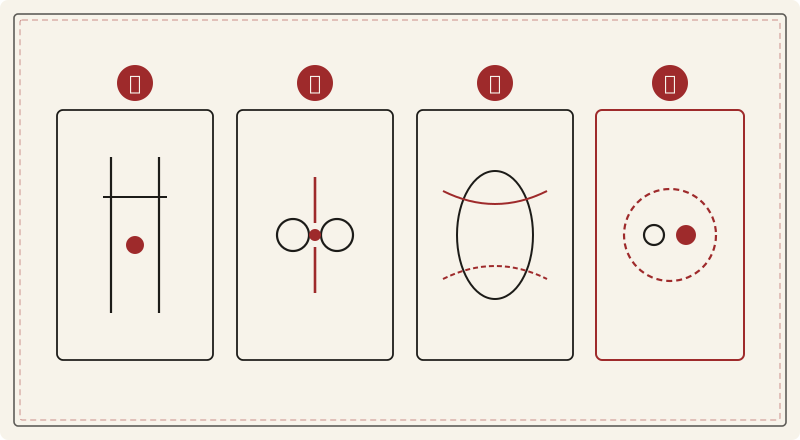
Classical four-panel Wudang Daoyin diagram illustrating the three-finger measurement for Neiguan (PC-6) and Waiguan (TE-5), thumb-and-index through-pressing across radius and ulna, Yinwei and Yangwei chest-rib linkage, and forearm pronation-supination rotation
Figure 1 — Inner-and-Outer Pass (Neiguan PC-6 & Waiguan TE-5) Wudang Daoyin Architecture: ① Three-finger (2 cun) measurement above the wrist crease locating palmar Neiguan between the two tendons and dorsal Waiguan between radius and ulna; ② Tou Xue Dui An (透穴对按 — Through-Pass Pinching): thumb on Waiguan and index/middle finger on Neiguan pressing gently toward each other; ③ Harmonizing the inner chest-diaphragm (Yinwei Mai) and outer flanks-shoulders (Yangwei Mai); ④ Supple radius-over-ulna Silk-Reeling forearm rotation (Chansijin).

2. Four-Stage Wudang "Through-Pass" (Tou Guan 透关) Forearm Daoyin Protocol

Because Neiguan (PC-6) and Waiguan (TE-5) sit directly opposite each other across the interosseous gap between the radius and ulna, Wudang Qigong and Daoyin practitioners rarely press them in isolation. Instead, they use a signature "Through-Pressing" (Tou Xue Dui An 透穴对按) grip so one hand stimulates both the Inner and Outer Passes simultaneously while breathing into the lower abdomen (natural abdominal breathing):

StageExact Anatomical Palpation & Hand GripGentle Daoyin Movement & RepetitionsBreath & Somatic Verification
1. Three-Finger Measurement (San Zhi Liang Cun 三指量寸)Sit or stand upright; hold your left palm upward and place the index, middle, and ring fingers of your right hand flat across the inner wrist starting from the distal wrist creaseAt the proximal edge of the index finger (2 cun above the wrist crease), feel the soft groove between the two prominent central tendons (Neiguan PC-6), and directly opposite on the back of the forearm between the two bones (Waiguan TE-5)Make a light fist briefly if needed to make the two palmar tendons stand out clearly, then relax the hand completely
2. Simultaneous Thumb-and-Middle Through-Pressing (Tou Xue Xuan Rou 透穴旋揉)Encircle the left forearm loosely with your right hand: place the right thumb pad on Neiguan (PC-6) and the right index or middle finger pad directly opposite on Waiguan (TE-5)Gently pinch the two points toward each other into the space between the radius and ulna, kneading in 24 slow clockwise and 24 counterclockwise circles, then switch to the right forearmExhale slowly on each inward press; notice the chest (Tanzhong) and upper back softening together
3. Active Forearm Pronation-Supination Under Light Pinch (Xuan Bi Kai Guan 旋臂开关)Maintain a moderate, comfortable thumb-and-middle-finger hold on left Neiguan and Waiguan while holding the left elbow softly bent in front of the ribsSlowly turn the left palm fully upward (Yang) and then fully downward (Yin) 18 times, feeling the radius and ulna glide beneath your pinching fingertips; repeat on the right armThis active release melts deep forearm fascia stiffness from typing or gripping
4. Dual-Palm Chest Opening & Settling (Kai Xiong Gui Yuan 开胸归元)Release the grip and hold both palms in front of the chest (Middle Dantian / Huangting)Inhale as the palms open slightly outward; exhale as both palms descend smoothly to rest over Zhongwan, Qihai, and Guanyuan for 6 quiet breathsFeel warmth radiating from the inner wrists into the palms and lower abdomen

Why is unlocking Neiguan and Waiguan considered essential preparation for Wudang Taijiquan and Wudang straight sword (Jianfa)?

  1. Effortless Inward and Outward Forearm Spirals (Neixuan / Waixuan 内旋/外旋): Every ward-off (Peng), rollback (Lu), press (Ji), and push (An)—as well as postures like Twin Peaks Pierce the Ears (Shuangfeng Guan'er)—requires continuous rotational coiling of the forearm around its long axis. Anatomically, that spiral happens when the radius pivots around the ulna across the interosseous membrane right at Neiguan–Waiguan. When Stage 3 of this Daoyin frees that pivot, the palm turns without dragging the elbow or shoulder out of alignment.
  2. Connecting the Left Jianzhi to the Right Wrist: In Wudang sword forms, when the left Sword Finger (Jianzhi) touches the inside of the right forearm to support a cut or thrust, the contact point is none other than Neiguan (PC-6)—linking the Yin-Yang channels of both arms into a single unified bow.

4. Heritage Practice on Wudang Mountain and in Singapore & Safety Notes

Practiced daily across the courtyards of the UNESCO World Heritage ancient Taoist temples on Wudang Mountain (No. 72 Jianhe 2nd Road, Wudangshan, Hubei, China; UNESCO World Heritage guide) and taught in the foundational wellness classes at Lee Wudang International Pte. Ltd. (58A Smith Street (2nd Floor), Singapore 058962; beginner guide), this two-minute forearm routine observes two simple safety rules:

  • Press with the Flat Finger Pad, Not the Fingernail: Because the median nerve runs deep beneath the palmar tendons at Neiguan, use broad, warm thumb-pad pressure rather than digging in with a sharp nail, aiming for a gentle, spreading warmth rather than sharp tingling.
  • Non-Medical Self-Care Scope: Avoid pressing over acute wrist injuries, recent IV sites, or inflamed skin; this traditional Daoyin method supports everyday relaxation and movement quality and does not replace medical care.

Practice Reflection for Students

Right now, measure three fingers up from your left wrist crease, pinch Neiguan (inside) and Waiguan (outside) gently with your right thumb and middle finger, and slowly turn your left palm up and down nine times—feeling how immediately the inner forearm and chest relax.

Seeker’s Q&A · Frequently Asked Questions

Where are Neiguan (PC-6) and Waiguan (TE-5), and what does pressing them together do?

Both are three finger-breadths (2 cun) above the wrist crease and face each other across the forearm: Neiguan (PC-6) on the inner side, between the two central tendons, and Waiguan (TE-5) on the outer side, in the hollow between the radius and the ulna. Classical theory links Neiguan with the chest, heart and stomach, and Waiguan with the ribs, outer shoulder and neck. Pinch the pair gently between thumb and middle finger and turn the palm up and down nine times: this frees the space between the two forearm bones, so the arm rotates smoothly in Taijiquan and the chest feels less tight. Use the pad of the thumb, and do not press over an acute wrist injury or inflamed skin; this does not replace medical care.


How can I apply this in practice?

Right now, measure three fingers up from your left wrist crease, pinch Neiguan (inside) and Waiguan (outside) gently with your right thumb and middle finger, and slowly turn your left palm up and down nine times—feeling how immediately the inner forearm and chest relax.
