Beiyuan Tribute Tea: Song Court Taste, Skilled Labour and the Limits of ‘Imperial Tea’
北苑贡茶:宋代宫廷品味、制茶劳作与“御茶”标签的边界
Beiyuan (北苑) is remembered as a celebrated source of tribute tea for the Song court. That short description hides a larger system. Tea gardens, specialist workers, officials, moulds, deadlines, relays to the capital and changing court preferences all helped create its reputation. The story is therefore not simply “an emperor’s favourite tea.” It is a case study in how place, labour, administration and taste were made to reinforce one another.
1. Beiyuan was both a place and an institution
A production landscape in the Jian’an region
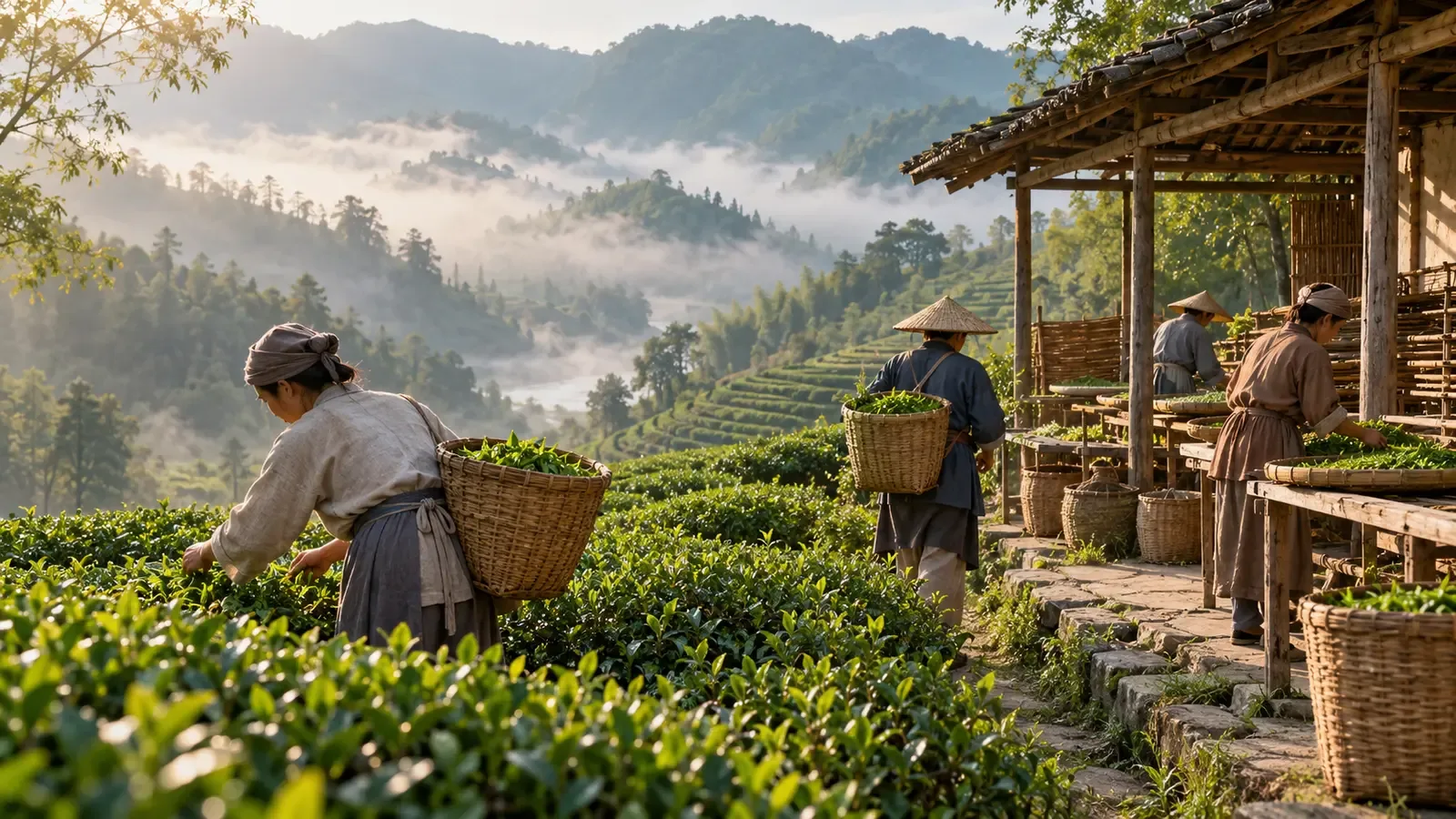
Song texts locate Beiyuan around the Jian’an tea country of northern Fujian, associated with Phoenix Mountain and connected roasting sites. Modern administrative names and boundaries are not identical to medieval ones, so “Beiyuan” should not be treated as a precise contemporary vineyard-style parcel. It named a famous production centre within a wider landscape already introduced in our history of Chinese tea culture.
The Tea Office made tribute organised work
An official Fujian government account dates the establishment of a specialised tribute-tea office at Beiyuan to 977. Its overview of Jian ware and Song tea culture helps place production within supervised institutions. A date for an office is not the beginning of all local tea knowledge: cultivation, processing experience and regional exchange had earlier histories.
2. Tribute tea was not the whole Song tea economy
Tribute moved selected goods toward the court
贡茶 (gòngchá) identifies tea supplied as tribute, but the word does not mean that every leaf from the region was reserved for an emperor. Beiyuan records focus on selected grades, named forms and delivery sequences. They illuminate a privileged channel of production and allocation, not a census of everything grown, sold or drunk in Fujian.
Tea taxation and tribute answered different state needs
The Song state also regulated commercial tea through changing fiscal arrangements. A chapter on taxation in Song China describes tea and wine monopolies as important to public finance and economic management. Tribute, monopoly, tax, public purchase and ordinary trade therefore should not be collapsed into one “imperial system.” Our tea-trade networks guide follows other routes and markets.
3. Making a court tea cake
Early picking made time part of quality
Song descriptions distinguish tiny buds, bud-and-leaf standards and later material. Picking could begin before full spring warmth, and the most prestigious consignments were hurried toward the capital. This pursuit of freshness demanded coordinated labour and transport; it was not proof that the earliest possible bud is always best for every tea. Compare those historical selections with the wider principles in picking tea in China.
Steaming, pressing, grinding, moulding and drying formed a chain
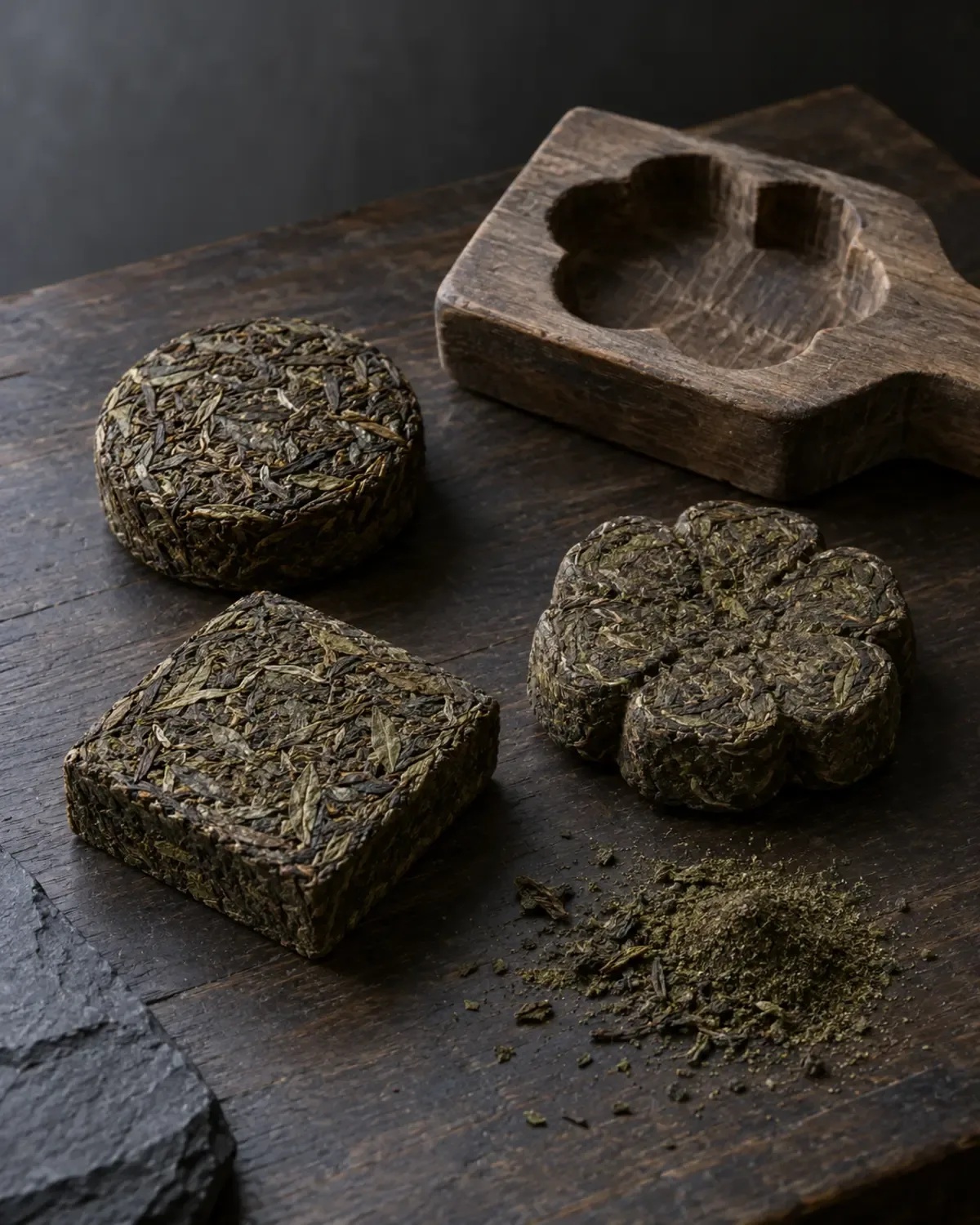
The primary Beiyuan Bielu and Xuanhe Beiyuan Gongcha Lu describe gardens, harvest timing, steaming, pressing out moisture, grinding paste, forming cakes and controlled drying. Each operation affected colour, taste, structure and storage. These were compressed teas, yet “compressed tea” spans many later technologies; our guide to tea cakes and bricks explains why form alone does not establish date or identity.
4. Prestige rested on skilled and organised labour
The finished cake condensed many kinds of work
Garden care, picking, carrying, washing, steaming, pressing, grinding, mould preparation, drying, inspection, packing and transport involved different hands. Texts often centre officials, rare grades and court consumption, but the material result depended on coordinated labour. Calling the product “imperial” can hide those workers behind a single glamorous patron.
Speed was managed, not magical
The tribute record lists multiple dispatches and presents the earliest consignments as a race against the season. This tells us about administrative priority, perishability and prestige. It does not justify converting literary travel descriptions into an exact universal delivery time. Roads, weather, batch, destination and period mattered, and the surviving record is selective.
5. Court taste changed the product hierarchy
Dragon, phoenix and other names belonged to a moving catalogue
The tribute record names many cakes and notes different moulds, dimensions, materials and ranks. Older forms could fall below newer ones; some disappeared while others were introduced or renamed. The catalogue shows deliberate differentiation, but a poetic name is not a modern cultivar, recipe or certification. A dragon impression on a present-day cake cannot by itself prove continuity with Song tribute production.
Rare material and technical refinement reinforced each other
The Daguan Chalun discusses site, weather, picking, steaming, pressing, manufacture and a scarce “white tea” within the Song cake-tea world. That historical category is not the modern white-tea family. Court attention could elevate rarity and technical difficulty, while officials and makers responded with further refinements. Preference flowed both downward as demand and upward as local expertise.
6. Beiyuan’s reputation joined nature, technique and writing
Place was described, compared and ranked
Cai Xiang’s Chalu (Record of Tea) praises tea associated with Beiyuan and Phoenix Mountain while examining colour, fragrance, taste, storage and preparation. Such claims record a connoisseurial geography, not a chemical map. Soil, slope and shade mattered through the farming and processing practices that made them legible.
Terroir was also cultural work
A recent scholarly study of tea and place in Song China shows how writers connected environmental description, local technique, refined taste and imperial order. Beiyuan’s fame was not simply discovered in the land. It was produced through repeated comparisons, texts, institutions and skilled transformations of leaf.
7. Reading the records without turning them into a factory manual
Tea treatises are rich but interested sources
Officials and connoisseurs wrote to distinguish good from poor work, celebrate innovation, instruct readers and preserve names. Their categories are therefore historically valuable and rhetorically shaped. A list of cakes tells us that differentiation mattered; it does not reveal every worker’s experience, all local tea, or a complete audited production ledger.
Numbers require their labels and dates
Where a text reports cakes, plants, dispatches or grades, the unit and passage must travel with the number. Different reigns and later annotations describe different moments. Combining their largest figures into one timeless annual output would manufacture precision. Responsible interpretation identifies who recorded a quantity, for which category and period.
8. Seven questions for an “imperial tea” claim
- Does the claim identify Beiyuan, another tribute centre, or only use court imagery?
- Which dated text, object, inscription or archive supports the connection?
- Is the product a compressed cake, powder for whisking, or a modern loose-leaf tea?
- Does “tribute” describe historical allocation, a modern geographical indication, a brand or a ceremony?
- Are the cultivar, garden boundary and processing method independently documented?
- Which parts are reconstruction, revival, adaptation or marketing?
- Does the label acknowledge growers and makers rather than crediting prestige to the court alone?
9. Why Beiyuan still matters
A history of relationships, not a timeless luxury badge
Beiyuan reveals how a tea place can be built through ecology, labour, technique, bureaucracy, transport, writing and taste. Modern producers may honour that history, but no present product becomes a Song cake merely by using “imperial,” “dragon” or “tribute.” The most respectful revival states what is documented, what has been reconstructed and what is newly created. Continue with the existing guide to Song whisked tea, the companion article on doucha, and our further reading and practice.