Fixing Tea Leaves (Shaqing): Heat, Enzymes and a Turning Point in Chinese Tea
茶叶杀青:热、酶活性与中国制茶的转折点
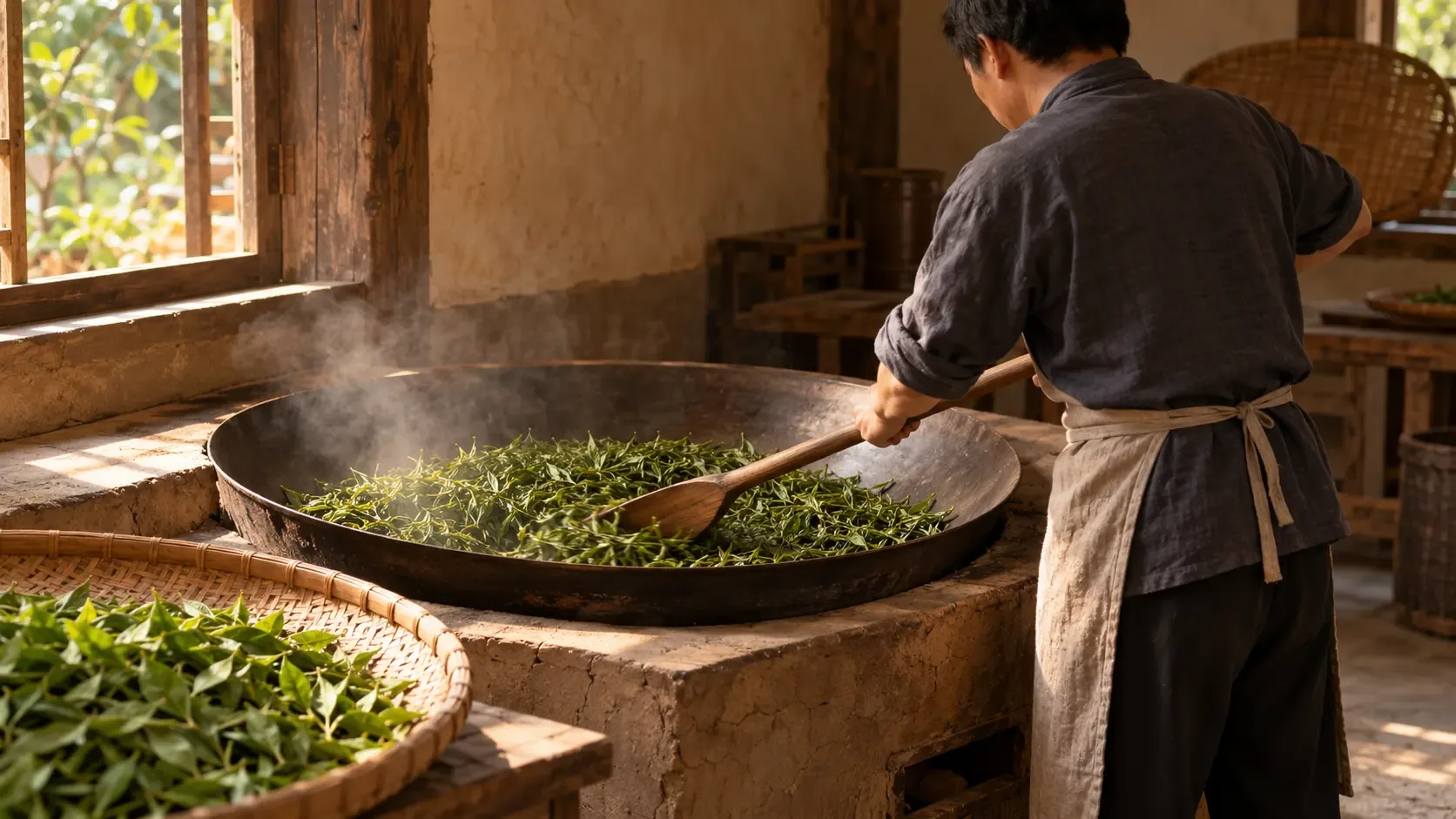
Fixation—shāqīng (杀青) in Chinese tea manufacture—is a controlled application of heat at a decisive moment. It rapidly reduces the activity of enzymes that would otherwise keep driving oxidation after the leaf is disturbed. The treatment also changes moisture, aroma, texture and readiness for later work. Its purpose and place, however, depend on the tea being made.
Why “kill-green” can mislead
A literal translation, not a complete definition
Shaqing is often translated literally as “kill-green.” The phrase is memorable but easy to overread: the maker is not erasing greenness, killing every microorganism or making a shelf-stable product. “Fixation” or “enzyme inactivation” better names the central processing aim while leaving room for the other changes caused by heat.
Rapid reduction, not an absolute zero
Polyphenol oxidase and peroxidase are commonly discussed because they participate in oxidative reactions. A peer-reviewed review of green-tea manufacture describes fixation as a characteristic enzyme-inactivating stage, achieved through methods including steaming and pan-firing. The useful claim is rapid suppression under a particular process—not that every enzyme in every leaf reaches zero. Read the manufacturing review.
What controlled heat changes
The oxidative pathway is redirected
Picking separates a shoot from its plant, and later handling damages cells and mixes substances that were previously compartmentalised. Fixation narrows the period in which enzyme-driven oxidation can continue. This makes it a boundary between the fresh or partly transformed leaf and the material a maker will roll, shape or otherwise develop. Start with Picking Tea in China and Withering Tea Leaves to see what has already happened.
Texture, moisture and aroma move together
Heat softens tissues, drives off some water and changes volatile and non-volatile compounds. A controlled study of coupled fixation methods measured a rapid fall in polyphenol-oxidase activity alongside changes in green-tea aroma and taste components. Its equipment and numerical conditions belong to that experiment; they are evidence of interacting mechanisms, not a universal workshop recipe. Read the fixation study.
Fixation is not drying
Different purpose, timing and leaf state
Fixation acts early enough to change the biochemical route of the leaf. Drying normally comes later and lowers moisture toward a more stable finished product. Both can involve heat, but identical heat does not follow: the leaf’s moisture, form, exposure and processing purpose differ.
Nor is it sterilisation
Tea language sometimes turns “high heat” into “sterilisation.” That is too broad. A fixation step is controlled for tea manufacture and sensory development; without validated time, temperature and microbiological evidence, it should not be described as a sterilisation treatment or a health guarantee.
Not every tea follows the same path
Four basic flows name fixation
China’s production-licensing rules place shaqing in the basic flows for green, oolong, yellow and dark tea. The same process map does not name it in the basic flows for black or white tea. This regulatory overview is not a catalogue of every regional variation, but it prevents the claim that all six Chinese tea families share one identical fixation stage. Consult the official process flows.
Position in the sequence gives the word meaning
For green tea, fixation usually establishes an early limit on oxidation. For oolong, it follows withering and zuoqing, stopping the desired partial transformation. Yellow and dark teas move from fixation into different subsequent operations. One word therefore names a shared principle, not one interchangeable recipe.
Steaming and pan-firing are different routes
Moist heat and contact heat
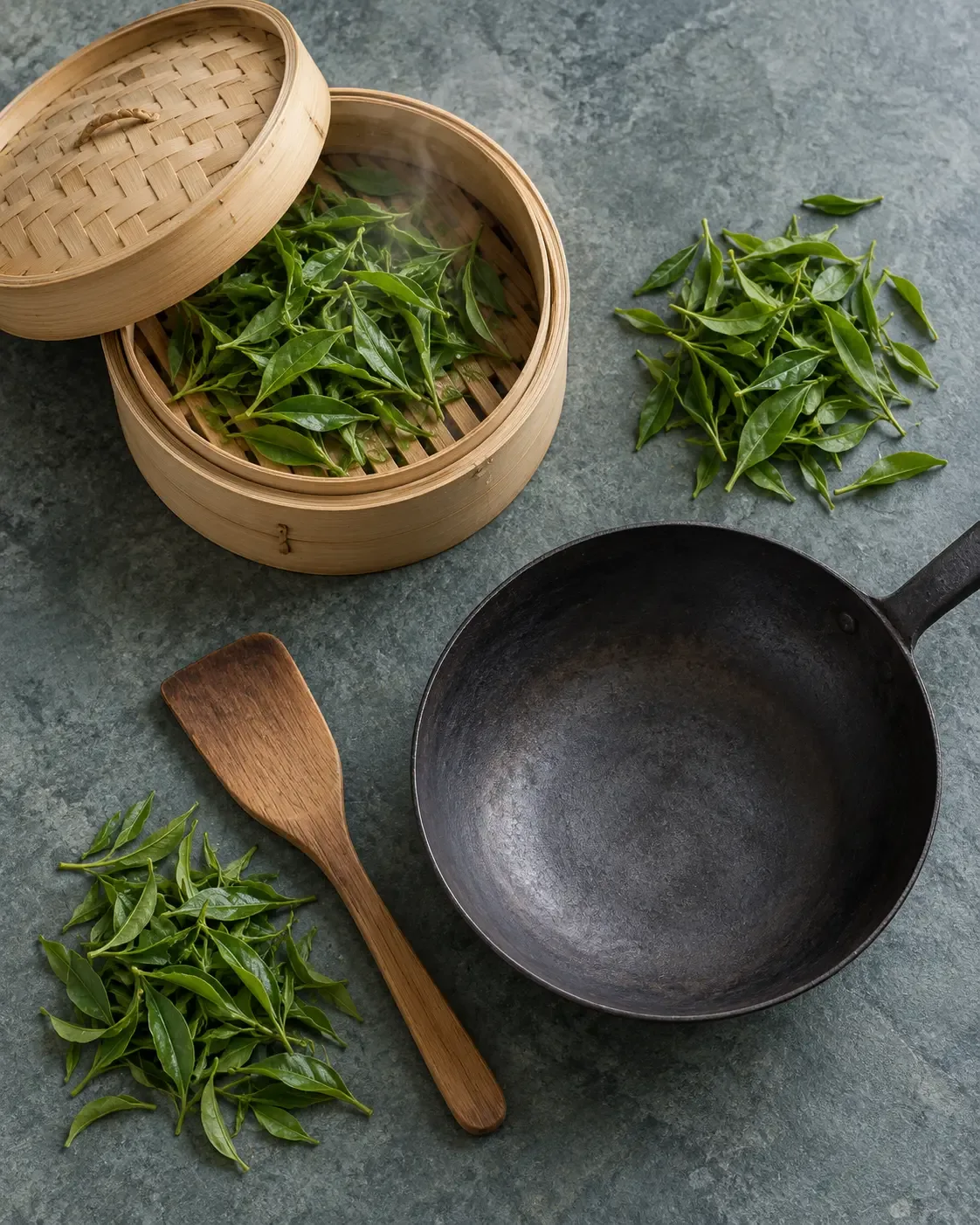
Steam transfers heat through moist vapor, while pan-firing relies more heavily on contact with a heated surface and the movement of leaves. Each route can inactivate enzymes, but heat transfer, water movement and aroma development differ. China’s current national standard for steamed green tea confirms that steaming is an established green-tea category rather than an exception outside Chinese tea. See the steamed-green-tea standard.
Method is not a quality ranking
Neither “steamed” nor “pan-fired” is a complete verdict on quality. Leaf material, loading, heat delivery, movement, cooling and later rolling and drying all matter. The current technical specification for steamed-tea processing gives a formal reference for that route without turning it into the single model for every tea. See the steamed-tea specification.
Green tea: an early processing boundary
Holding back oxidation while building character
In the basic green-tea flow, fresh leaves move to fixation before rolling and drying. The stage limits enzyme-driven browning, yet its sensory work is not merely “preserving freshness”: heating can also reduce raw green notes and help form cooked, nutty, vegetal or other aromas according to material and method. Precise endpoints belong to a defined product and workshop system.
Oolong: fixing after making green
Stopping at a chosen degree of transformation
Oolong first undergoes withering and zuoqing, a sequence of rest and handling that encourages controlled partial oxidation. Fixation then checks that trajectory before rolling and drying. The current national technical specification for oolong processing provides a general framework, while regional teas still differ in leaf, equipment and sensory aim. See the oolong-processing standard.
Yellow and dark tea: the next step changes the result
A shared boundary, divergent pathways
In the official basic flows, yellow tea proceeds from fixation and rolling into yellowing before drying, while dark tea proceeds through rolling and pile fermentation before drying. These later operations are not footnotes: they explain why fixation does not make every treated leaf into green tea. Classification follows the whole process sequence.
A seven-question workshop method
How to read a fixation claim
- Which tea family, region, cultivar and leaf standard are being discussed?
- Where does fixation occur relative to withering, zuoqing, rolling, yellowing, piling and drying?
- Which heat-transfer method and equipment are used, and how are the leaves moved?
- What are the starting moisture, leaf maturity, batch size and loading depth?
- Which sensory observations or measurements define the local endpoint?
- Is a stated time or temperature a legal standard, a study condition or one maker’s practice?
- What cooling and next operation prevent residual heat from carrying the process too far?
These questions connect workshop decisions with tea landscapes, tea history and routes for further reading and practice. Fixation is best understood as a controlled turning point: heat redirects transformation, but the meaning of that turn comes from the leaves, the method and the process that follows.