Doucha: Tea Contests in Song China and the Limits of Modern Re-Creation
斗茶:宋代茶事竞赛与现代重现的边界
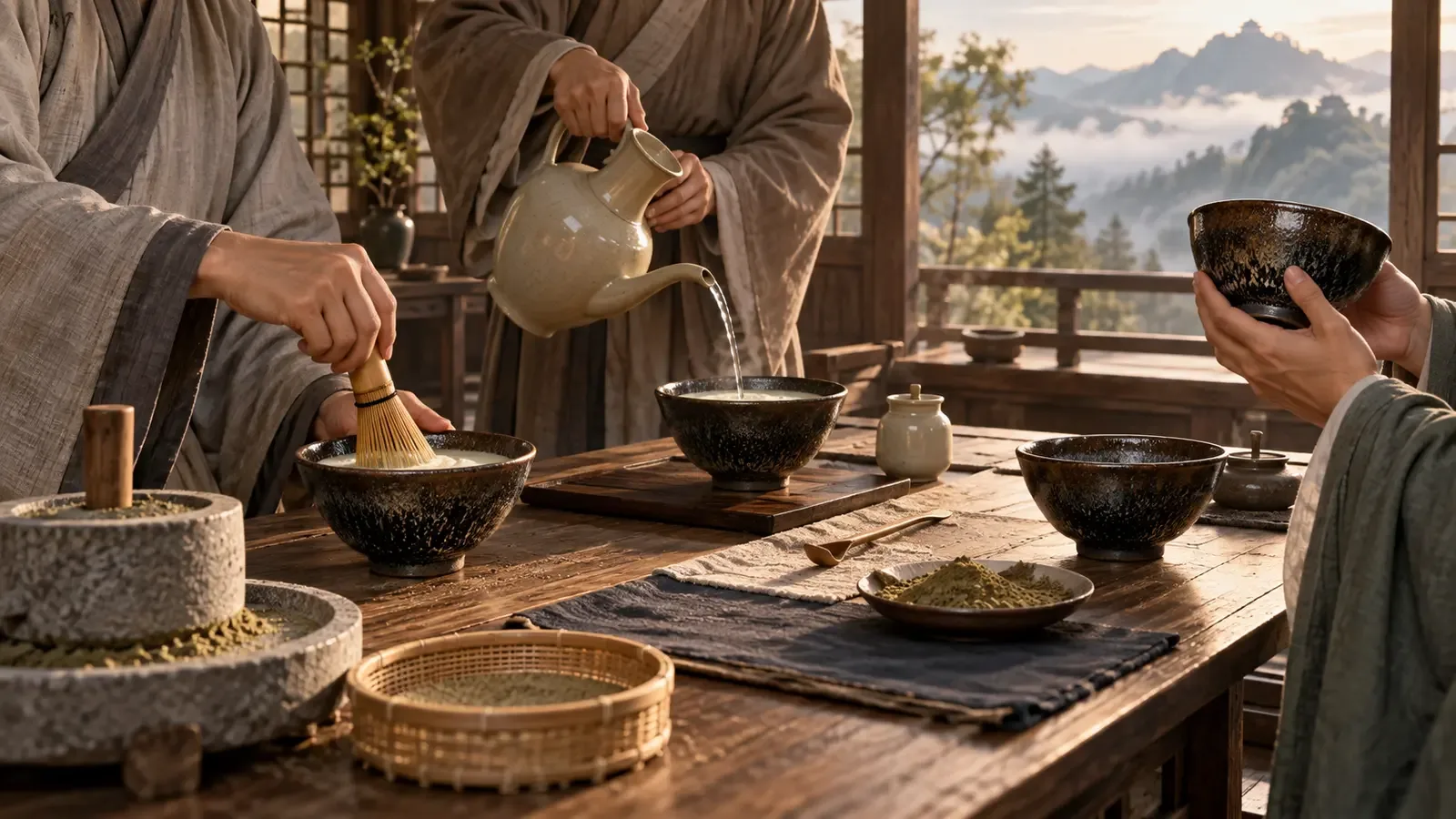
Doucha (斗茶), literally “contending with tea,” is often rendered as “tea competition” or “tea battle.” The vivid name can mislead if it suggests one timeless tournament. Practices changed by place and period. The best-documented Song examples joined tea material, grinding and sieving, water, vessels and whisking skill in a comparison whose visible foam and water marks mattered. They were not modern blind cuppings performed in old clothes.
1. A historical practice, not one permanent rulebook
The word names comparison more than a single format
Sources use competition language for testing tea and preparation skill, but they do not establish one standardized national bracket. Participants, stakes, setting and criteria could vary. Song documentation is especially rich, yet that does not prove every Chinese tea contest began then or followed one court procedure. Place the subject within the longer history of Chinese tea culture rather than treating a popular reconstruction as the origin story.
Song evidence describes a different tea world
Cai Xiang’s eleventh-century Chalu (茶录, Record of Tea) discusses tea, preparation and utensils in the context of Jian’an tea. The material could be steamed, pressed into cakes, dried, then prepared by breaking, grinding and sieving. A contest built around that powder cannot simply be mapped onto today’s whole-leaf oolong, green-tea or black-tea judging.
2. From cake tea to powder and foam
Grinding and sieving were part of the result
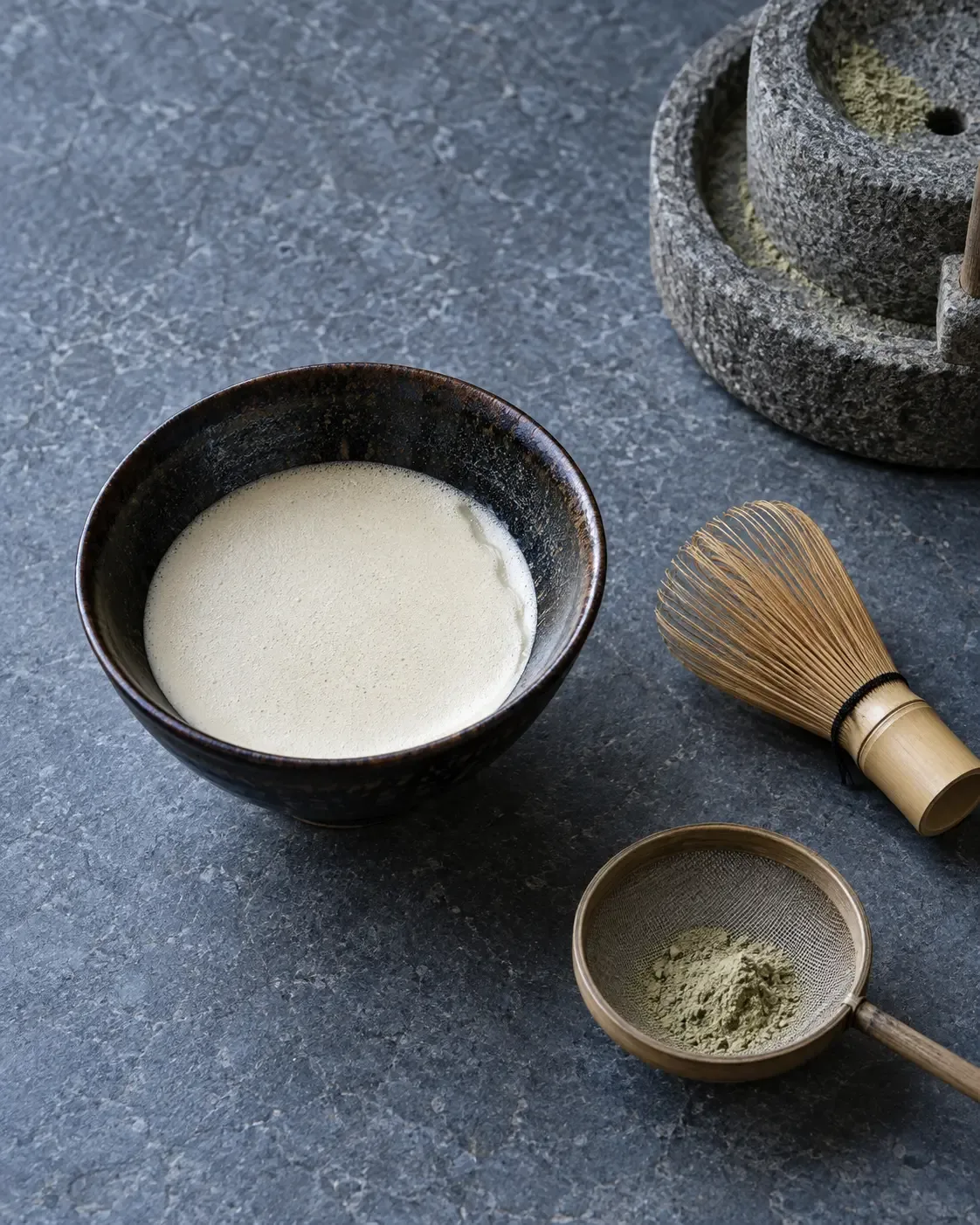
The prepared cake was not dropped whole into water. It was processed into fine powder close to use; particle size and freshness could affect colour, suspension and texture. The period sequence therefore joined manufacturing quality with later handling. Our guide to whisked tea in Song China explains the preparation route in detail; here the important point is that the competitor helped make the visible cup.
Water was added and the tea was struck or whisked
Powder and a little water were first brought together, then more hot water was added while the mixture was worked. The Hong Kong Antiquities and Monuments Office illustrates this sequence in its account of tea-drinking and competition in Song daily life. Terms such as 点茶 (diǎnchá) and 击拂 (jīfú) belong to this historical method; translating them simply as “brewing” hides the labour of forming a fine, persistent surface.
3. What judges could see
Colour and surface were period-specific criteria
Song tea texts value a pale, bright presentation and describe how preparation affected the surface. The Daguan Chalun (大观茶论), preserved under the name of Emperor Huizong, discusses tea manufacture, powder, bowls, water, whisking, colour, aroma and taste. These are evidence for an elite Song aesthetic, not a universal command that good tea in every period must be white or frothy.
The water mark made endurance visible
Cai Xiang records that in Jian’an contests the side on which a water trace appeared first lost, while a surface that endured longer won; margins could be described as one or two “waters.” The criterion linked material and technique: coarse powder, unsuitable water, poor temperature control or uneven action could all affect the surface. It was not a laboratory measurement of foam height, and the surviving wording does not give us a complete modern scoring sheet.
4. Tea quality and preparation skill were entangled
The leaf arrived with a history
Growing place, picking, steaming, pressing, drying, storage and the condition of the cake influenced what could be achieved in the bowl. Competition could therefore reinforce reputations of production areas and tribute teas. Yet a famous place name in a later sales description does not prove that its product follows a Song formula; processing categories and commercial meanings changed over centuries.
The preparer controlled several variables
Grinding, powder fineness, bowl warming, water quality, water temperature, pour size, pour position and whisking rhythm could interact. No single flourish alone won. Water was particularly consequential, but historical praise of a spring is not a complete chemical analysis. For modern comparative tests, consult our practical guide to water for Chinese tea and disclose the water actually used.
5. Why dark Jian bowls mattered
Dark glaze made pale foam easier to read
Black and brown Jian wares offered strong contrast with a light tea surface. The Antiquities and Monuments Office describes Jianzhan as favoured bowls for Song tea competitions. Contrast helped the eye follow foam and the first exposed water line around the wall. Glaze markings such as “hare’s fur” or “oil spot” name ceramic effects; they do not mean the bowl itself could certify the tea.
Form, glaze and heat worked together
A broad mouth allowed access for working the tea, while a substantial body could retain heat. A Smithsonian study page for a Jian-ware bowl with oil-spot glaze connects Fujian production, dark glaze and whisked powdered tea. Surviving bowls still differ in body, profile and glaze; “Jian-style” is not one exact template. Read them with our wider guide to Chinese teaware, clay, glaze and form.
6. Competition was also social life
Skill circulated through producers, officials and connoisseurs
Tea contests made knowledge visible. They could compare local products, demonstrate preparation, establish reputation and give participants a shared vocabulary of success and failure. Court interest, tribute systems and literati writing helped preserve some practices in texts, while everyday and market settings left a less even record. “Popular in the Song” therefore should not be read as “performed identically by everyone.”
Images are representations, not security-camera footage
Paintings later called “doucha pictures” can be later works, copies or contested attributions. They reveal how an activity was represented, but the date of a depicted costume or vessel must be checked against the museum catalogue. A modern scene assembled from several famous images is interpretation. Responsible captions identify that boundary rather than presenting a picturesque reconstruction as documentary proof.
7. Modern tea competitions inherit comparison, not one Song score
Controlled comparison is the durable idea
Modern judging may blind-code samples, fix leaf mass and infusion time, define product classes and score appearance, aroma, liquor, taste and infused leaf. China’s current GB/T 23776-2018 sensory-evaluation method belongs to that modern standardized context. Our guide to formal tea sensory evaluation explains why a score only has meaning within its protocol and rubric.
Today’s award does not recreate a Song victory
A loose-leaf competition judged for aroma and infused leaf answers different questions from a powdered-tea surface contest. Organizers may borrow the name 斗茶 for cultural continuity or public interest, but the rule sheet must tell us what is actually compared. Heritage language can be meaningful without implying an unchanged lineage of criteria, equipment, judges or winning teas.
8. Seven questions for a re-creation or contest
- Which dated text, object or museum record supports the chosen format?
- Is the tea a reconstructed cake and powder, or a modern loose-leaf product?
- Which variables belong to the tea material, and which belong to preparation skill?
- How are powder, water, bowl, temperature, pouring and whisking controlled?
- Is “water mark” judged from a declared rule, or used only as picturesque language?
- Are vessel, clothing and setting labelled as replicas, interpretations or documented finds?
- Does a modern score identify its product class and rubric instead of borrowing Song prestige?
9. Re-create respectfully by making choices visible
A source-led experience can still be lively
A good public demonstration can grind, sieve, warm, pour, whisk and compare without claiming to recover every Song gesture. Name the source, date the reference, disclose substituted materials and distinguish tasting from theatre. That honesty does not diminish craft; it lets visitors see how evidence, experiment and interpretation meet. Continue with further reading and practice to compare primary tea texts, museum objects and current sensory methods.