Drying Tea Leaves: Moisture, Heat and the Stability of Finished Tea
茶叶干燥:水分、热量与成茶稳定
Drying is the deliberate reduction of water near the end of tea manufacture. It makes the leaf less hospitable to rapid change, fixes much of its workable shape and prepares it for cooling, sorting, packing and storage. Yet drying is not only subtraction: heat, time and air movement can continue to alter aroma, colour and taste. The meaning of the stage depends on what the leaf has already undergone.
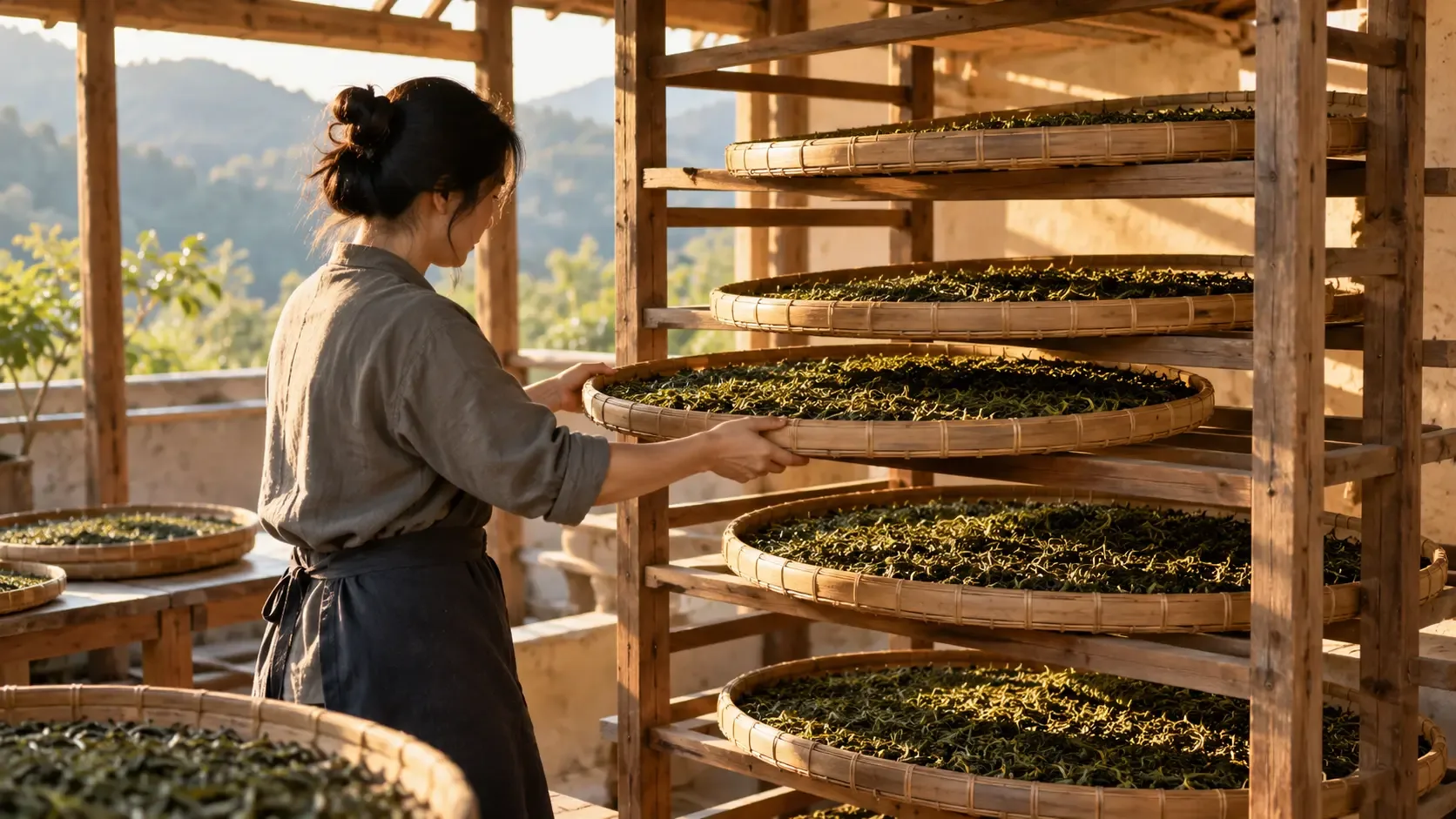
Drying is more than “making the leaf dry”
Lower moisture supports stability
Fresh and partly processed leaves contain enough water for physical movement, enzyme activity and many chemical reactions. Drying removes a large share of that water so the made tea changes more slowly under suitable storage. It does not make tea sterile, permanently unchanging or immune to humidity after packing.
Heat continues sensory work
Thermal drying can transform polyphenols, lipids, amino acids and carbohydrates as water leaves. A scholarly review describes thermal degradation, lipid oxidation and Maillard chemistry as contributors to colour, taste and aroma during tea drying. The useful conclusion is that drying conditions matter—not that every desirable aroma comes from the same reaction or temperature. Read the thermochemical review.
Drying differs from fixation and withering
Fixation redirects an earlier pathway
Fixation uses controlled heat earlier in several tea-family pathways to reduce the activity of oxidation-related enzymes. Drying usually comes later, after shaping or other transformation, and aims to bring the made leaf toward a more stable condition. Both may use heat, but timing, leaf moisture and purpose differ.
Withering keeps the leaf workable
Withering is controlled water loss that softens fresh leaf and enables later work; it does not normally seek the stable condition of finished tea. Rolling then rearranges and disrupts tissues to a chosen degree. Drying acts on this already transformed material.
Heat, airflow and leaf loading form one system
Water must move from inside to outside
Heat can supply energy for water to move and evaporate, while airflow carries humid air away from the leaf surface. Leaf thickness, density, size and the depth of a tray or machine load influence how evenly that movement occurs. The same air temperature can therefore act differently on a thin open layer and a dense uneven mass.
Fast, hot or dry are not complete instructions
Excessive surface drying may leave water distributed unevenly; prolonged or intense heating can flatten fresh notes or generate stronger cooked ones. Too little drying can leave a tea vulnerable during storage. These are process risks, not universal diagnoses by touch alone: a maker needs a defined product, equipment, measurements and sensory targets.
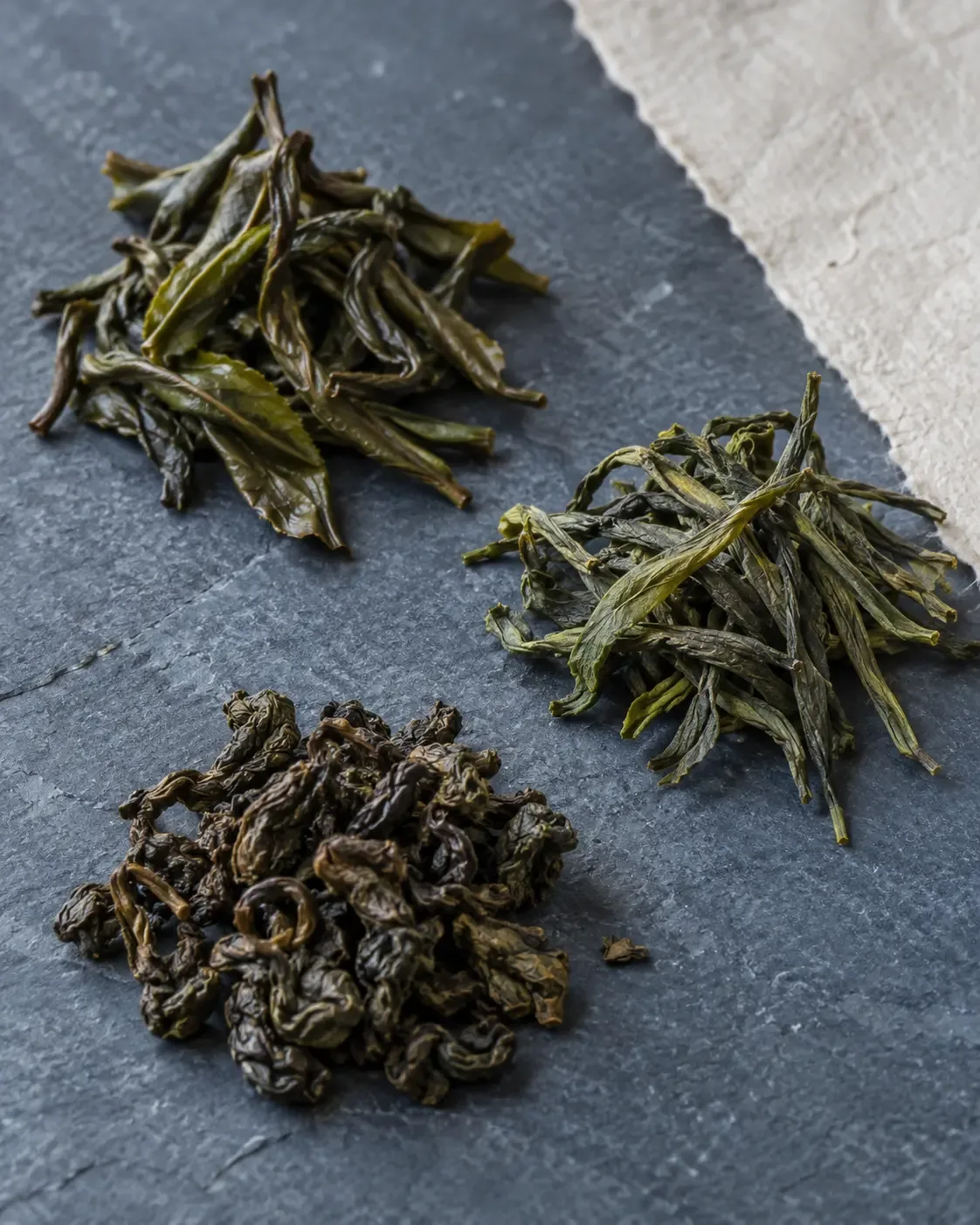
Process position changes across tea families
All six basic flows end with drying
China’s production-licensing rules place drying at the end of the basic flows for green, black, oolong, yellow, white and dark tea, after different preceding operations. This common endpoint does not erase the differences among the six Chinese tea families. It shows why drying must be read as part of a sequence, not as a self-contained recipe. Consult the official process flows.
The incoming leaf is never the same
Green leaf reaches drying after fixation and rolling; black leaf after withering, rolling and enzyme-driven oxidation; oolong after withering, zuoqing, fixation and rolling. Yellow and dark teas undergo additional transformations before drying, while white tea reaches it after withering in the basic flow. Moisture, chemistry and form therefore differ before heat and air are applied.
Green tea: several routes to a stable leaf
Hot air, pan contact and sunlight are not interchangeable
A controlled study of large-leaf green tea compared hot-air, pan-fired and sun drying and found different volatile profiles among the treatments. Its specific samples and conditions do not rank every tea or establish a universal method, but they show that drying helps form aroma rather than merely preserving a pre-existing one. Read the green-tea drying study.
Black tea: drying follows oxidation
Stabilising a transformed leaf
In black tea, drying follows the stage conventionally called “fermentation,” more precisely dominated by enzyme-driven oxidation. Moisture reduction and heat slow that transformation while developing the finished sensory profile. China’s current black-tea processing standard provides the general technical frame without making every regional black tea identical. See the black-tea processing standard.
Different drying methods leave different aroma patterns
A comparative black-tea study examined hot-air, pan-fired and sun drying with sensory and instrumental methods and reported distinct aroma outcomes. Those differences belong to the studied material and equipment; they support careful method selection, not a claim that one named method is always superior. Read the black-tea drying study.
Oolong, yellow, dark and white tea carry other histories
One word, different leaf states
Oolong drying follows partial oxidation, fixation and rolling, and may be followed in some products by later roasting or refiring that should not be confused with the initial drying stage. The current national oolong-processing specification gives a broad framework for the sequence. Yellowing, piling and extended withering create different starting materials in yellow, dark and white tea. See the oolong-processing standard.
Storage begins only after cooling and protection
Dry leaf can take water back
Tea leaving a dryer may still carry residual heat, and immediate sealing can trap heat or redistributed moisture. Once cooled and packed, the leaf remains responsive to humid air, oxygen, light and odours. Drying therefore hands the tea to storage rather than ending its material life; suitable containers and environment still matter. Continue with Chinese Tea Caddies.
A seven-question method for reading drying claims
Connect the dryer to the whole tea
- Which tea family, cultivar, leaf standard and intended style are being discussed?
- What stages occurred before drying, and what is the incoming leaf’s moisture, form and temperature?
- Does heat reach the leaf mainly through moving air, a heated surface, sunlight or a combination?
- How thick and even is the leaf layer, and how are leaves turned or redistributed?
- Are stated time, temperature and moisture values from a standard, a study or one maker’s practice?
- How are endpoint, evenness and sensory development assessed for this particular tea?
- How is the tea cooled, rested, sorted, packed and protected from moisture returning?
These questions turn “drying” from a final verb into a readable system of leaf, heat, air and time. They also separate evidence from inherited shorthand. For source pathways and comparative tasting, continue to Learning Chinese Tea. A stable finished tea is not simply the driest possible leaf, but one whose moisture reduction and sensory development suit the material and the life intended for it.