Withering Tea Leaves: Water Loss, Time and the First Transformation
茶叶萎凋:失水、时间与采后初变
Withering begins after fresh tea shoots leave the field, but it is not a passive wait. Makers manage water loss while the leaf is still responsive, watching how texture, posture, aroma and handling change. The aim is not one universal moisture number. It is to prepare suitable material for the next operation in a particular tea, under particular conditions.
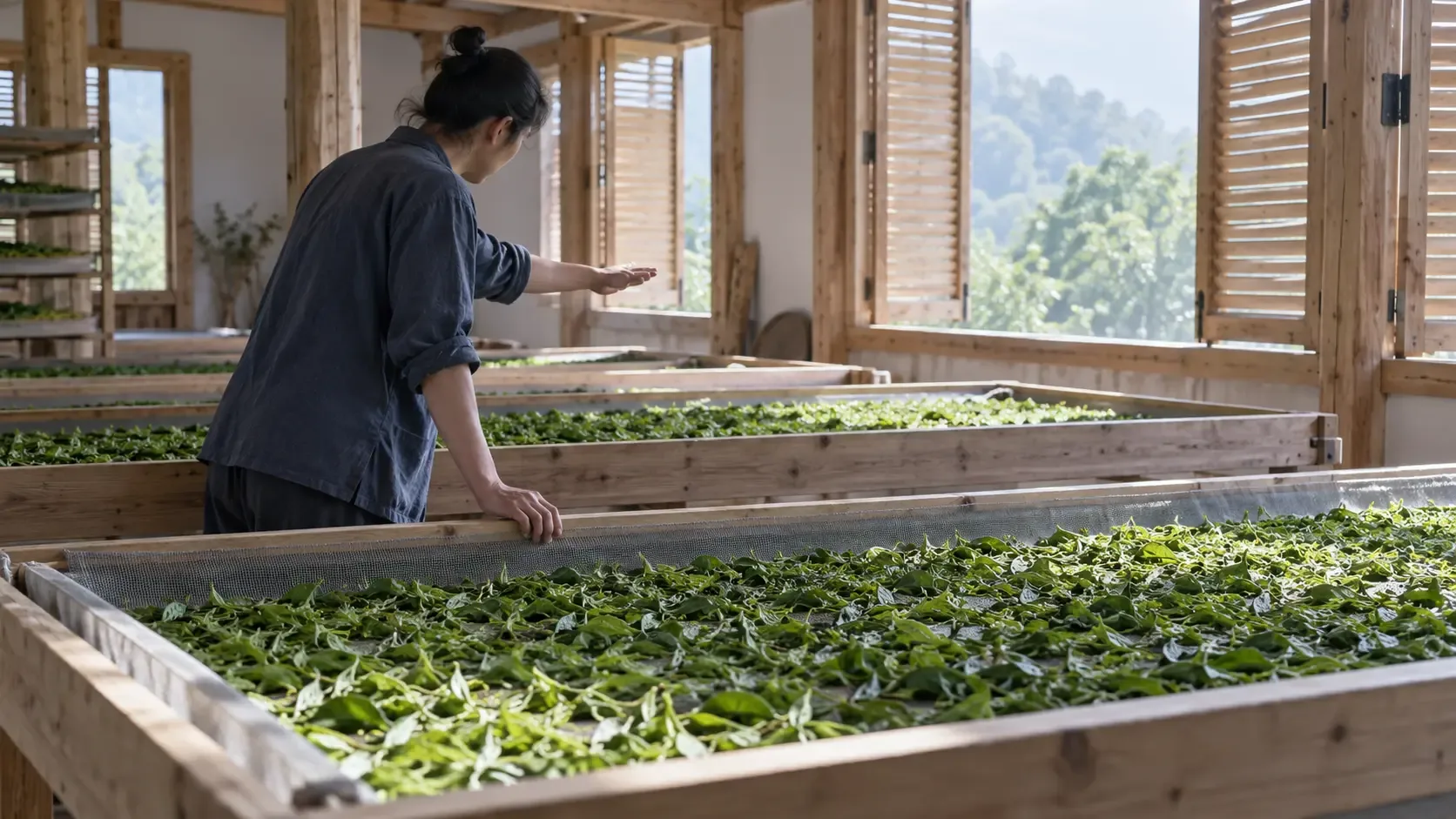
Withering is not simply drying
From harvest to deliberate process
The transition starts with sound fresh material. As Picking Tea in China explains, shoot maturity, damage, heat and transport already shape what reaches the workshop. Withering then turns that perishable leaf into a deliberately managed batch through spreading, ventilation, rest and observation.
A transition, not terminal preservation
Withering lowers water content and changes how the leaf bends, while later drying normally aims to stabilise the finished or nearly finished tea for storage. Confusing the two hides the most important point: a withering leaf remains in transition. It should neither be treated as untouched fresh leaf nor assumed to be shelf-stable.
What water loss changes physically
Pressure, mass and pliability
As water leaves the tissues, internal pressure falls and the shoot usually becomes less rigid. A softer leaf may tolerate rolling or shaping differently from a crisp one. The mass of the batch also falls. These changes are practical, but none is a stand-alone guarantee of flavour or quality.
Visible cues have limits
Posture, surface feel and the behaviour of stems can help a trained maker read a batch, yet the same appearance may arise under different combinations of cultivar, leaf maturity and environment. The comparison below makes one physical tendency visible without turning it into a universal endpoint.
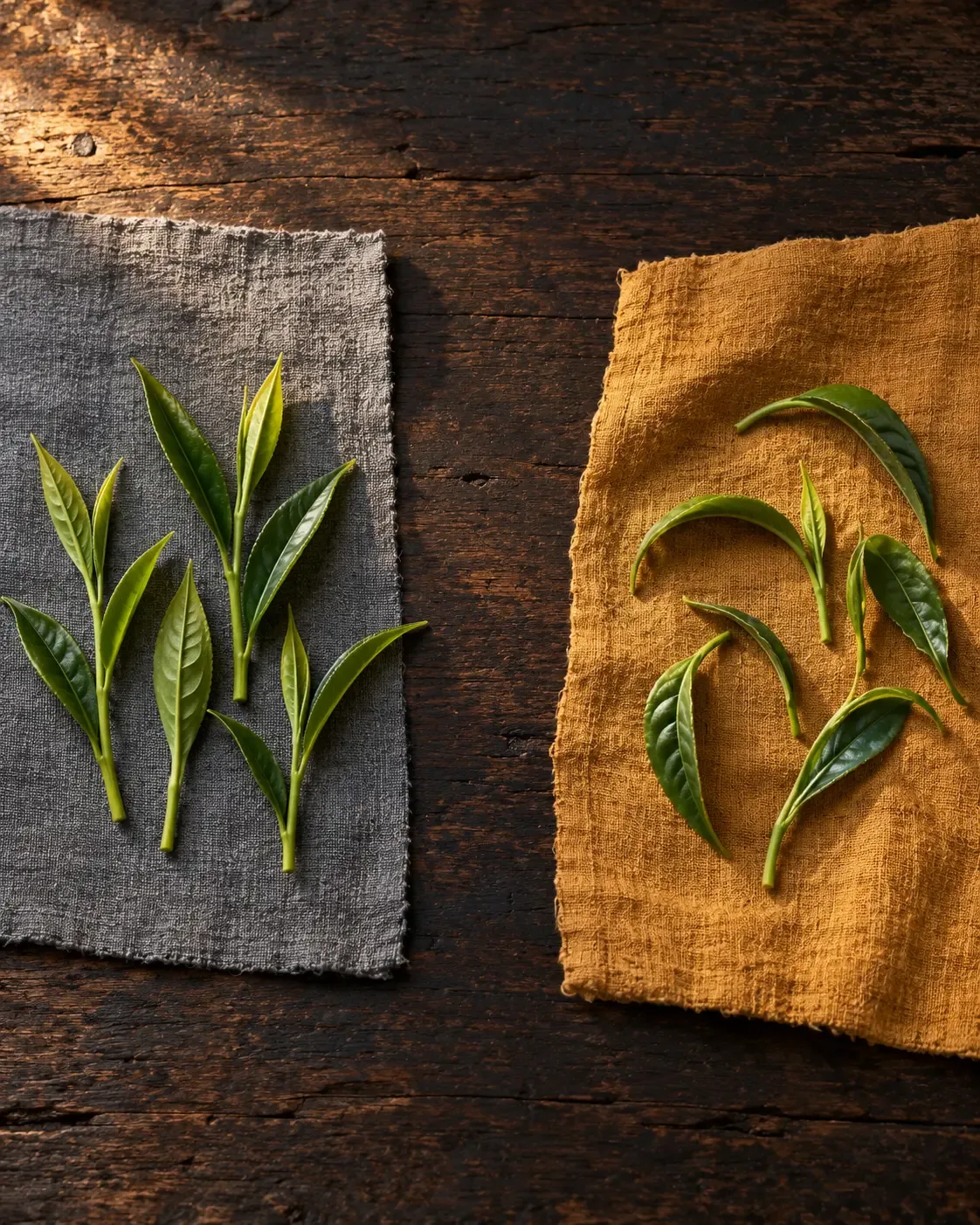
The leaf remains biologically active
Water loss and metabolism overlap
Withering is both physical and biochemical. A peer-reviewed oolong study describes substantial water loss alongside stress responses and shifts in metabolites during solar and indoor withering. Its measurements belong to that experiment, not to every tea, but they show why “just letting leaves dry” is inadequate language. Read the oolong study.
Aroma change is not a simple timer
Enzymes, membranes and volatile precursors can change while water is leaving, and later steps continue that story. A review of black-tea manufacture distinguishes physical water loss from the accompanying chemical transformations, while also showing how strongly results depend on process conditions. Withering time alone cannot predict a finished cup. Read the black-tea review.
Not every tea follows the same path
Process families differ
China’s current production-licensing rules list withering in the basic flows for black, oolong and white tea, but not in the corresponding basic flows for green, yellow or dark tea. The document is a regulatory process map, not a complete account of every local technique, yet it guards against the claim that all tea is withered in the same way. Consult the official process flows.
One word covers different jobs
Within the six Chinese tea families, the same term can occupy different places and carry different weight. White tea centres its manufacture on withering and drying; black tea prepares leaf for rolling and oxidation; oolong places withering before the distinctive sequence of bruising and further transformations.
Environment works as an interacting system
Air, temperature, humidity, light and leaf depth
Airflow carries moisture away; relative humidity affects the gradient that drives loss; temperature changes the pace of physical and biochemical reactions; light can add heat and stress; and the depth of a spread changes how evenly the leaves exchange air. Altering one factor changes the meaning of the others.
Control is not a universal recipe
A fixed duration or tray depth copied from another tea may be misleading. Weather, equipment, cultivar, shoot maturity and the next step all matter. Skilled control means comparing observations across the whole batch, turning or redistributing only when appropriate, and preventing stagnant heat, uneven loss or damage—not chasing a picturesque clock.
White tea: withering as the central stage
Long attention with minimal intervention
In the Chinese national standard for white-tea processing, the stated scope frames manufacture through withering and drying. That economy of named stages does not make the work simple: the character of the leaf is built through how moisture is lost before final drying. The standard is evidence for this production framework, not a single household recipe. See the white-tea standard record.
Black tea: preparing for rolling and oxidation
Softening before stronger transformation
The basic black-tea sequence places withering before rolling, oxidation—often called “fermentation” in tea manufacture—and drying. Softer leaf can be worked during rolling, but the desired degree depends on the product and method. GB/T 35810-2018 is a current general standard for black-tea processing; it should be read with product-specific rules rather than as one target for every factory. See the black-tea standard record.
Oolong tea: withering before making green
Sun, shade and indoor air are choices
Oolong production may combine outdoor or solar exposure with indoor withering before zuoqing, the repeated handling often translated as “making green.” The sequence is designed for partial oxidation and aroma development, but methods vary by region and tea. GB/T 35863-2018 provides a general oolong-processing reference without erasing those differences. See the oolong standard record.
A seven-question workshop method
How to read a withering claim
- Which tea family, region, cultivar and leaf standard are being discussed?
- What condition did the fresh leaf have when it entered the workshop?
- Is the method solar, shaded, indoor or mechanically ventilated, and why?
- How do airflow, temperature, humidity, light and leaf depth interact?
- Which observations are used, and are they local cues or measured specifications?
- What operation follows—drying, rolling, bruising, fixation or something else?
- Is the stated duration or endpoint a formal standard, a study condition or one maker’s practice?
These questions reconnect workshop craft to tea landscapes, tea history, the Way of Tea and paths for further reading and practice. Withering is best understood as controlled change: water leaves, the living leaf responds, and the maker judges when this particular material is ready for its particular next step.