Compressed Tea in China: Cakes, Bricks and How to Read Them
中国紧压茶:茶饼、茶砖与辨读方法
Compressed tea turns processed leaves into a portable object: a cake, brick, bowl-like nest or another pressed form. The shape is easy to notice, but it does not by itself identify the tea family, date, place, maker or quality. This guide shows how to separate those questions, read a pressed tea carefully and prepare it without turning trade history or ageing into a sales myth.
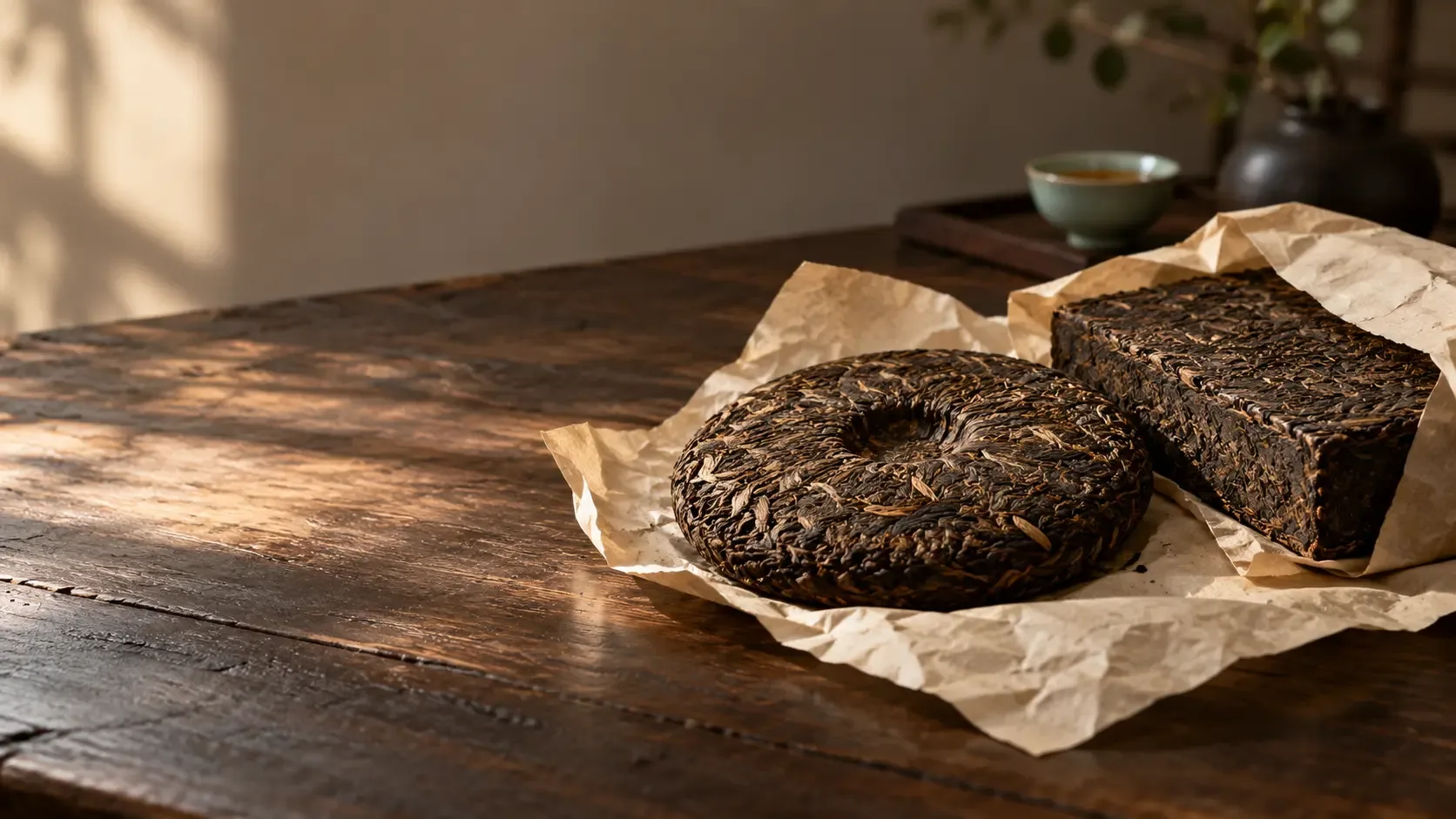
Compression is a form, not a tea family
What the press changes
Producers soften prepared tea, place it in a mould and apply pressure. Compression changes density, handling and the way air and moisture move through a mass of leaves; it does not create one universal flavour. A pressed object may be made from different materials and processes, so begin with the six tea families and their processing, then ask what pressing added.
What a shape cannot prove
A round cake is often associated today with pu’er, while rectangular bricks and bowl-like forms appear in several regional traditions. Association is not identification. Shape can be copied, reused or chosen for packaging, and colour alone cannot reliably separate age, storage history or production method.
A long history with several discontinuities
Tang and Song cakes belong to their own preparation worlds
Historian James A. Benn’s study of tea in China treats tea as a commodity whose preparation, ritual and social meanings changed over time. Early cakes described in medieval sources should not be treated as unchanged ancestors of every modern compressed tea. Tang boiling, Song tribute production and whisked tea each answered different tastes and institutions; the separate guide to Song whisked tea follows one of those historical settings.
Modern compression is not one survival
Pressed tea continued, disappeared or was remade differently across regions and markets. A nineteenth-century trade brick, a modern dark-tea brick and a contemporary pu’er cake may all be compressed, yet their raw material, manufacture, circulation and preparation can differ. It is safer to describe a dated object than to claim one uninterrupted tradition.
Why pressing mattered to movement and exchange
Density, division and transport
A compact form can be stacked, wrapped and moved more readily than an equivalent volume of loose leaf. The Smithsonian’s pressed-tea blocks have designs on both faces and deep grooves dividing one back into sixteen sections. Those visible features support questions about handling and division, but they do not by themselves prove who used the blocks or how they were valued.
Trade routes were social routes
Tea moved between producers, merchants and communities with different brewing habits. The Smithsonian records multiple Chinese nineteenth-century tea bricks, reminding us that museum collections preserve particular trade objects rather than a single timeless type. Compression helped movement; people, languages, taxes, tastes and local additions gave the object meaning.
Read the object in layers
Silhouette, mould and edge
Record diameter or length, thickness, curvature, central depression, corners and mould relief before breaking anything. Then inspect the edge: whole leaves, stems, fragments and powder may be distributed differently inside and outside. Density and breakage can reflect pressing and handling, but they are not a quality score on their own.
Wrapper, stamp and surface
Packaging may name a product, factory, standard, weight or date, but a wrapper is evidence to verify, not an automatic certificate of age or origin. Compare front, back and edge; note repeated motifs, grooves, abrasion, stains and later labels. The tea-caddy guide offers a parallel lesson: container, contents and provenance are related but never interchangeable.
Leaf material and manufacture
Look before assigning a famous name
Visible buds, broad leaves, stems and cut particles can help describe a blend, but surface leaves may not represent the centre. Aroma can reveal smoke, flowers, earth, storage odours or unwanted dampness; it cannot establish a precise year. If provenance matters, retain the wrapper, purchase record and photographs together.
Processing knowledge is living and regional
UNESCO’s 2022 inscription of traditional tea-processing techniques and associated social practices in China covers skills from cultivation and leaf picking through processing, drinking and sharing. It also stresses natural conditions and local customs. Compression should therefore be read within a named production tradition, not as a detached trick applied identically everywhere.
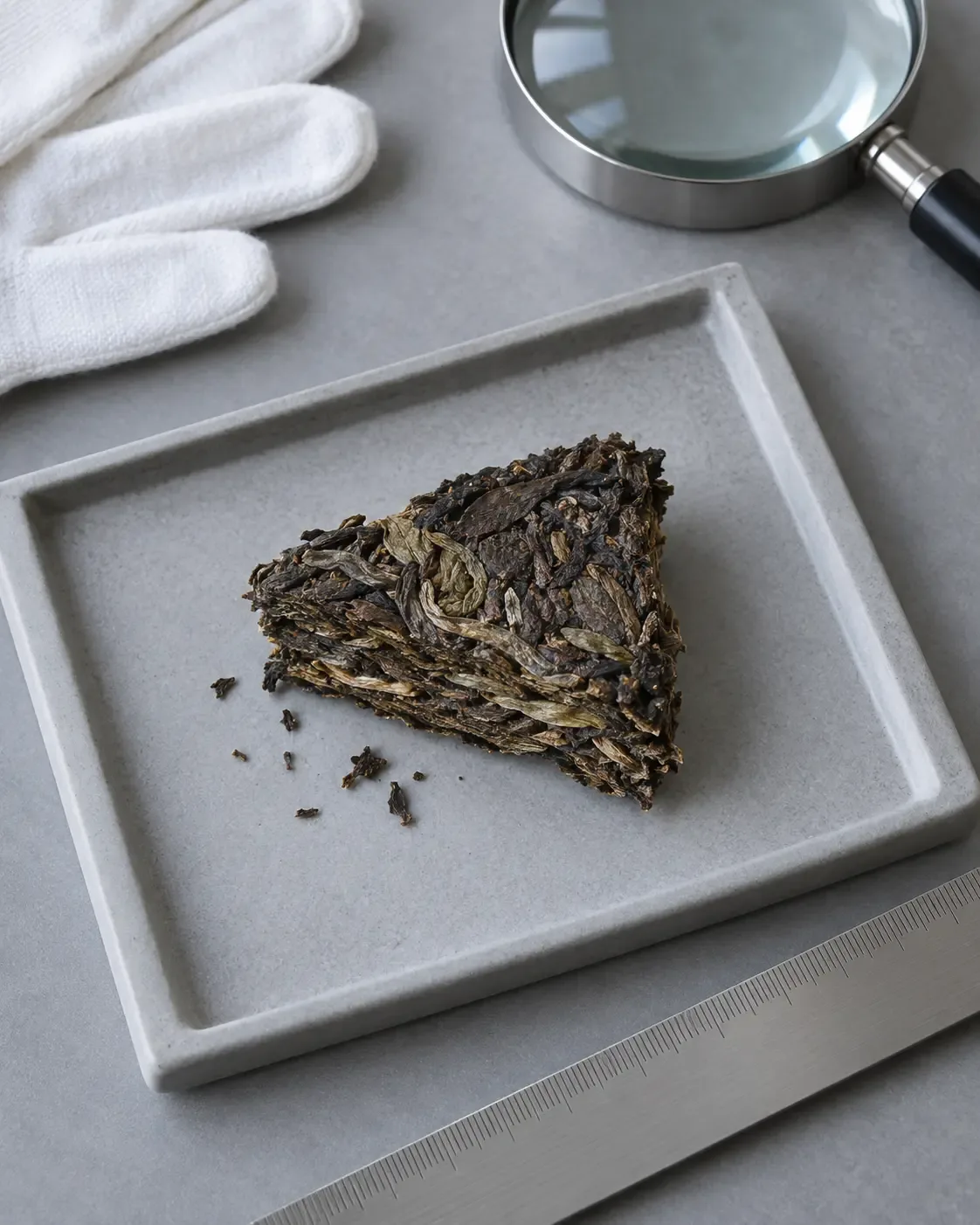
Open and brew with restraint
Protect hands and preserve evidence
Support the tea on a stable, clean surface and work gradually from an existing edge or loosened layer. Keep the point of any tool directed away from the supporting hand. Do not force a dense brick while holding it in the air. For an old, rare or collection object, do not sample it at all without the owner or conservator’s approval.
Let the tea, not the shape, set the method
Use a small measured portion, smell it dry, rinse only when appropriate to that tea, and adjust water temperature, time and leaf quantity after tasting. A brick does not require one universal recipe. The guides to water and a flexible gongfu method explain how to compare infusions instead of obeying a fixed performance.
Storage, quality and health boundaries
Ageing is not the same as neglect
Keep tea away from direct sun, uncontrolled damp, pests and strong odours. Some products are intended to change during storage, but neither age nor a dark surface guarantees improvement. Hami’s 2023 government brick-tea consumer guidance advises cool, ventilated, dry, odour-free storage and checking packaging, surface and smell.
Do not romanticize mould or make medical promises
Unwanted mustiness, visible fuzzy growth, sour or rotten odours and moisture damage are reasons to stop and seek qualified food-safety advice or discard the tea. Natural post-fermentation is controlled production, not permission to consume spoiled food. This cultural guide does not diagnose safety, authenticate a vintage or promise health effects.
A six-pass method for reading compressed tea
- Identify the record: photograph the whole object, wrapper and any labels before opening.
- Describe the form: note shape, size, thickness, grooves, mould marks and breakage without naming a tea family yet.
- Inspect the material: compare surface, edge and centre for leaves, stems, particles and density.
- Separate claims: distinguish what the object shows from what a seller, wrapper, catalogue or oral history says.
- Check storage: record odour, staining, pests, damp and packaging damage before brewing.
- Taste comparatively: change one variable at a time and write down water, dose, time and each infusion.
Return to the Chinese Tea Culture gateway to place compressed tea beside history, processing, ware, water and hospitality. The aim is not to rank cakes and bricks by prestige, but to understand how leaf, pressure, movement, packaging, storage and use meet in one object.