Sorting and Grading Tea: Leaf Size, Shape and What a Grade Really Means
茶叶筛分与分级:叶片大小、形态与等级的真正含义
Finished tea can look remarkably uniform: long twisted leaves, tight pearls, flat blades or small dark particles. That order is not always present when primary manufacture ends. Sorting separates material by physical properties; grading places it within a named product system. The two operations overlap in practice, but neither creates a universal ladder on which every tea can be ranked.
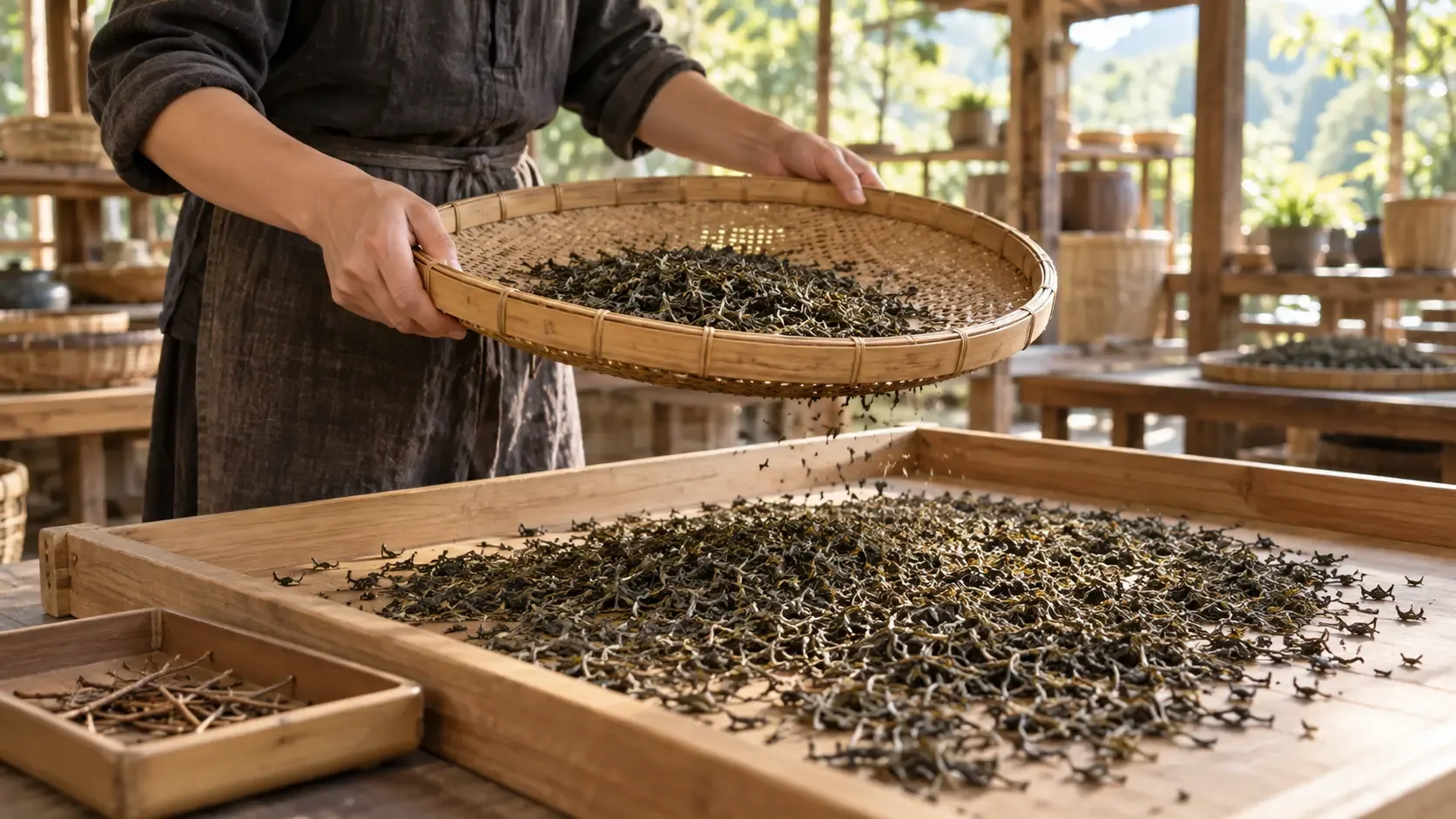
Sorting and grading are not the same thing
From rough tea to finished tea
Chinese production language often distinguishes maocha (毛茶), tea after its primary making stages, from jingzhi cha (精制茶), refined or finished tea. “Rough tea” here names a production stage, not careless work or poor quality. China’s production-licensing rules describe refined processing as operations such as screening, air separation, stem removal and drying that turn rough tea into finished tea. They also require relevant product standards to control items such as powder, broken leaf, stems and non-tea material. Consult the official production rules.
Separation solves practical problems
A mixed batch may contain pieces that differ in length, thickness, density and shape, as well as loose stems or fine particles. Separating them helps a producer make batches more even, remove material outside a specification and prepare components for a final blend. A grade comes later: it is a declared category whose meaning depends on the named tea, its governing standard and the market or producer using it.
What the refining tools actually do
Screens classify size and shape
Screens with openings of different dimensions let smaller particles pass while retaining larger ones. Repeated screening can create several fractions, but an exact mesh sequence is not a timeless recipe: it depends on the tea’s form and the intended product. A long strip, a rolled pellet and a compressed-tea component behave differently. The machine measures a physical relationship between leaf and opening; it does not taste the cup.
Airflow and picking separate other material
Air separation uses differences in aerodynamic behaviour—affected by mass, shape and surface area—to divide lighter and heavier material. Stem picking may be mechanical, optical or manual. These operations can improve consistency, but a lighter fraction is not automatically inferior, and a stem is not evidence of negligence in every tea. The specification and the desired style decide what belongs.
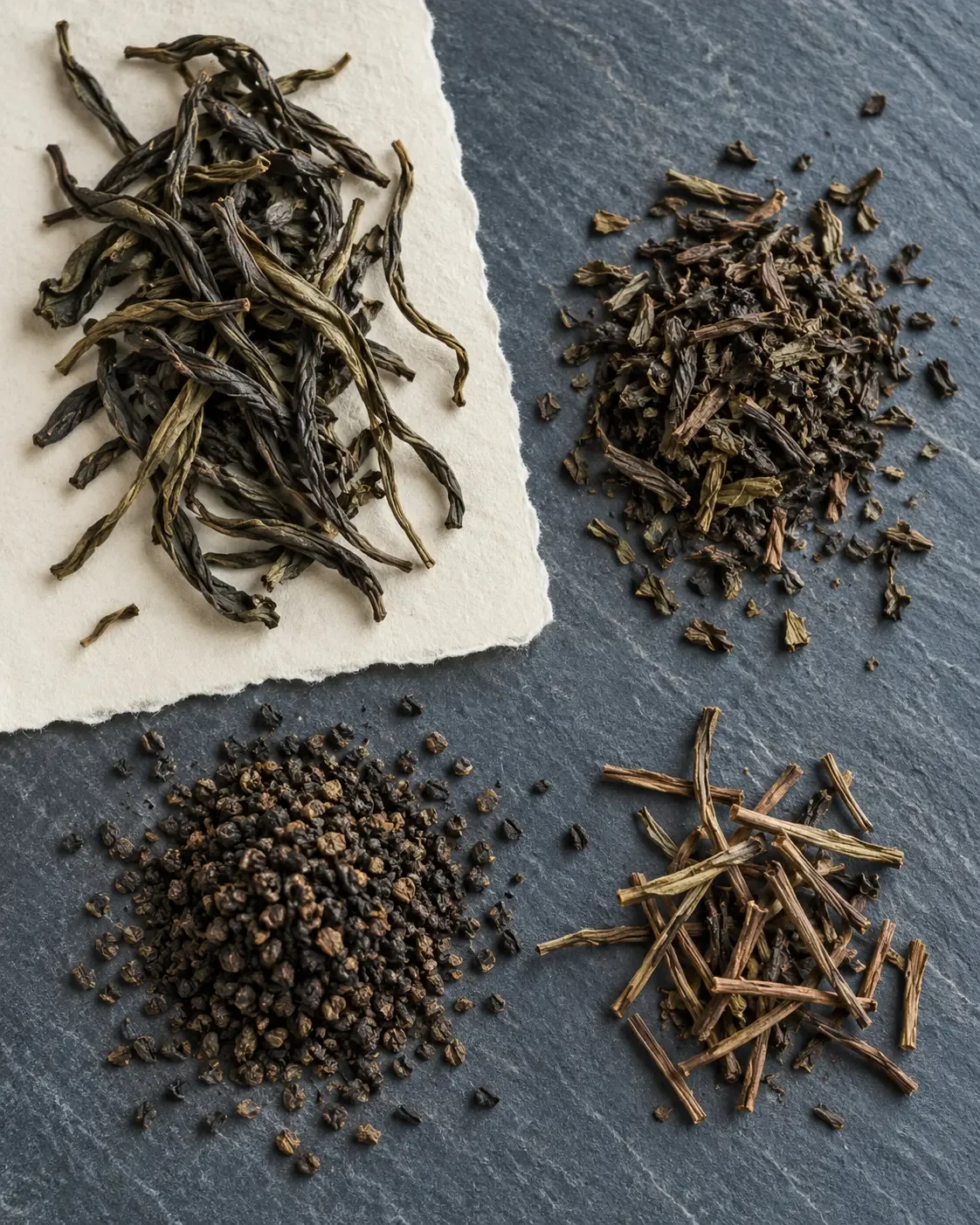
A grade belongs to a product standard
There is no master ladder for all tea
Words such as “special,” “first grade” or “grade one” only become precise when attached to a defined product. The same word can refer to different leaf standards, appearance tolerances or sensory expectations in different specifications. China’s current national methodology for sensory evaluation provides a shared way to assess appearance, liquor colour, aroma, taste and infused leaf, but it does not collapse every tea into one score. See GB/T 23776-2018.
Longjing and broken black tea use different frames
West Lake Longjing is governed by a product specification concerned with that protected tea, while broken black tea has its own national standard and physical vocabulary. Both may use grades, yet the categories answer different questions. A grade within West Lake Longjing cannot be translated into an equivalent rank for broken black tea. See the current West Lake Longjing standard record and the current broken-black-tea standard record.
Whole leaf, broken leaf, fannings and dust
Useful black-tea trade vocabulary
In much black-tea commerce, sieve fractions are grouped under broad terms such as whole leaf, broken leaf, fannings and dust. Tea Board India material uses this familiar size-based sequence. It is useful when reading black-tea catalogues, but it is not a universal taxonomy for all Chinese tea. A flat green tea, a ball-rolled oolong and a heicha brick need other descriptive frames. See the Tea Board India discussion.
Broken does not mean failed
Broken black tea is an established product category, not merely damaged whole-leaf tea. Smaller fractions may be intentionally produced and selected for a particular liquor strength, colour, brewing speed or packing format. Conversely, visually intact leaves do not guarantee fine plucking, skilful manufacture or a balanced cup. Size is information; quality is a larger judgement.
Appearance and cup must be read together
Dry form is one part of evaluation
Dry-leaf appearance reveals useful things: whether the batch is reasonably even, whether the form matches its type, and whether stems, powder or foreign material exceed expectations. Sensory evaluation continues with aroma, liquor, taste and the infused leaf. Uniformity can support predictable brewing and a clear product identity, but diversity of bud, leaf and stem can also be intentional. A convincing grade therefore joins visual criteria to the cup rather than letting one photograph settle the question.
Particle size changes brewing
Smaller pieces often infuse faster
Breaking a leaf increases exposed surface and shortens diffusion paths. A controlled study of tea-bag infusion found that smaller particles swelled and infused more rapidly under its test conditions. That does not mean “dust is strongest” under every method, nor that rapid extraction is inherently better. It means particle size is one of the variables a brewer must read. Read the infusion study.
Adjust the method; do not declare a winner
A fine fraction may need less time, a lower dose or more room than its packaging suggests; a large twisted leaf may open slowly and reward several infusions. Water temperature, leaf-to-water ratio, vessel, agitation and chemistry also change extraction. Compare teas with methods suited to their form before attributing every difference to grade.
Sorting looks different across tea families
Refining follows the product, not one universal sequence
Some oolongs are stemmed, screened, blended and re-roasted after primary making. Green teas may be classified by shape and tenderness while preserving a deliberately formed leaf. Black teas can be separated into size fractions, and white teas may retain a visibly mixed architecture of buds, leaves and stems according to type. These are product choices inside the broader map of tea families and character, not stages that every tea must share.
Blends and compressed tea add another layer
Separated fractions can be recombined to meet a sensory target, so a finished blend need not equal a single screen output. Material intended for cakes, bricks or tuos may be sorted and blended before pressing; the final shape is not itself a grade. Later drying or re-drying and storage condition also affect stability and aroma.
Seven questions for reading a tea grade
Turn a label into useful evidence
- What exact tea, origin and product standard does the grade name?
- Is the term an official category, a producer’s house grade or a seller’s description?
- Which plucking, appearance, moisture and sensory criteria does it include?
- Does “whole,” “broken,” “fannings” or “dust” describe a black-tea size fraction rather than overall merit?
- Was the tea screened, air-sorted, picked, blended or compressed after primary manufacture?
- Does the dry-leaf image match what appears in the brewed leaf and cup?
- Have price, age, packaging and brewing method been mistaken for grade?
Read the product, then brew the leaf
Connect labels to practice
A useful grade should tell you what specification to read and what comparison is fair. Protect the sorted tea in an appropriate tea caddy, choose suitable water and brewing conditions, and compare adjacent grades within the same product before crossing tea families. For standards, scholarship and careful tasting methods, continue to further reading and practice. Sorting explains how material was organised; grading only becomes meaningful when the product, criteria and cup are named together.