Tea Sensory Evaluation: Appearance, Aroma, Taste and the Limits of a Score
茶叶感官审评:外形、香气、滋味与分数的边界
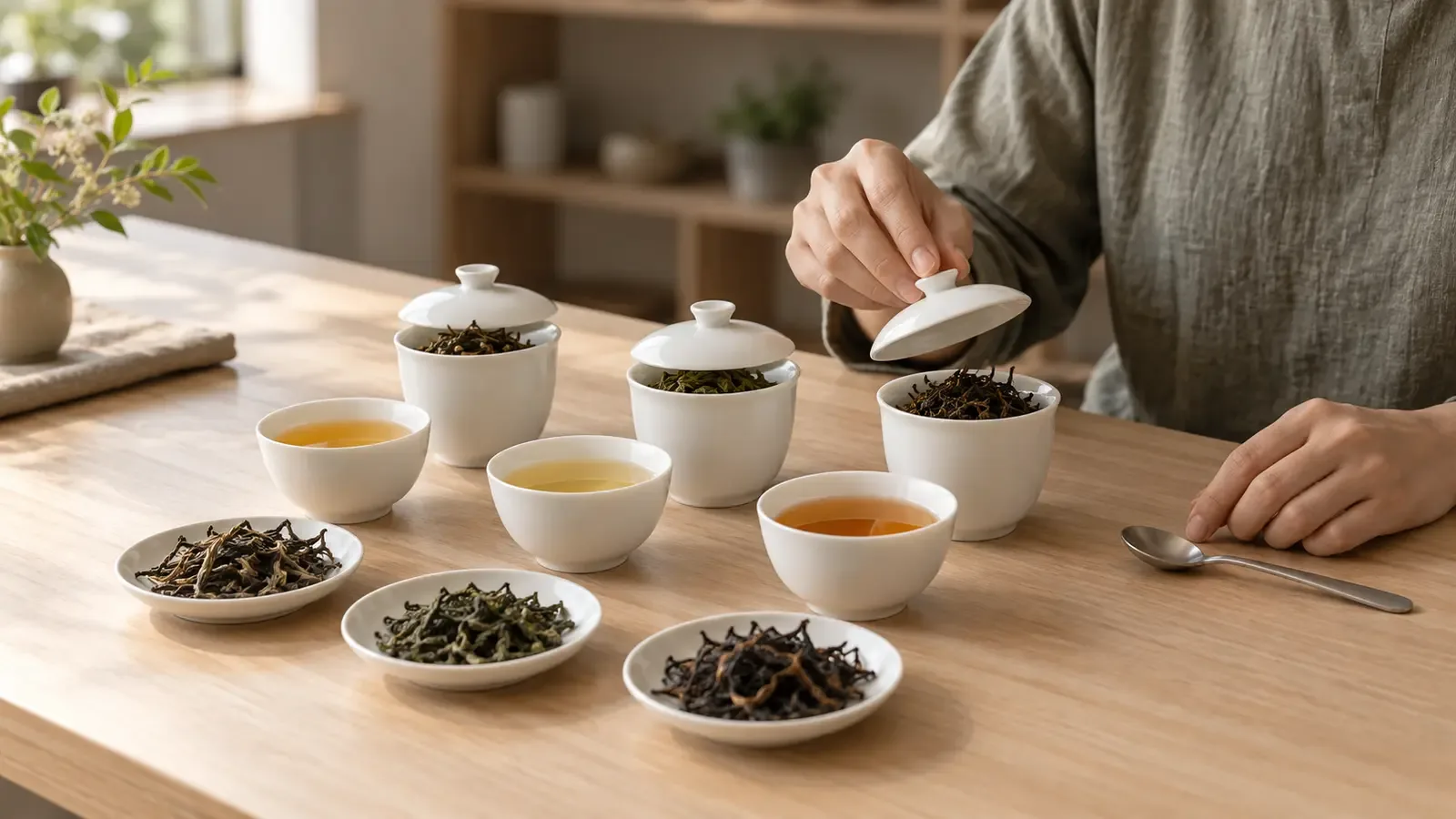
Formal tea evaluation is not a search for the most poetic tasting note. It is a way to compare samples under stated conditions, record what the senses can detect, and separate observation from inference. The taster still uses human sight, smell, taste and touch; discipline comes from controlling preparation, using agreed terms, repeating comparisons and admitting what the cup cannot establish.
1. Evaluation is controlled comparison
Description is not the same as liking
A descriptive evaluation asks which attributes are present and how intense they are. A preference test asks whether people like a sample. Both are legitimate, but they answer different questions. The general guidance in ISO 6658:2017 on sensory analysis distinguishes analytical sensory work from hedonic responses. A trained panel may agree that one tea is more astringent without agreeing that it is better. Begin with our guide to tea types and character to place a sample in its processing family before judging style.
Standardization makes samples comparable
If leaf mass, water, vessel, infusion time or serving temperature changes, the cup changes too. China’s current GB/T 23776-2018 method for sensory evaluation of tea defines conditions, methods and ways to express results. A stated protocol does not abolish subjectivity; it narrows avoidable variation so differences between samples become easier to discuss.
2. Preparing a fair infusion
Start with a representative sample
A handful selected for especially beautiful leaves is not representative of a mixed lot. Before infusion, mix the sample as the applicable method requires and take a test portion without quietly removing broken leaf or stems. Record the sample code, amount, vessel, water source and temperature, infusion time, date and any deviations. Water is part of the result, not an invisible neutral medium; our guide to water for Chinese tea explains why mineral composition and treatment matter.
A fixed protocol is not the ideal daily brew
Professional evaluation may use a single, deliberately demanding infusion to expose differences. ISO’s ISO 3103:2019 preparation of tea liquor for sensory tests is one internationally defined method, not a command that every tea ceremony or product class must use it. Gongfu brewing answers other questions across successive infusions; see utensils and the gongfu method. Fair comparison requires one declared method applied consistently, not a universal “perfect cup.”
3. Appearance before and after water
Read the dry leaf without over-reading it
Observe shape, size, colour distribution, surface, integrity and visible inclusions under consistent light. Uniformity can matter within a defined grade, but a whole-leaf style is not automatically superior to a purposeful broken-leaf product. Sorting terms describe commercial and physical characteristics, not a single ladder of worth; compare them with our guide to tea sorting, leaf size and grade meaning.
Liquor and infused leaf add different evidence
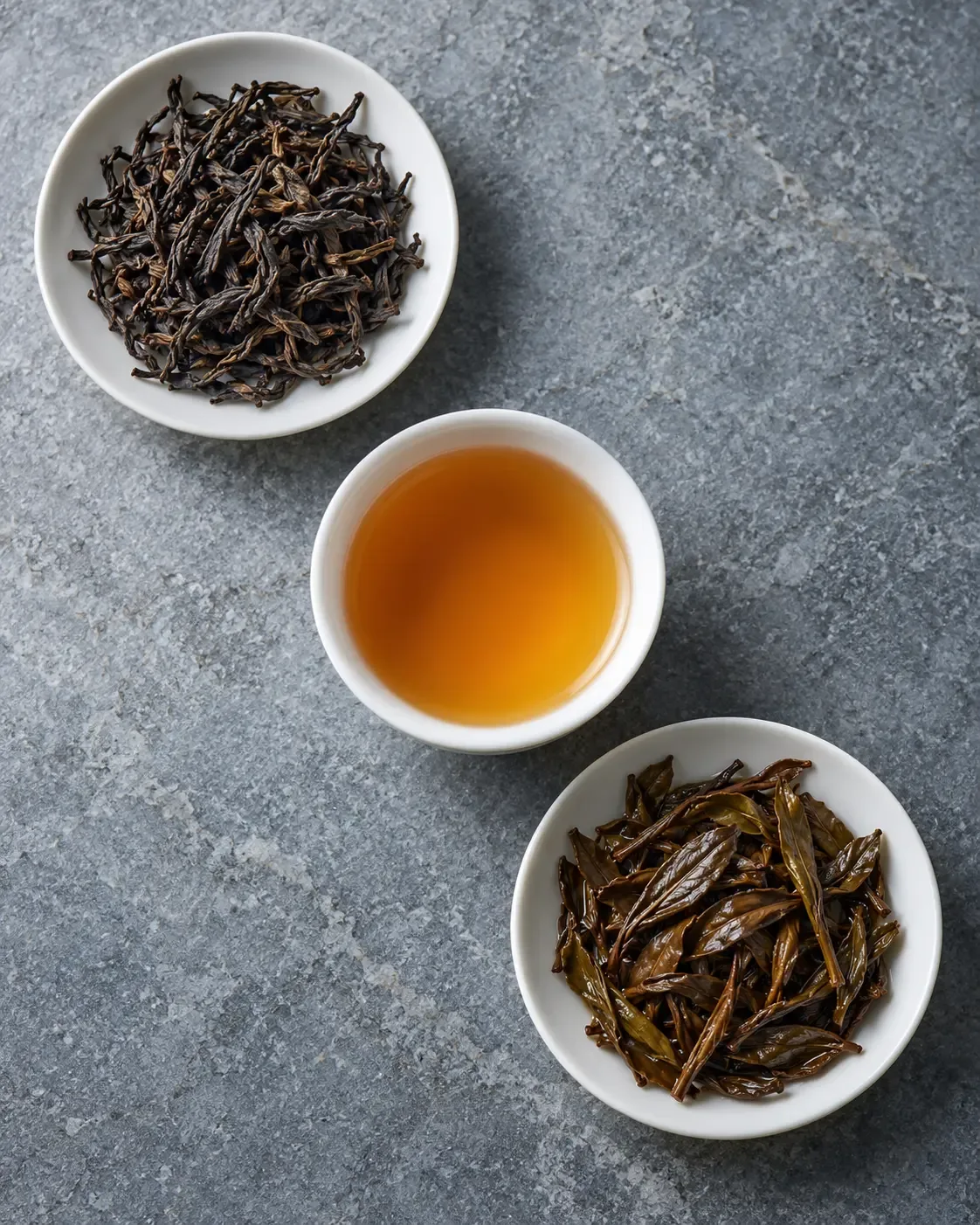
Liquor colour and clarity are judged against the expected product style and the preparation used. The opened leaf can reveal tenderness, evenness, colour and the presence of stems or fragments that were hard to see dry. Cloudiness, redness or dark edges are observations before they are causes. Water, cooling, suspended particles, roasting, oxidation, storage and handling can produce overlapping signs, so appearance alone should not be used to reconstruct a process.
4. Aroma is a sequence, not one sniff
Different moments reveal different volatiles
Dry leaf, the warmed or covered cup, the poured liquor and the infused leaf can present different aromatic information. Assessors work in a consistent order and at useful temperatures because highly volatile notes emerge and disappear quickly, while cooler liquor may make other notes easier to distinguish. Sniffing continuously causes adaptation; brief observations and rest preserve attention.
Separate intensity, character, purity and persistence
“Strong” says little about whether an aroma is floral, toasted, woody, stale or smoky. Record the descriptor and its intensity, then consider cleanliness, integration and persistence under the chosen rubric. Pleasantness is a separate judgment. An intense roast note may be stylistically appropriate, dominant, or unwanted depending on the product; the cup does not supply the category rule by itself.
5. Taste and mouthfeel
Basic tastes do not exhaust flavour
Sweetness, bitterness, acidity, saltiness and umami-like savouriness may be perceived in different balances, while aroma reaching the nose from the mouth contributes much of what people call flavour. Temperature and order matter: a very hot liquor can mask detail, and a forceful sample can carry over into the next. Neutral rinsing, rest and a planned order help, but cannot turn a fatigued palate into an instrument.
Astringency, body and aftertaste need their own words
Astringency is chiefly a drying, puckering or rough tactile sensation, not another name for bitterness. Body can be thin, rounded, viscous or coating; aftertaste describes what persists or develops after swallowing or expectorating. Terms such as 回甘 (huígān) can name a later return of sweetness in Chinese tea discourse, but they should not be treated as proof of a health effect or a particular molecule without further evidence.
6. Vocabulary and flavour wheels
Useful terms need definitions and references
Words become reproducible when panelists share definitions, examples and reference materials. China’s current GB/T 14487-2017 sensory-evaluation terminology for tea provides a national vocabulary framework. A local panel may build a more specific lexicon for a tea family, but it should document what each term means rather than assuming that “orchid,” “mineral” or “fire” is self-explanatory.
A wheel is a map, not a measuring instrument
A flavour wheel groups words so assessors can move from broad families to more precise descriptors. Research on sensory wheels for Taiwanese specialty teas shows how expert panels can develop product-specific lexicons. A wheel does not detect molecules, verify a mountain, authenticate a cultivar or prove age. It improves communication only when its terms and references suit the tea being evaluated.
7. Assessors, panels and scores
Training improves agreement, not superhuman perception
Selection, sensory acuity, vocabulary practice, reference standards and repeated calibration help assessors recognize attributes and use scales consistently. ISO 8586:2023 on the selection and training of sensory assessors provides general guidance. Blind codes, balanced serving orders, replicates and panel discussion can reduce particular biases, but individual sensitivity, culture, experience and temporary condition still matter.
Scores belong to a rubric
A numerical score compresses observations and category rules into one result. Its meaning depends on the form, weights, product class, defects, panel, preparation and purpose. There is no safe assumption that 90 points in one system equals 90 in another. Publish the rubric and protocol with the number. For commercial products, blending can be used to maintain a target style; our guide to tea blending and batch consistency explains why a consistent profile is constructed rather than discovered by a score.
8. A seven-line tasting record
- Sample: use a blind code where possible; record product class and lot only after evaluation.
- Protocol: note leaf mass, water, vessel, temperature, time, serving order and deviations.
- Dry leaf: describe shape, size, colour, integrity, uniformity and visible inclusions.
- Aroma: record where and when it was smelled, its character, intensity, purity and persistence.
- Liquor: describe colour, clarity, tastes, astringency, body, balance and aftertaste.
- Infused leaf: note opening, tenderness, evenness, colour, stems and fragments without inventing causes.
- Comparison and uncertainty: state the reference set, repeats, agreement and claims the tasting cannot support.
9. What tasting can—and cannot—establish
Describe first; explain with independent evidence
Sensory evaluation can compare samples, characterize a style, locate obvious differences and track consistency when its conditions are controlled. It cannot by itself authenticate geographical origin, cultivar, pesticide status, organic certification, chemical concentration, production date or a hidden processing step. Those claims require traceability records, standards, audits or appropriate laboratory methods.
The disciplined sequence is simple: state the protocol, describe what was perceived, compare like with like, and keep inference proportional to evidence. A careful cup report is valuable precisely because it does not pretend to know everything. Continue with further reading and practice to connect sensory notes with production standards, scholarly studies and transparent product records.