Oxidation and Post-Fermentation in Tea: Enzymes, Microbes and Misleading Labels
茶叶氧化与后发酵:酶、微生物与容易混淆的标签
Tea language often compresses several different transformations into one word. Oolong may be sold as “partly fermented,” black tea as “fully fermented,” and dark tea as “post-fermented.” These labels can help people navigate a shelf, but they do not describe one continuous scientific scale. A clearer reading asks who or what is doing the work: enzymes already present in the leaf, microorganisms acting on the material, heat, moisture, time—or several of these in sequence.
1. Two processes hidden behind one word
Oxidation: reactions in damaged leaf tissue
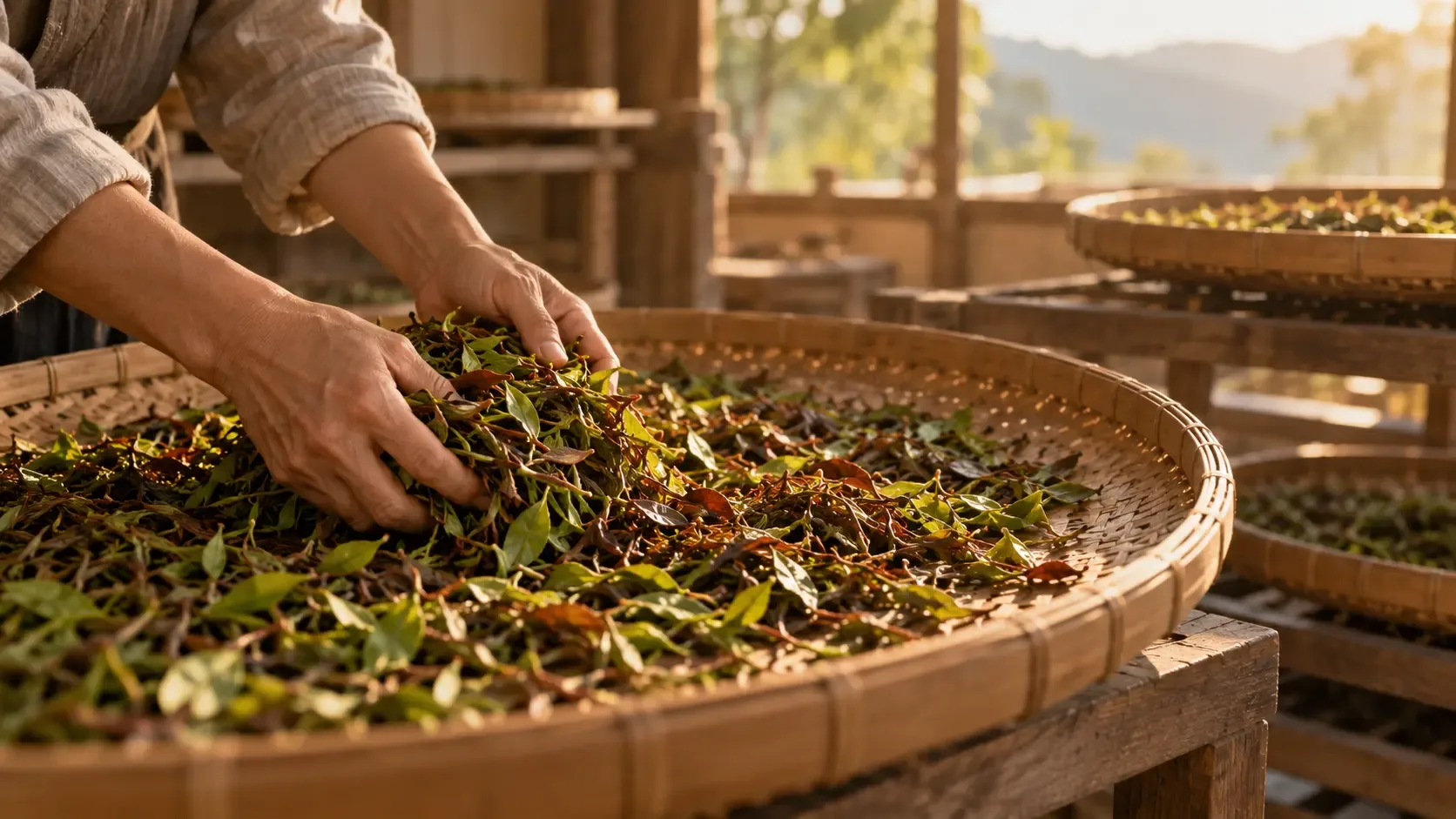
When harvested leaf tissue is withered, bruised or rolled, cellular compartments are disrupted. Oxygen, polyphenols and endogenous enzymes can then meet more readily. The resulting network of reactions changes colour, aroma, astringency and other sensory properties. It is more accurate to call this enzymatic oxidation than microbial fermentation. Our guide to withering explains how water loss and time prepare the leaf for later transformations.
Fermentation: microorganisms are active participants
In food science, fermentation is driven by microorganisms and their enzymes. It does not have to be anaerobic: solid-state tea fermentations can involve oxygen as well as bacteria, fungi or yeasts. This is different from a leaf’s own oxidative enzymes acting after tissue damage. The two processes may overlap in a product, so “oxidized” and “fermented” are not mutually exclusive labels.
2. What changes inside a bruised leaf
Enzymes, oxygen and polyphenols
Tea catechins are not simply “destroyed.” Enzymatic oxidation and subsequent reactions produce a complex mixture that includes theaflavins, thearubigins and other compounds. Their proportions depend on cultivar, leaf condition and processing. A peer-reviewed chemistry review describes the mechanisms of enzymatic catechin oxidation; it also shows why a single colour percentage cannot capture the chemistry.
Rolling changes contact, not just shape
Rolling and bruising alter the physical contact between cellular contents and air. Pressure, duration and leaf condition therefore affect the path of transformation, while later heating and drying slow or stop many reactions. See rolling and cell disruption for the mechanical side of this turning point.
3. Reading the six tea families without a false ladder
Green and yellow tea
Green-tea processing applies fixation early to reduce the activity of endogenous oxidative enzymes. Yellow tea also begins with fixation, then develops its character through its own moist-heaping or yellowing steps. “Unfermented” is conventional shorthand, not a claim that no chemical change occurs. The distinction becomes clearer in our article on fixation and enzyme activity.
White, oolong and black tea
White tea changes during withering and drying even without a separately named oxidation stage. Oolong uses repeated handling to manage uneven, style-dependent oxidation. Black tea permits much more extensive enzymatic oxidation before drying. The six-family overview in types of tea and character is a map of process families, not a numerical ranking.
Dark tea follows another route
Dark tea commonly includes a later stage in which microbial activity contributes to transformation. China’s current GB/T 32719.1 dark-tea standard record identifies a distinct product family. That does not make every dark tea identical or make the word “dark” a synonym for black tea: Chinese heicha and hongcha are separate categories.
4. Post-fermentation is an ecology, not an ingredient
Warmth, moisture, material and time
In piled or other post-fermentation processes, changing moisture, temperature, aeration and substrate conditions select changing microbial communities. A peer-reviewed study of Pu-erh material tracked sensory, chemical and microbial succession during fermentation. Its lesson is not a recipe: community composition and metabolites vary with raw material and process conditions.
There is no universal “tea microbe”
Research detects fungi, bacteria and yeasts in fermented teas, but abundance and function vary by product, stage and method. A review of microorganisms in tea fermentation documents this diversity. It is therefore misleading to attribute every dark tea to one named organism—or to treat visible mold as proof of desirable fermentation.
5. Pu-erh, dark tea and storage are not interchangeable
Product identity comes before a broad process label
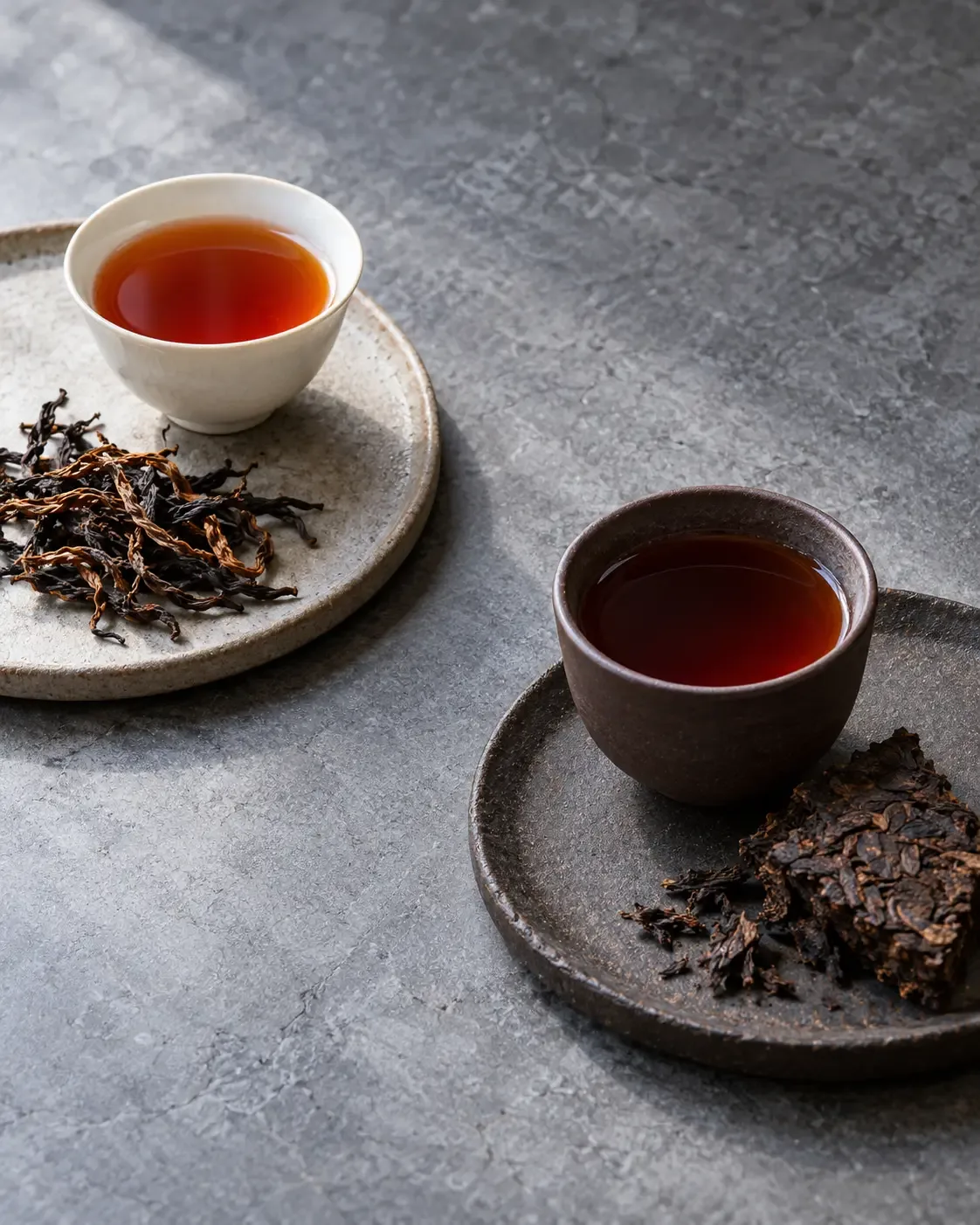
Pu-erh has defined materials, regional identity and processing conventions; dark tea is a broader category containing multiple products. Raw and ripe Pu-erh also follow different processing histories. A compressed shape does not settle the question, because many tea families can be pressed. Our guide to compressed cakes and bricks helps separate form from category.
Storage is not automatically active fermentation
Finished tea continues to interact with oxygen, moisture and temperature, but “aging” does not prove a beneficial microbial process. Storage conditions can also damage tea. Product identity, documented manufacture, clean aroma and safe storage matter more than romantic claims about decades or cellars.
6. Why “partial” and “full” percentages mislead
Trade shorthand is not a laboratory measurement
“Partly fermented” and “fully fermented” describe conventional style families. They are not literal readings of 30, 70 or 100 percent. Different compounds transform at different rates, and the leaf is heterogeneous. Even a black tea called “fully fermented” retains many unoxidized constituents.
Colour and flavour are clues, not meters
Redder liquor, darker leaf or lower greenness may be consistent with extensive oxidation, but roasting, cultivar, storage, particle size and brewing also change appearance and flavour. The market’s convenient spectrum is useful only if it is not mistaken for one measurable reaction.
7. What a careful drinker can observe
Compare leaves, liquor and change across infusions
Observe dry-leaf form, infused-leaf colour, liquor clarity, aroma and how the tea changes across steeps. Record what you see without converting clues into certainty. A dark liquor cannot by itself prove microbial post-fermentation; a green edge cannot quantify oxidation; an earthy aroma cannot authenticate age or origin.
8. Seven questions for a producer or label
- Which named tea category and product standard does this tea follow?
- Which steps involved withering, bruising, rolling, fixation, piling or drying?
- When was heat applied to reduce endogenous enzyme activity?
- Was a managed microbial stage part of manufacture, or is only later storage being described?
- Is “partial” or “full” a style term, or is a real analytical method cited?
- What evidence supports claims about origin, year, storage and process?
- Are safety and storage instructions separated from flavour or wellness marketing?
9. A more precise tea vocabulary
Name the mechanism, then name the tradition
Use “enzymatic oxidation” when the leaf’s own enzymes and oxygen are central; use “microbial post-fermentation” when microorganisms materially shape the product; and use a traditional term such as fajiao when quoting a recognized process name, with an explanation beside it. China’s current GB/T 40633-2021 tea-processing terminology standard and the national tea production licensing process flows provide useful official anchors. Continue with further reading and practice: good vocabulary should make observation more careful, not make every tea fit a single diagram.