Chinese Teahouses: Commerce, Conversation, Performance and Changing Urban Publics
中国茶馆:商业、交往、表演与变动中的城市公共生活
More than a quiet room for tea
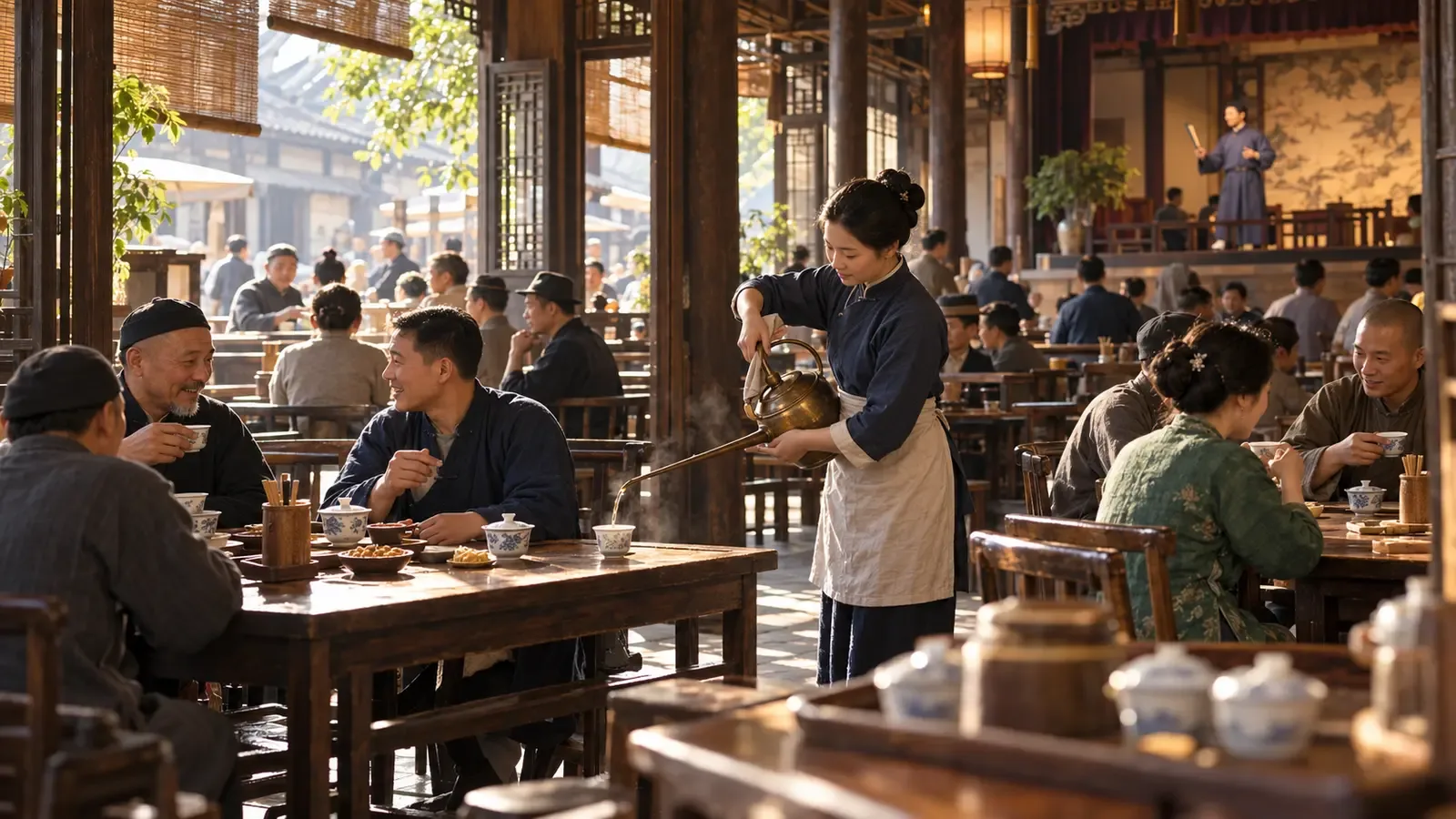
A Chinese teahouse was first of all a business: rent, fuel, water, leaves, cups and labour had to be paid for. Yet many houses also became places to wait, bargain, hear news, meet a client, settle a dispute, watch a performance or simply occupy a seat in company. The familiar modern image of silent, private tasting captures only one possible use of tea. A busy neighbourhood house, a refined upstairs salon, a storytelling venue and a theatre called a chayuan could all organise tea and sociability differently.
Names are clues, not fixed categories
Terms such as 茶馆 (chaguan), 茶楼 (chalou), 茶坊 (chafang) and 茶园 (chayuan) changed with period and place. They may suggest scale, an upper floor, a workshop-like shop or a performance garden, but signage alone cannot prove the clientele or programme. Historians therefore combine business records, newspapers, regulations, memoirs, photographs, fiction and surviving plans rather than translate every term as the same institution.
A small business with a long social reach
Water, seats and time
The product was not just liquor in a cup. Customers paid for prepared water, a seat, service and permission to remain. A modest order could support a long conversation; rapid table turnover might matter less than reputation and habitual customers. Owners balanced fuel and leaf costs with snacks, entertainment, room hire or other services. Read this beside our guides to water for tea and Chinese teaware: material choices were also operating costs.
Workers made the room function
Servers carried kettles through crowded aisles, remembered orders, renewed water and managed informal credit. Their speed, balance, speech and knowledge could define a house as much as décor. Wartime Chengdu evidence also records conflict around women entering this occupation. That history warns against treating “the waiter” as a timeless male folk character: labour, respectability and gender were contested.
Neighbourhood infrastructure
Information, introductions and mediation
In early twentieth-century Chengdu, teahouses could function as places for gossip, news, business contacts, dispute mediation and political discussion. This did not make every table an open democratic forum. Access depended on money, location, reputation, gender, occupation and the tolerance of owners and authorities. “Public” is best understood as a changing practice of gathering, not as an automatic property of the building.
Commerce beyond the tea bill
Artisans, brokers and itinerant practitioners could meet customers there; associations and guilds could use houses for coordination. Such activity linked the teahouse to the wider market networks of tea, while remaining distinct from production, grading and wholesale exchange. A teahouse sold access to a social setting; it was not merely the final stage of a leaf’s journey.
Performance changed the architecture
Storytelling, opera and the attentive crowd
In Chengdu, storytelling and local opera made some houses major leisure venues. In Beijing, commercial theatres were often called teahouses, and the shift toward purpose-built playhouses changed how spectators, actors and stages related. In Jiangnan, storytelling houses supported regional forms such as Suzhou pingtan. These histories should not be collapsed into a single national programme.
Listening was social too
An audience ate, drank, called for service, recognised regulars and displayed status while attending to a performer. Reformers and police sometimes criticised noise, gambling, sexuality or “idle” time; others tried to use popular entertainment for education. The offstage room was therefore part of the performance. Tea did not simply accompany culture—it helped finance and organise its audience.
Who could enter, sit and be seen?
Class was visible but not mechanically separated
Prices, location, furnishings and private rooms could sort customers, yet historical research also finds mixed urban crowds. The same person might use different houses for work, leisure or ceremony. A photograph of bamboo chairs cannot by itself reveal whether credit was extended, which dialects were heard or who was unwelcome.
Gender and respectability changed
Many documented early modern urban houses were male-dominated, but exclusion was neither universal nor unchanging. Women appeared as workers, performers, customers and subjects of regulation under different conditions. Post-Mao Chengdu houses drew broader mixes of age, gender and status. It is safer to ask “who used this house, when?” than to declare the Chinese teahouse eternally male or universally open.
Reform, surveillance and political change
A room could be useful and suspect
Because teahouses concentrated conversation, officials, reformers and police paid attention to them. Newspapers and associations used established sociability, while surveillance and licensing constrained it. Early Republican critics sometimes cast teahouse life as wasteful or disorderly, turning everyday leisure into a debate about modern citizenship.
Socialism did not produce one simple ending
After 1949, private business reorganisation, state control and changing leisure institutions transformed Chengdu teahouses. Later reform brought renewal, but not a return to an untouched past. Wang Di’s long twentieth-century study shows decline, adaptation and new publics rather than a single story of disappearance and revival.
How to read images and literary teahouses
Fiction stages society
Lao She’s famous play Teahouse uses one Beijing establishment to stage sweeping social change. It is indispensable cultural evidence, but not a neutral inventory of every historical teahouse. As with tea poetry, genre shapes what can be shown.
Photographs freeze a managed instant
Images help with chairs, tables, kettles, sightlines and density; captions and provenance help identify place and date. Yet the photographer’s position, pose and publication context matter. Use the source-critical habits in our guide to reading tea texts: ask who made the record, for whom and why.
Visiting without turning history into décor
Observe the house’s actual rhythm
In a contemporary teahouse, notice how ordering works, whether water is renewed, how long customers remain, which activities coexist and whether a performance requires a separate ticket. Follow house rules, ask before photographing people and do not assume that long-spout pouring or antique-looking furniture proves an unbroken lineage.
Seven questions for a teahouse claim
- Which city, district and period does the claim describe?
- What term did the source use for the venue?
- Was tea the main income, or one service among several?
- Who worked there, and under what conditions?
- Who could enter, sit, perform or conduct business?
- Is the evidence a regulation, account, photograph, memoir, play or later reconstruction?
- Does a modern venue disclose what is restored, recreated or newly invented?
Related reading and sources
Continue with the history of Chinese tea culture, attention and hospitality, the six tea families and a flexible gongfu method. For the historical argument, see Qin Shao’s study of early Republican criticism, Di Wang’s Chengdu research and post-1949 history, Wang Di’s article on entertainment and popular education, Joshua Goldstein’s study of teahouse theatres, and the Sichuan University journal’s research on workers and gender conflict.