Tea in Chinese Buddhist Monastic Rules: Ceremony, Office and the Limits of Origin Stories
中国佛教清规中的茶:礼仪、职事与起源故事的边界
A monastic rule is an institutional source, not a timeless origin story
Rules show what compilers wanted a community to do
Chinese Buddhist “pure regulations,” or qinggui 清规, describe offices, invitations, seating, signals, meals, work, ceremonies and conduct in public monasteries. They are unusually rich evidence for organized life, but a prescription is not a census of everything that happened. A rule may respond to disagreement, preserve an ideal or regularize a local custom. Read it beside our guide to Chinese tea texts: identify work, date, compiler, genre and immediate problem before treating one line as “the Buddhist way of tea.”
“Monastic,” “Buddhist” and “Chan” are not interchangeable labels
The surviving codes examined here were written for particular Chinese Buddhist institutions and changed across the Song and Yuan-Ming transition. They do not describe every temple, every period or every Buddhist community. Nor may their procedures be transferred to Daoist monasteries at Wudang. For that different institutional history, use our pages on Quanzhen monastic life and Quanzhen and Zhengyi clergy.
The 1103 Chanyuan qinggui gives tea an institutional address
A dated compilation is stronger evidence than a founder legend
Changlu Zongze compiled the Chanyuan qinggui 禅苑清规 in 1103. Yifa’s annotated study identifies it as the earliest surviving comprehensive Chan monastic code and shows how it joined inherited Buddhist discipline to the needs of large Chinese public monasteries. That date does not mark the invention of monastic tea. It marks a textual witness: by the early twelfth century, compilers considered tea service important enough to regulate in writing.
The code belongs to a wider history of tea and Buddhism
James A. Benn’s history traces how Buddhist institutions, clergy and lay networks helped shape Chinese attitudes toward tea over many centuries. Monasteries were not sealed spiritual worlds; they received visitors, exchanged gifts, managed estates, appointed officers and participated in elite and local society. Tea moved through these connections as drink, courtesy and ritual medium. Our history of Chinese tea culture supplies the larger chronology without making one monastery stand for all of China.
Tea service made social order visible
Invitation, notice, seat and attendance formed one procedure
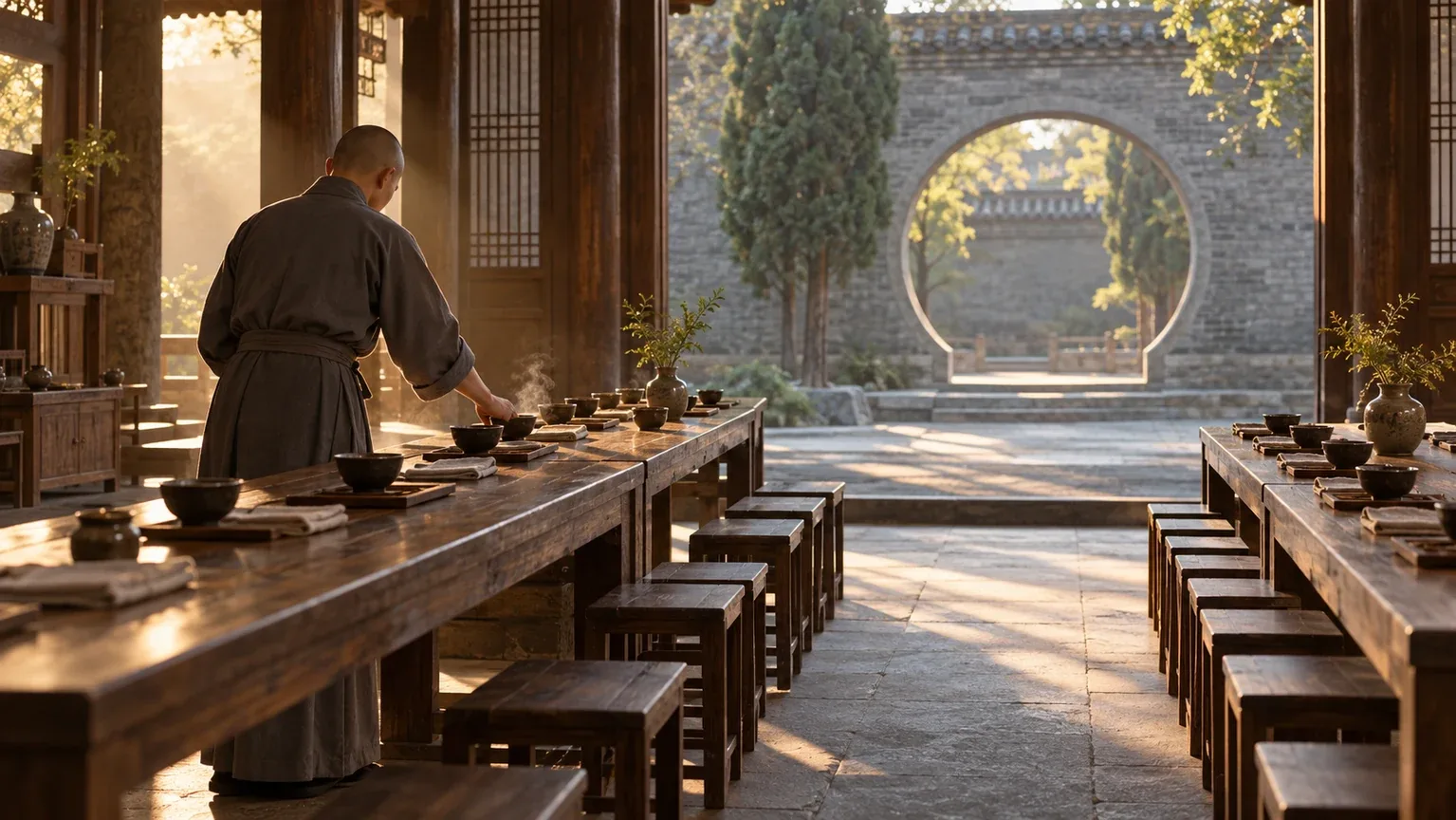
In a code, “having tea” can begin before water is heated. A written notice names the occasion; an invitation establishes host and guest; a seating plan arranges offices and seniority; attendants prepare the hall; a signal gathers the community; bows, incense and the circulation of bowls mark the event. The Chixiu Baizhang qinggui 敕修百丈清规 even warns invitees to check the posted seating notice and remember their place. Tea therefore made an administrative order perceptible through movement.
Protocol did not turn every cup into silent meditation
Later retellings often reduce monastic tea to alertness during meditation or to a private exercise in mindfulness. Those themes can matter, but the regulations preserve something broader: public etiquette, rank, welcome, appointment and collective obligation. Compare our practical way-of-tea guide, which offers modern hospitality without claiming that one contemporary table reproduces a Song monastery.
Tea welcomed guests and marked changes of office
A service could honour an abbot, visitor or new appointee
Tea ceremonies appear around the arrival of a new abbot, the reception of distinguished monks, the installation of a chief seat and the transfer of administrative duties. The host was not simply offering refreshment. The service acknowledged a relationship and located people within the monastery’s hierarchy. In the later code, a whole series of headings distinguishes tea offered by the abbot, administrators or senior officers. Each title, venue and guest list changes the social meaning of the same beverage.
Hospitality joined monastery and outside world
Officials, patrons, travelling monks and neighbouring communities could enter the documentary frame. A tea service helped receive them while preserving the institution’s own order. That makes monastic tea comparable to, but not identical with, the tea of visits and correspondence explored in Chinese letters and the roadside welcome described in travel writing. The comparison works only when host, guest, place and source type remain explicit.
Tea and “medicinal soup” were paired but not identical
Cha and tang shared ceremonial grammar
The codes frequently pair tea with tang 汤, a hot preparation that scholarship often renders “medicinal soup.” Invitations, seating, attendance and gestures could follow parallel forms. The pairing shows that historians should not isolate tea from a wider service culture of prepared drinks. It also warns against assuming that every occurrence of tang was tea, or that a similar protocol made the substances interchangeable.
A historical label is not modern medical advice
“Medicinal” describes the historical category used in scholarship, not a verified treatment. The source does not authorize a modern dose, diagnosis or health promise, and tea’s presence in a religious code does not make it a spiritual medicine. For the same boundary in another genre, see tea in Chinese materia medica. Cultural history can explain a ceremony without prescribing its contents.
Every service depended on labour, supplies and signals
The bowl in the hall conceals a chain of work
A formal service required fuel, water, tea, vessels, cleaning, storage, written notices, room preparation and people assigned to carry them out. Regulations name offices and attendants because ceremony is logistical as well as symbolic. The page rarely records the fatigue, cost or individual skill of every worker, so a historian should not mistake an elegant sequence of gestures for labour without friction. Our articles on water for tea and Chinese tea ware help reconstruct the material questions while leaving undocumented details open.
Drums, boards and posted notices coordinated time
The later Baizhang regulations list different drums for Dharma assembly, tea, meals, communal labour, bathing and night watch. A “tea drum” belongs to a sound system that organized bodies and tasks. A signal did not merely create atmosphere; it told a defined community what was about to happen. This is why tea belongs beside institutional timekeeping, not only beside taste. For comparison, Daoist bells, drums and chant must be read within their own ritual system.
Later codes edited the tradition rather than simply copying it
The Chixiu Baizhang qinggui is a later witness with new purposes
The imperially revised Chixiu Baizhang qinggui, compiled in the fourteenth century, organizes tea occasions in an elaborate institutional sequence: reception of a new abbot, changes among officers, services for new residents, seasonal observances and routine attendance. Its headings and procedures are evidence for later editorial and political conditions, not a transparent photograph of an eighth-century founding monastery. Place it after the 1103 code, not before it.
Continuity and change must be demonstrated occasion by occasion
Repeated vocabulary can indicate inheritance, but an added office, invitation form or imperial frame can alter what a ceremony does. Compare the two codes at the level of occasion, actor and sequence. A later rule may preserve an older form, expand it or claim antiquity for a new arrangement. The same caution applies to local evidence: our article on tea in Chinese gazetteers explains why repetition is not neutral observation.
Later slogans should not replace the documents
“Tea and Chan are one taste” is an interpretation, not a complete chronology
Modern accounts sometimes use formulas such as “tea and Chan are one taste” to explain the entire relationship at once, or repeat stories that a famous master invented tea to prevent drowsiness. Such sayings can have their own history, but they should not be backdated without a datable source. The monastic codes offer firmer, less romantic evidence: named hosts, ranked guests, posted notices, work, bowls, signals and obligations.
This does not strip tea of religious meaning. It locates meaning in a lived institution rather than in a single miraculous origin. The result is richer: tea could sustain wakefulness, express welcome, honour office, structure a gathering, connect clergy and laity and carry later symbolic interpretations—without every function appearing in every place.
A seven-question method for reading monastic tea
Move from the document to the occasion, people and limits
For every passage, record an answer—or an explicit uncertainty—to seven questions:
- Which code, edition, fascicle and date are you reading?
- Is the line a prescription, a retrospective claim, a title in a contents list or a report of practice?
- What occasion triggers the service: arrival, appointment, season, memorial, instruction or routine?
- Who hosts, who is invited, who serves and who is absent from the text?
- What do notice, seating, signals, vessels and gestures reveal about institutional order?
- Does the passage concern tea, tang, food or a paired sequence, and what material details remain unstated?
- Which later legend or modern generalization are you tempted to add, and can it be supported independently?
For present-day Wudang visitors, the final question is especially important. Use Wudang temple etiquette for respectful conduct, and tea, meditation and Daoist practice for a deliberately modest modern exercise. Neither page claims a Buddhist code as Wudang custom.
Primary texts and further reading
Read the editions, then compare the scholarship
Begin with University of Hawai‘i Press’s description of Yifa’s Origins of Buddhist Monastic Codes in China and the publisher page for James A. Benn’s Tea in China. The Academia Sinica study “Tea and Medicinal Soup Ceremonies as Seen in the Chanyuan qinggui” treats the paired services directly. Consult CBETA’s Chanyuan qinggui, fascicle 7 and its electronic-canon project, then compare the later Chixiu Baizhang qinggui, especially its contents list and “Attending Tea and Soup” section. Benn’s Oxford chapter on Buddhism and tea during the Tang, the Tea in China overview, a scholarly Cambridge review and the Academia Sinica follow-up “Between Self-cultivation and the Monastic Code” provide complementary frames. Treat every translation as an argument tied to an edition.