Tea in Chinese Painting: Objects, Social Worlds and the Limits of Visual Evidence
中国绘画中的茶:器物、社会空间与视觉证据的边界
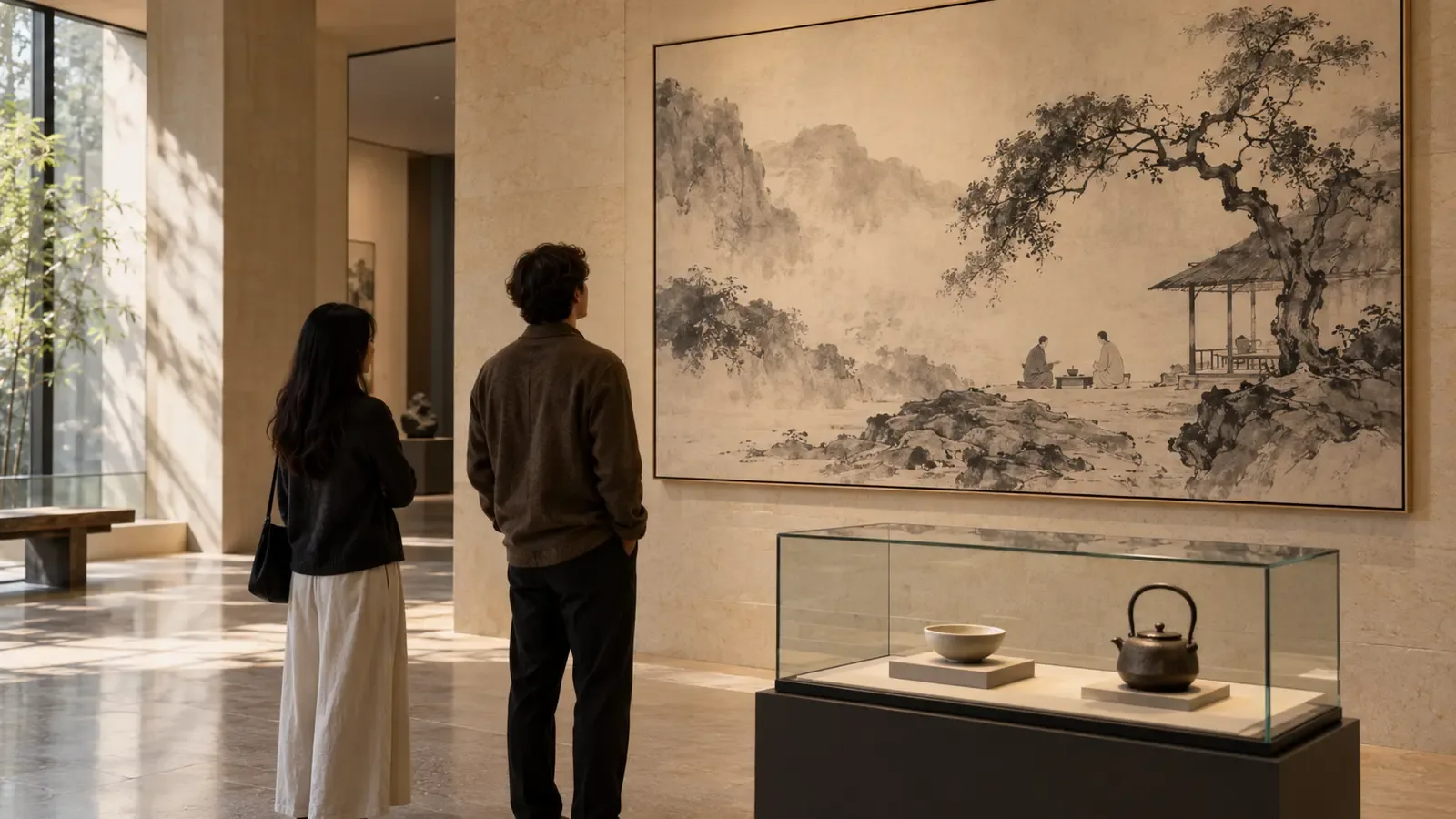
A painted bowl is not the bowl itself
Tea appears in Chinese painting as steam, vessel, gesture, landscape, service and social relationship. A picture may preserve evidence that no recipe records: who sits, who stands, how a kettle is placed, or how a gathering is framed. But painting selects and arranges. It can idealise withdrawal, compress several moments, quote an older style or make a servant nearly invisible. The first task is therefore to distinguish what the image shows from what we infer.
Begin with the whole work
Record artist or attribution, title, date, medium, dimensions, format, inscriptions, seals, collection history and later mounting. A handscroll unfolds through time; an album leaf asks for close viewing; a fan compresses a scene. Object records are stronger evidence than an isolated online crop.
Identify objects cautiously
Look for relationships, not one silhouette
A lidded bowl, ewer, brazier, bamboo basket or low table may suggest tea, but shape alone can mislead. Compare mouth, handle, spout, lid, scale and use. Our guides to Chinese teaware and water for tea help separate vessel function from decorative resemblance.
Absence is not proof of absence
A painter may omit fuel, waste water, storage, payment or washing to clarify the composition. Conversely, a detailed utensil can carry symbolic weight rather than document the most common equipment. A scene cannot establish a universal brewing sequence without support from texts, excavated objects or other images.
Gesture turns equipment into practice
Follow hands, sightlines and sequence
Who holds the kettle? Who waits? Does an attendant work while a seated scholar reads or plays the qin? Gestures can suggest pouring, warming, carrying or offering, but a still image rarely fixes exact order, temperature or quantity. Compare depicted action with the changing methods in our history of Chinese tea culture.
Steam is an artistic device too
Steam can locate heat, activate empty space or evoke fragrance; it is not a thermometer. The National Museum of Asian Art invites close sensory observation of Tea Sipping under Willows, a useful exercise so long as imagined sound or aroma remains clearly distinguished from visible evidence.
Social hierarchy occupies space
Seated figures and standing labour
Paintings of literati leisure often foreground the scholar and relegate water carrying, fuel and preparation to attendants. This does not make labour unimportant; it reveals whose experience the picture privileges. Ask who receives attention, who is named, who works and who has access to the retreat.
Gathering, withdrawal and self-fashioning
Wu Changshuo’s Brewing Tea joins tea, qin and the solitary scholar to celebrate refinement and self-cultivation. Such imagery tells us about literati ideals and the artist’s self-presentation. It cannot by itself describe every household or teahouse. Read it beside our guide to tea in poetry.
Landscape makes tea meaningful
Willows, rocks and pavilions frame taste
A remote pavilion, stream or old tree can associate tea with cultivated retreat, season and place. These settings may be specific, imagined or inherited from earlier pictorial models. The scene participates in landscape culture; it is not automatically a map to a plantation or spring.
Place names need corroboration
Inscriptions can connect a scene to a mountain, garden or celebrated tea, yet names also build cultural reputation. Our article on Beiyuan tribute tea shows how place, technique and institutional prestige became entangled.
Words and images share the surface
Read inscriptions, colophons and seals separately
A poem written by the painter, a later owner’s colophon and a collector’s seal do not have the same date or authority. Transcribe before translating; note damaged or uncertain characters; identify who added each layer. A later inscription may preserve reception history without proving the original scene’s identity.
Image-text tension is evidence
Words may name tea while the vessel remains ambiguous, or praise rustic simplicity on an expensively mounted scroll. Such tension is not a flaw to erase. It reveals how viewers framed the work. Use the source questions in our guide to reading Chinese tea classics.
Copies, attributions and changing formats
A later painting can preserve an older convention
Chinese painters copied, adapted and quoted earlier masters. A Ming- or Qing-period work may stage an ancient gathering through later clothing, utensils or brush conventions—or deliberately archaise them. “After” an older master is not the same as an untouched window onto that master’s century.
Museum labels can change
Attributions are research conclusions, not permanent facts. Consult the current object record, provenance and conservation notes, then record the access date. Compare versions rather than selecting whichever image best fits a modern tea story.
From visual clue to responsible reconstruction
Build a claim ladder
Start with direct observations: number of figures, relative positions, visible objects, inscription layers and format. Next offer interpretations with alternatives. Only then compare texts and material remains. Do not reconstruct precise recipes, social rules or health effects from an image.
Seven questions for a tea painting
- What is the current attribution, date, medium and format?
- Which objects are visible, and which identifications remain uncertain?
- Who prepares, serves, drinks, watches or remains outside the scene?
- What does landscape or architecture contribute?
- Which inscription, seal or colophon belongs to which moment?
- Is the work original, copied, adapted, remounted or fragmentary?
- Which claim needs confirmation from texts or surviving objects?
Related reading and museum sources
Continue with attention and hospitality, gongfu utensils and method, Chinese teahouses and further reading. Museum evidence includes the Smithsonian’s Tea Culture in China lesson and Tea Sipping under Willows record; the Met’s Wu Changshuo, Brewing Tea, Tray with Scholars and Preparing Tea by a Mountain Gorge; and the Smithsonian’s Technology and Tea Culture comparison.