Tea–Horse Trade Networks: Routes, Markets and Cultural Exchange
茶马贸易网络:路线、市场与文化交流
“Tea–Horse Road” is a convenient name, but it can mislead if imagined as one fixed highway carrying only two commodities. Across different periods, tea-producing districts, market towns, mountain passes and frontier administrations were joined by changing routes through southwest and northwest China. Tea and horses were strategically important, yet porters, pack animals, merchants, officials, innkeepers and consumers also moved other goods, information and techniques. The history is best read as a network.

Begin with a network, not a single line
Several corridors and many branches
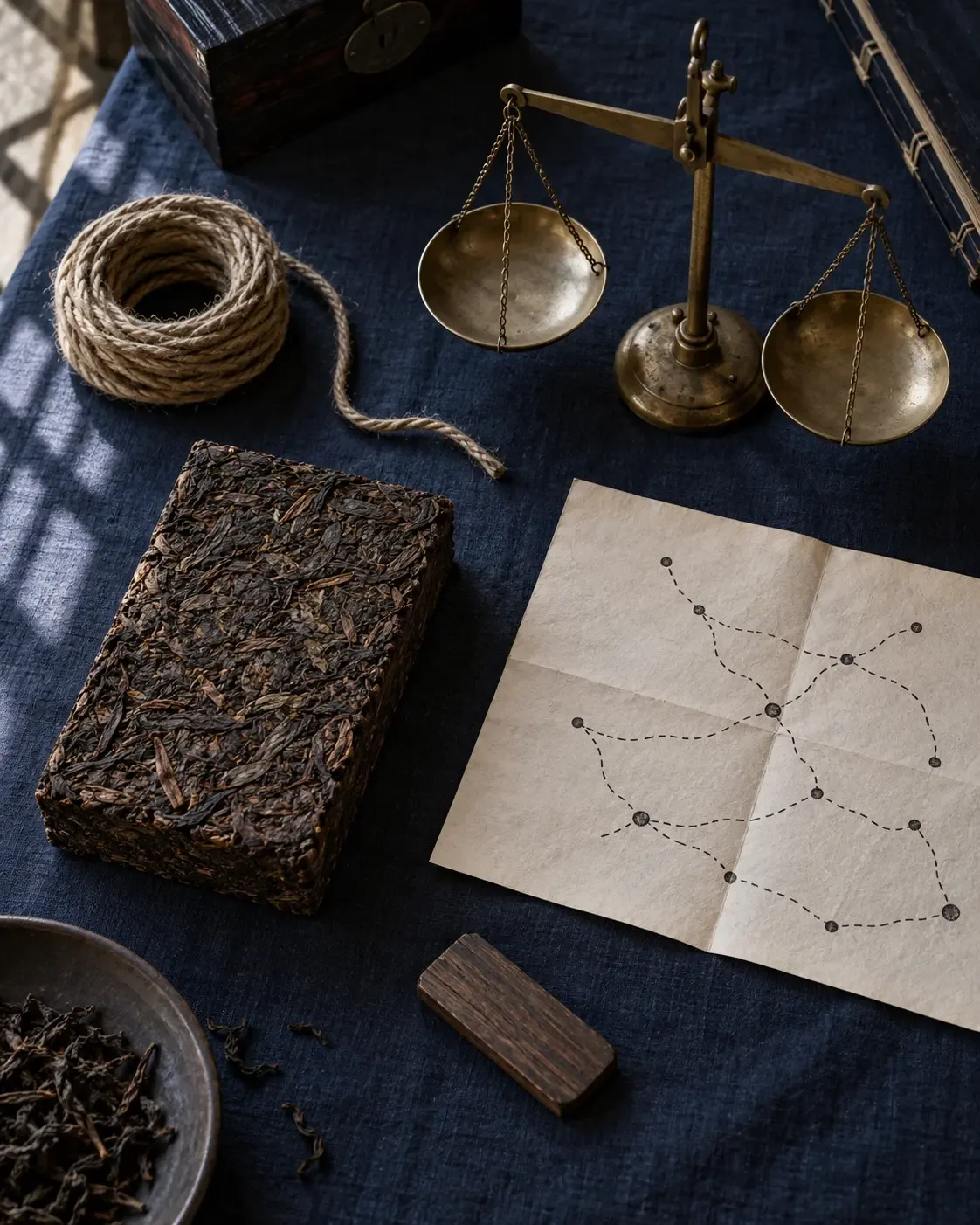
The Palace Museum’s Tea–Horse Road overview identifies major Yunnan–Tibet, Sichuan–Tibet and Shaanxi–Gansu routes together with numerous subsidiary lines. Those corridors changed with season, security, government policy and commercial opportunity. A map that draws one bold line is therefore a teaching aid, not a complete itinerary.
A historical name with uneven meanings
The phrase groups together exchanges that did not begin at one date or operate under one authority. Some segments linked tea districts to Tibetan communities; others connected Sichuan, Yunnan, Shaanxi, Gansu, Qinghai and further markets. Rather than search for a single “origin,” ask which route, century, government and community a source describes.
Why tea and horses mattered
Tea could travel as a durable commodity
Processed tea concentrated value in a relatively compact load, and pressing could make stacking and wrapping easier. But leaf, cake and brick forms varied by place and period. The guide to compressed tea explains why shape alone cannot prove date, origin or quality.
Horses were transport, military resources and wealth
Horses mattered to states and local economies in more than one way: they carried people and goods, and governments also sought them for military supply. “Tea for horses” names a strategic relationship, not a promise that every trader directly bartered one load of tea for one animal. Prices, taxation, credit, licences and other goods could intervene.
Markets were shaped by institutions
Official trade and regulation
Tea commerce could be taxed, licensed or channelled through designated offices. The Palace Museum’s outline of historic tea administration notes that the Ming restored tea–horse exchange policy and established specialist Tea and Horse Offices in Gansu and Sichuan. Such institutions reveal state interests, but official rules never describe the whole market.
Private trade and local intermediation
Merchants assembled loads, negotiated credit and prices, hired transport and relied on local knowledge. Scholarship on southwest borderlands describes trade through processes and relationships rather than a sealed road; C. Patterson Giersch’s study of cross-border networks places merchants and intermediaries at the centre of movement. State exchange, private commerce and informal traffic could coexist or conflict.
The work of movement
Terrain decided what a route could carry
Steep gradients, rivers, rain, snow and altitude made transport a material problem. Pack animals were crucial on many segments, while people also carried heavy tea loads where roads were narrow or animals impractical. Loads had to be divided, protected from moisture and transferred between transport systems. The road was labour, not simply scenery.
Towns were nodes, not pauses
Market towns joined routes to warehouses, lodging, workshops, religious sites and administrative offices. UNESCO records that the Old Town of Lijiang functioned from the twelfth century as an important distribution centre between Sichuan, Yunnan and Tibet and as a place of communication among Naxi, Han, Tibetan and Bai communities. A node could reshape goods and relationships rather than merely pass them onward.
Exchange changed tea
Preparation followed local life
Tea arriving in a new community did not retain one universal recipe. People combined it with local water, vessels, salt, milk or butter, and fitted it to patterns of hospitality and everyday nourishment. The Palace Museum’s Tea Across Vast Routes exhibition describes the emergence of diverse tea drinks through contact between farming and pastoral regions. These preparations are living cultural practices, not museum curiosities.
Containers and forms answered movement
Wrappers, baskets, caddies and compressed forms protected and divided tea in different contexts. Packaging can preserve names, weights or marks, but it must be read alongside the object and its provenance. Compare the separate guide to Chinese tea caddies before treating any container as self-explanatory.
What moved besides tea and horses
Goods, skills and information
Salt, textiles, medicinal materials, metalwork and daily necessities also circulated on parts of these routes. So did news, languages, religious practices, designs and techniques. This does not mean that every traveller or town shared the same culture; exchange can involve adaptation, unequal power, misunderstanding and selective borrowing.
Communities were participants, not background
Broad labels such as “Chinese,” “Tibetan” or “caravan” can hide the agency of particular communities and occupations. Historical evidence may preserve an official tax record, a merchant account or a foreign traveller’s photograph more readily than a porter’s voice. Responsible interpretation states whose record survives and avoids turning ethnic diversity into a decorative route story.
How to read evidence without romanticizing the road
Place different sources beside one another
Use administrative records to study policy, objects to study manufacture and wear, archaeology and architecture to study places, and oral history to study remembered practice. Each has limits. A surviving brick proves that a type of object existed; a road scar may show movement; neither alone establishes the full route, date or identity of its users.
Separate history from heritage presentation
Today, “Tea–Horse Road” also names museums, tours, products and regional heritage projects. Those activities can preserve buildings and memory, but present-day route branding is not automatically evidence for medieval or early modern conditions. Check the date of every claim and distinguish a reconstructed itinerary from a documented historical journey.
A seven-question route-reading method
- Which period? Name the dynasty, century or dated source instead of saying only “ancient.”
- Which segment? Identify the production district, market, pass or destination rather than assuming one route.
- Who recorded it? Distinguish official, merchant, traveller, community and modern heritage accounts.
- What moved? List tea form, animals, other goods, people and information separately.
- How was it moved? Ask about porters, pack animals, boats, roads, season and transfer points.
- What governed exchange? Look for licences, offices, taxes, prices, credit and informal trade.
- What changed on arrival? Study local preparation, language, containers and social use rather than assuming cultural continuity.
Return from the route to the cup
A cup of tea does not contain a complete trade history, but attention to processing, water, vessels and hospitality can reconnect an everyday drink with the labour that moved it. Continue with the history of Chinese tea culture, then use the guides to water, a flexible gongfu method and attention and hospitality. The goal is not to reenact a romantic caravan, but to notice how ecology, labour, regulation and cultural choice meet in tea.