Tea in Chinese Travel Writing: Roads, Hospitality and the Limits of an Itinerary
中国游记中的茶:道路、待客与行程证据的边界
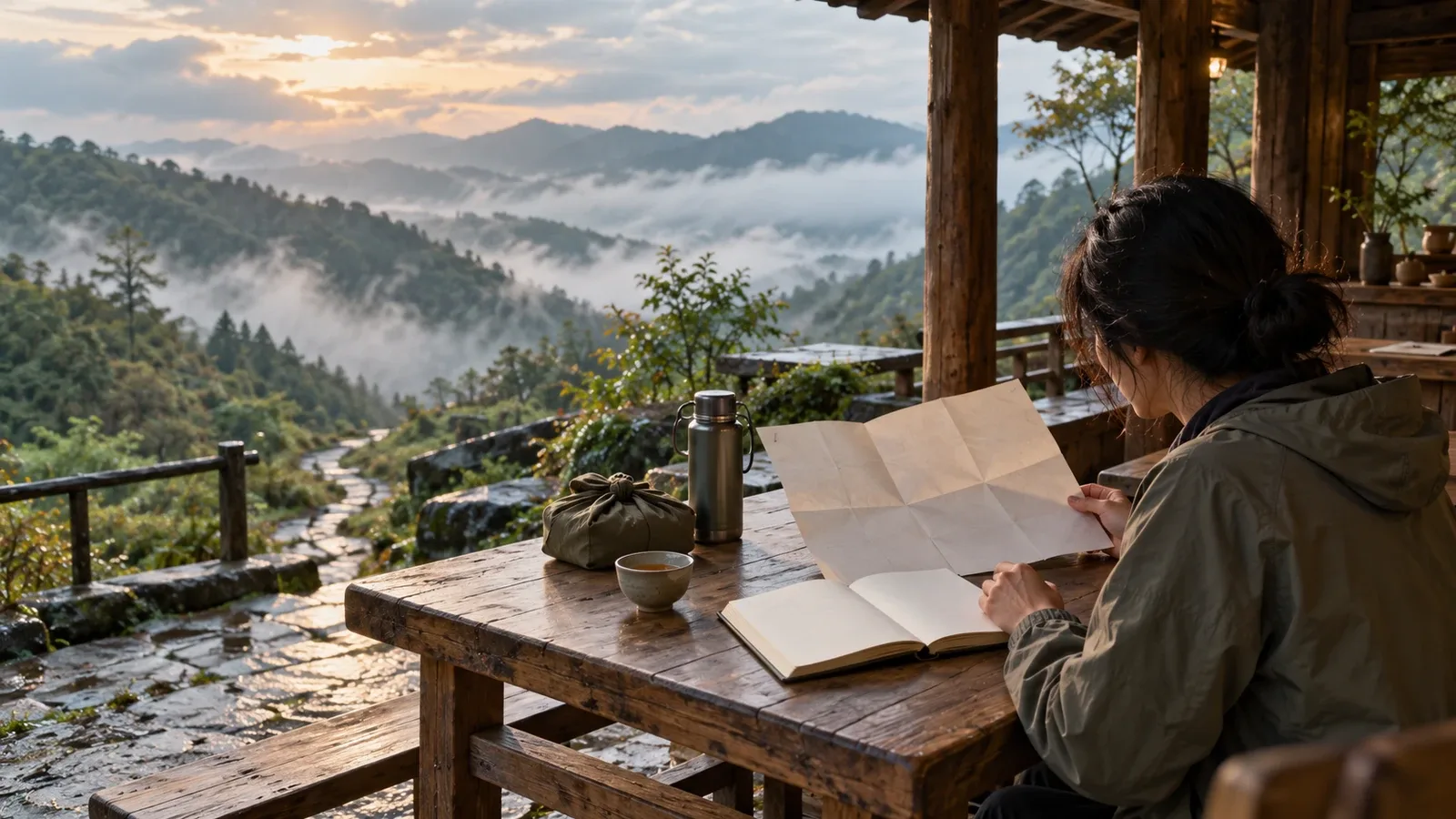
Tea enters the road as a small but active detail
“Travel writing” is not one stable genre
Imperial Chinese writing about journeys includes records of sites, excursion essays, route diaries, pilgrimage accounts, official travel and texts shaped for later readers. Modern histories of youji show that geography, literary form, memory and self-presentation developed together. Before using a tea reference as evidence, identify the kind of text, the journey it claims to record and the form in which it survives.
A brief cup can carry a large narrative load
Tea may occupy only a line, yet it can mark arrival, permission to rest, conversation, weather watching or a change of company. Begin with the action: who offers, prepares or comments on it, and what happens next? Our guide to tea in Chinese poetry asks a similar question of literary convention, while the Chinese poetry and literature gateway provides a wider reading context.
Hospitality appears at thresholds
Temples, inns and households are different social spaces
In the first scroll of Lu You’s Record of Entering Shu, an elderly nun named Miaojidashi Liuchuo invites the traveler to stay for tea while speaking about repairs to a shrine hall. The moment joins drink, shelter, conversation and institutional life. It records a particular encounter, not a rule that every religious house served tea in the same way.
Service reveals relationships
A host’s tea can acknowledge rank, friendship, religious hospitality or practical care; a traveler’s wording can also hide the people who fetched water, tended heat and cleaned vessels. Read the cup beside our articles on attention and hospitality and Chinese teahouses, while keeping domestic, monastic, official and commercial settings distinct.
Tea gives journeys a bodily rhythm
Pauses matter as much as distances
Dates, stages and place names can make a diary look like a modern route log, but meals, illness, rain, waiting and hospitality determine how the road is experienced. Tea may mark a halt without telling us its exact duration, recipe or cost. The itinerary is therefore a sequence selected by a writer, not a continuous record of every mile.
Weather changes what can be seen and written
In Xu Xiake’s Huangshan diary, the monk Xiaguang serves tea and leads the traveler upstairs while they debate whether a distant trace is mountain shadow or cloud and what it may mean for rain. Tea frames looking and interpretation. The scene is valuable precisely because observation, forecast, conversation and literary description remain intertwined.
Water connects taste to place
A named spring is both resource and claim
Lu You’s fourth scroll notes boiling Guanyin Spring water and sipping tea after a meal. Such compact wording links a beverage to a named place, but it does not supply mineral analysis, brewing ratios or a universal ranking. Read it beside water for Chinese tea and ask what the name contributes to memory and description.
Scenery does not authenticate flavour
Mountain mist, clear springs and celebrated sites can make tea appear naturally self-explanatory. A travel text may intensify that connection through sequence and style. Compare descriptions with local records, material evidence and environmental history before turning literary scenery into a claim about timeless terroir; our guide to tea landscapes offers that broader frame.
Regional taste travels through conversation
Praise and criticism are situated judgments
Elsewhere in Record of Entering Shu, Lu You says an official prepared tea skilfully although the tea itself was poor, then records a companion’s allegations about adulteration and seasonal decline in Jian tea. The passage preserves contemporary talk and discrimination of quality. It does not independently prove every ingredient, date or practice mentioned.
Local products are made by networks
A place-name tea reaches the traveler through growers, carriers, vendors, hosts and commentators. Writers often notice the prestigious name more readily than routine labour. Pair regional claims with our accounts of tea–horse trade networks, skilled picking and sorting and grading.
Roads are social systems, not empty lines
Access depends on people and institutions
Boats, ferries, post stations, monasteries, guides, servants and local hosts make movement possible. Tea can reveal one contact point in that infrastructure, but a polished first-person account may compress negotiation, payment, risk and dependent labour. Compare it with gazetteers and sacred geography, which organize place through a different documentary logic.
Travelers do not meet every community equally
Literacy, office, gender, wealth, religious affiliation and language shape where a writer can enter and whose words are recorded. Silence about women, labourers, carriers or minority communities is not evidence of absence. It is a reason to ask how the narrator’s route and social position filtered the scene.
An itinerary is edited evidence
Maps can clarify without claiming certainty
Place names change, routes branch and transmitted texts may preserve gaps or later editorial decisions. Plotting a journey is useful when uncertainty remains visible: mark approximate locations, disputed identifications and passages reconstructed from context. Do not convert a literary sequence into precise coordinates that the source never gives.
Later editions and translations reshape the road
Paragraphing, punctuation, variant characters, abridgment and translation can alter pace and emphasis. Record the edition or digital transcription used and compare passages when a claim depends on one term. The same source discipline underlies reading Chinese tea classics.
A seven-question method for tea on the road
Move from the line to the network
Begin with the sentence, then widen the frame through seven checks:
- What kind of travel text is this?
- Which edition and date am I using?
- Who serves, prepares, drinks or judges the tea?
- What pause or relationship does it create?
- Which route, water source or product name is specified?
- Whose labour and voice remain outside the frame?
- Which historical claim still needs comparison with another source?
Primary texts and further reading
For genre history, consult Richard E. Strassberg’s Inscribed Landscapes, James M. Hargett’s Jade Mountains and Cinnabar Pools and the Cambridge history of Chinese travel writing. Read the cited passages in Lu You’s first and fourth scrolls and Xu Xiake’s Huangshan diary. Continue with further reading and practice.