Picking Tea in China: Seasons, Bud-and-Leaf Standards and Skilled Labour
中国采茶:季节、芽叶标准与劳作技艺
Tea picking is often reduced to a picturesque gesture: fingers taking a bright green bud from a bush. In practice, it is a chain of decisions. A picker must recognise which shoots fit the intended tea, work within a changing flush, protect the leaf from crushing or heat, and move it towards processing. The result is not explained by “hand-picked” alone. It depends on the match between plant, season, product specification, labour and the next stage of manufacture.
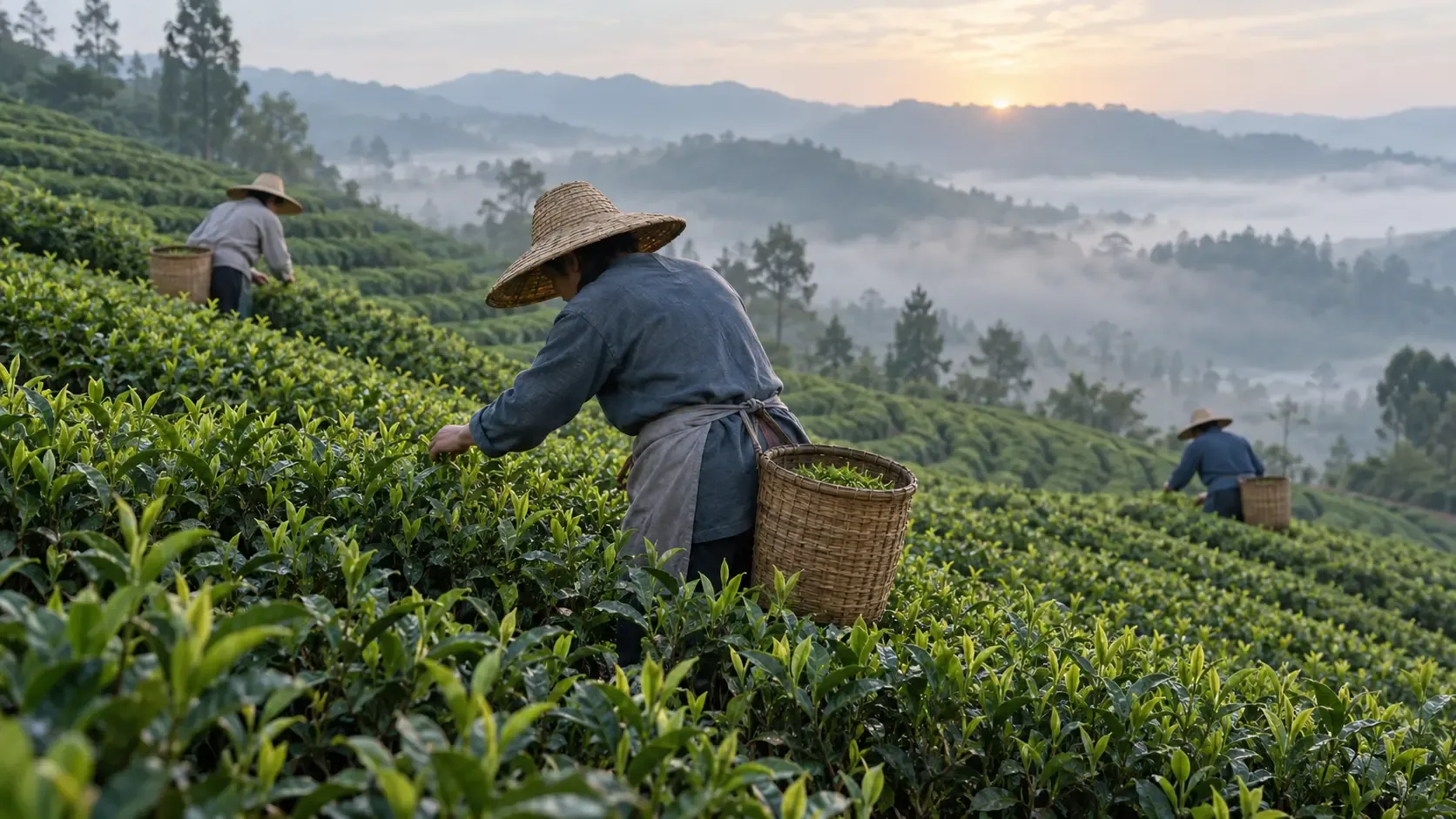
Picking is selection, not simply removal
The product begins in the field
Fresh leaf is the starting material for all six families introduced in Six Chinese Tea Families, yet each finished tea asks different things of that material. A tender green tea, a robust dark tea and an oolong made from more developed leaves cannot be judged by one shoot formula. Picking therefore translates a processing plan into field choices.
A moving target
Tea bushes do not present identical shoots at once. Buds, one-leaf shoots and more open growth can share the same plucking table. Weather and altitude alter the pace, while cultivars sprout differently. Skilled work means selecting consistently from this uneven surface without treating the plant as a factory conveyor.
What a bud-and-leaf standard describes
Useful shorthand, not a universal ranking
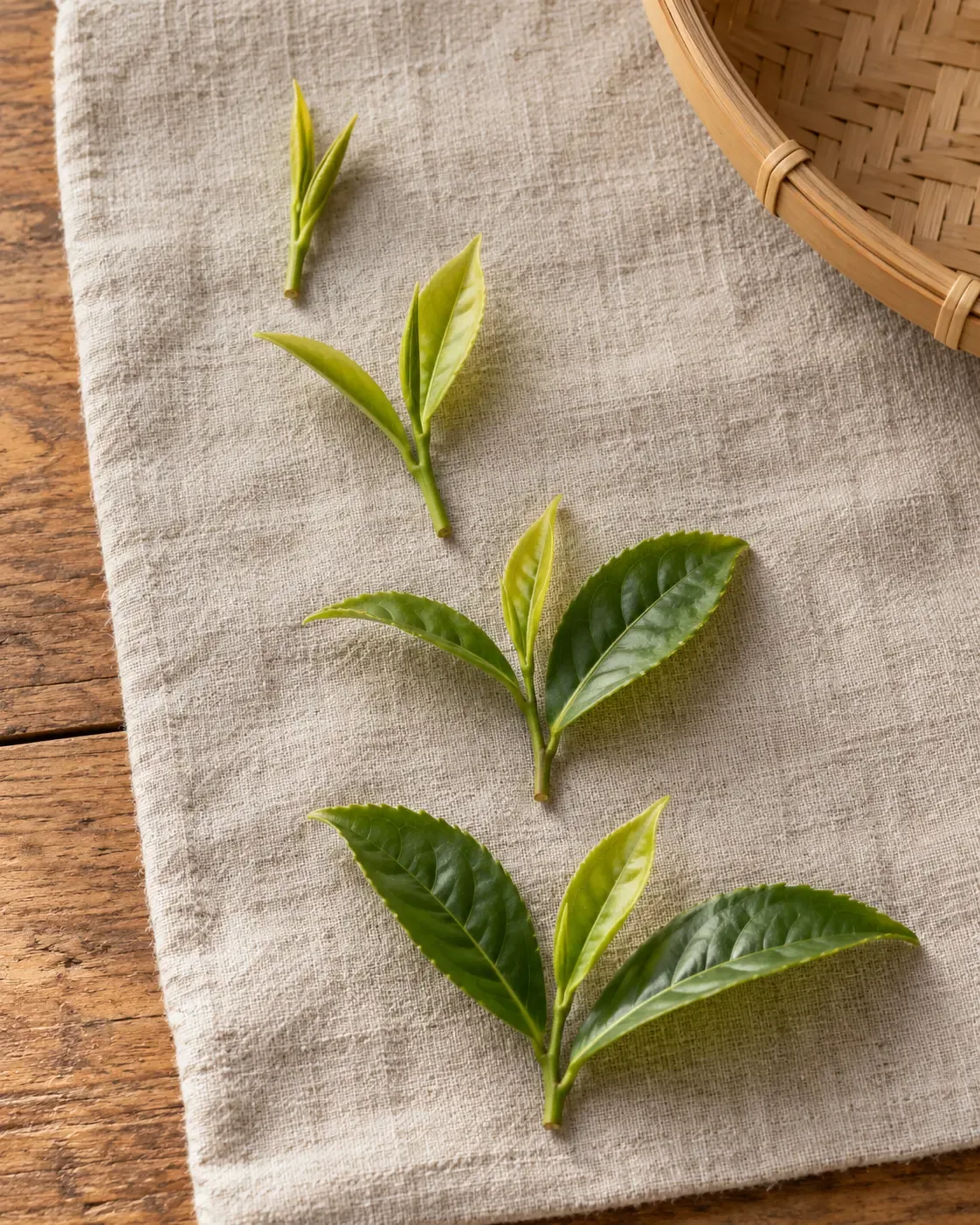
Phrases such as “single bud,” “one bud and one leaf,” or “one bud and two leaves” describe the configuration and maturity of a harvested shoot. They help growers, buyers and makers communicate. They do not, by themselves, prove origin, flavour, safety or quality, and a smaller shoot is not automatically better for every tea.
Tenderness, uniformity and intended process
A picking standard may specify which leaves are open, their tenderness, acceptable stem length and how uniform a lot should be. The relevant question is not “Which formula is best?” but “Which material fits this cultivar and process?” The visual comparison below makes maturity visible without turning it into a universal grade.
Season is local, not a fixed calendar
Flushes follow plants and weather
“Spring tea” is useful language, but it covers many local calendars. Latitude, elevation, slope, shade, rainfall, temperature and cultivar all influence when shoots become pickable. The same date can mark early growth in one garden and dormancy or mature growth in another. The landscape context matters, as explored in Tea Landscapes in China.
Start dates are operational decisions
A dated Chongqing technical notice offers one local example: in 2024 it advised beginning when roughly 5–10 percent of the plucking surface met the specified standard, then returning every one to three days during the peak. Those figures are guidance for that place and moment, not a rule for China as a whole. They show that a harvest starts by observing growth, not merely by reading a festival date. Read the Chongqing guidance.
Qingming and Longjing: a specific example
Calendar language carries history
Pre-Qingming tea has acquired powerful cultural and commercial value, but early picking has never meant the same thing everywhere. Research on Song-dynasty Beiyuan shows how place, court demand and arrival before Qingming helped organise ideas of distinction. Calendar labels are therefore historical conventions as well as agricultural descriptions. Read the historical study.
A regional practice, not a national template
In West Lake Longjing production, spring picking is commonly associated with one bud and one leaf or one bud and two leaves, and the intense period between Qingming and Guyu. This is a meaningful Hangzhou example, not the master pattern for white, oolong, black or dark teas elsewhere. See the Hangzhou account.
Labour, speed and care after picking
Consistency is embodied knowledge
Pickers repeatedly judge tenderness, leaf opening and damage while moving through uneven plants. Speed matters because a flush does not wait, but haste that crushes shoots or mixes maturity can work against the intended batch. This is skilled seasonal labour, not an invisible prelude to the “real” craft indoors.
The leaf remains alive after separation
Once detached, fresh shoots continue to respire and change. Deep compression, sun and delayed transport can warm or bruise the lot before deliberate withering, fixation or oxidation begins. Regional rules therefore address containers, transport, grading and storage as well as the moment of removal. Sichuan’s DB51/T 2482-2018 is explicitly scoped to Sichuan, which is exactly why it is useful evidence for the plurality of practice. Consult the standard record.
Hand, shears and machines
Method must fit the tea and field
Hand picking can make fine selections in an uneven canopy. Shears or machines can harvest faster and may suit level fields, regular hedges and products designed for broader leaf standards. Neither “hand” nor “machine” is a complete quality verdict. The Chongqing guidance even allows mechanical picking at peak demand: what matters is whether the method delivers suitable, sound material at the needed time.
Standards are plural and regional
Read specifications in context
China has national, industry, local and product-specific standards, while farms and factories may add purchase specifications. A Sichuan technical code cannot be silently applied to Fujian or Yunnan. The FAO description of Anxi Tieguanyin makes the point from another angle: season, climate, variety and leaf maturity are considered together for a particular oolong system. Explore the FAO Anxi profile.
Heritage, claims and evidence
Respect practice without freezing it
UNESCO’s inscription of China’s traditional tea-processing techniques includes plantation management and leaf picking alongside making, drinking and sharing tea. Heritage recognition describes living knowledge transmitted in communities; it does not make every marketing claim historical fact. A useful reading separates documented practices from picturesque generalisation. Read the UNESCO inscription.
A seven-question field method
How to read a picking claim
- Which place, garden and cultivar are being discussed?
- Which finished tea is the fresh leaf intended to become?
- What exactly does the bud-and-leaf formula include or exclude?
- Which season and observed stage of growth does the claim refer to?
- Was the leaf selected by hand, with shears or mechanically, and why?
- How was the fresh leaf protected, sorted and moved after picking?
- Is the statement a standard, a local practice, a seller’s specification or a heritage narrative?
These questions connect fieldwork to tea history, attention and hospitality, compressed tea and tea trade networks. They also restore the picker to the story. Before water, ware or ceremony, tea is a perishable agricultural material shaped by informed choices—and by people whose knowledge deserves to be named.