Yellow Tea and Menhuang: Moist Heat, Time and the Making of a Tea Family
黄茶与闷黄:湿热、时间与一类茶的形成
Yellow tea is sometimes presented as green tea that has simply become less green. That description misses the decisive step. After early heating, the maker deliberately holds the leaf in a warm, moist condition so colour, aroma and taste can continue to change. This stage is called 闷黄 (mènhuáng), usually translated as yellowing. It is not one fixed recipe, and it is not the midpoint of a universal fermentation scale.
1. Yellow tea is a process family
Six families, not six points on a colour line
China’s current product standard GB/T 21726-2018 for yellow tea treats yellow tea as a defined tea family. National production-licensing guidance likewise lists it separately from green, white, oolong, black and dark tea. The categories are better read as processing traditions than as progressively darker stops on one scale. Our guide to tea types and character provides the wider map.
What menhuang names
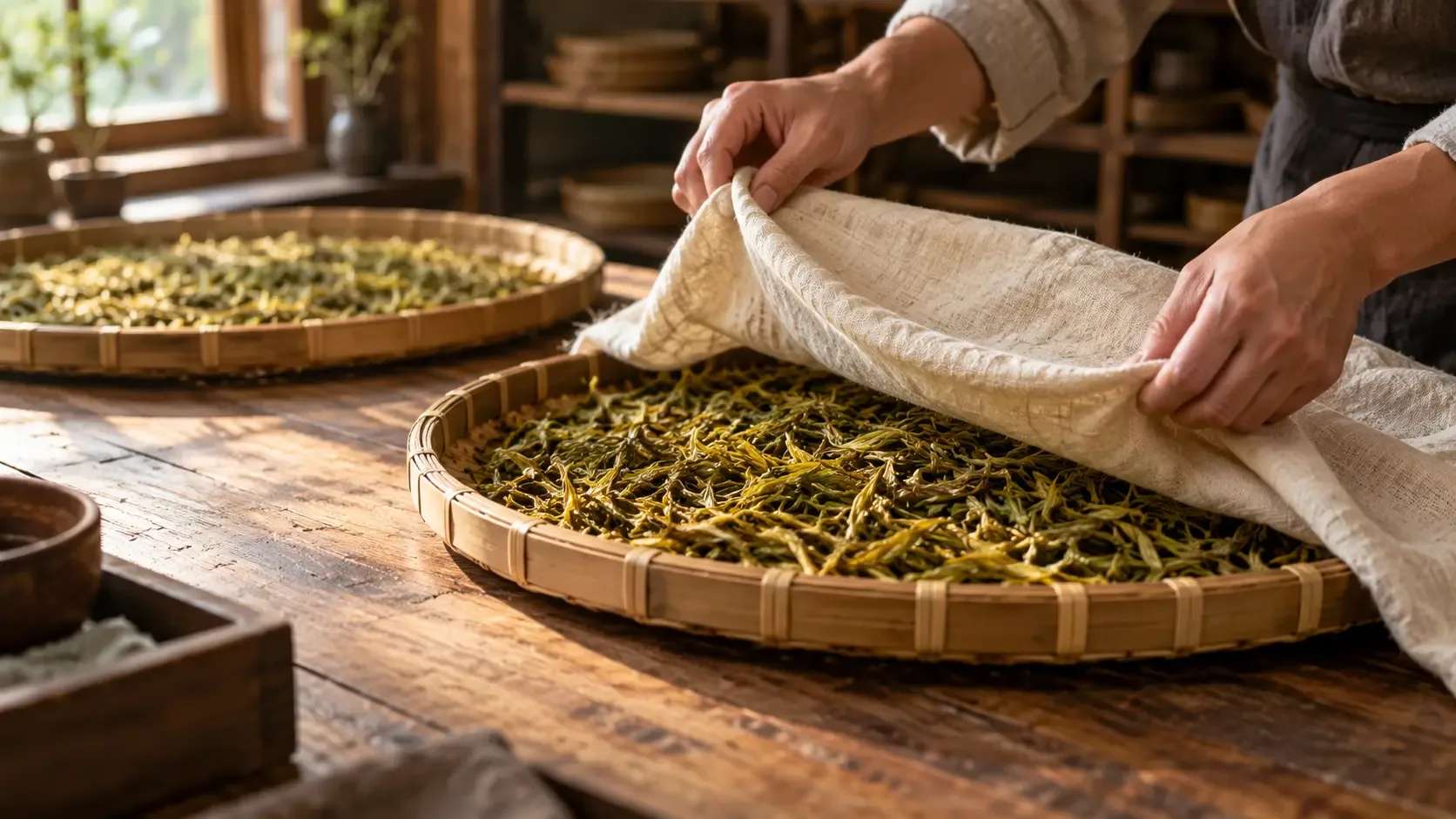
The characters 闷黄 join the ideas of enclosing or holding and yellowing. In practice, warmed leaf may be covered, wrapped, heaped or otherwise retained so its own moisture creates a humid local environment. English phrases such as “sealed yellowing,” “sweltering” and “moist heaping” describe related operations, but they should not be assumed to name one identical technique.
2. Where yellowing sits in the sequence
Fixation comes first
Yellow tea normally receives 杀青 (shāqīng), or fixation, early. Heat reduces the activity of endogenous oxidative enzymes and changes the physical state of the leaf. The current GB/T 39592-2020 yellow-tea processing standard is an official anchor for the family’s production terminology. For the underlying turning point, see fixation, heat and enzymes.
Before rolling, after rolling, or more than once
Yellowing does not occupy one compulsory slot. Depending on the product, it may occur before rolling, after rolling, around drying stages, or in repeated intervals. Rolling changes shape and contact between leaf tissues, while drying changes moisture and stability; their order therefore matters. Our separate guide to rolling and cell disruption explains why sequence cannot be reduced to a label.
3. A warm, moist microenvironment
Water, heat, cover and time work together
Warm leaf, retained moisture and limited exchange create conditions unlike open cooling. Heat and water accelerate some chemical transformations, while the leaf’s temperature, moisture distribution and exposure continue to shift. A controlled study of yellowing duration and sensory chemistry followed one experimental material over 0–13 hours; its value is evidence of changing compounds and associations, not a timetable for every yellow tea.
No universal sealed box
Cover material, leaf quantity, pile depth, turning, aeration and workshop climate all alter the microenvironment. Even the word “sealed” can overstate what happens in loosely covered or periodically opened leaf. A standard gives a shared framework, while a product specification and an actual production record tell us which operation was used.
4. What changes during yellowing
Green colour softens by several pathways
Chlorophyll-related pigments can degrade or transform, and the visible balance among green, olive, straw and gold shifts. That does not mean every finished leaf, infusion and liquor must display the same yellow. Bud teas, larger-leaf teas and different cultivars begin with different materials and are handled differently.
Taste and aroma change together with chemistry
Studies report changes among catechins, amino acids, sugars and volatile compounds during yellowing, alongside shifts in bitterness, astringency, sweetness and aroma. A comparative UPLC-MS study of green- and yellow-tea processing helps show how an added yellowing operation differentiates the two routes. These associations describe tested samples; they do not make one compound a universal flavour switch.
5. Yellowing is not black-tea oxidation
Fixation changes the enzymatic starting point
Black-tea manufacture makes extensive use of endogenous enzymes after tissue disruption. Yellow tea is normally fixed before yellowing, so its starting conditions are different. Residual enzyme activity may vary with leaf and heat treatment, but calling yellow tea “lightly oxidized black tea” confuses the sequence and mechanism. The distinctions are set out in oxidation, post-fermentation and tea terms.
Microorganisms are not the family’s defining principle
Microbial communities can be measured in many plant materials and processing environments, and research continues to examine their possible roles. That does not make yellow tea a dark tea or make visible mold desirable. The family is defined by its processing route, especially fixation and yellowing, not by a universal starter culture or a single named microbe.
6. One name, many yellow teas
Bud teas and larger-leaf teas ask different questions
Junshan Yinzhen, Mengding Huangya and Huoshan Huangya are familiar examples, but their names are not interchangeable formulas. Tender buds, mixed shoots and larger leaves differ in thickness, moisture and response to handling. Research on large-leaf yellow tea at industrial scale shows that yellowing and later roasting or drying can each contribute to aroma development.
A product label is not a process record
“Yellow tea” identifies a family; it does not disclose cultivar, plucking standard, covering material, number of yellowing stages or drying regime. Exact claims require a product standard, producer documentation or direct observation. The official tea production licensing process flows are useful boundaries, not substitute batch notes.
7. What a drinker can observe
Look at dry leaf, liquor and infused leaf
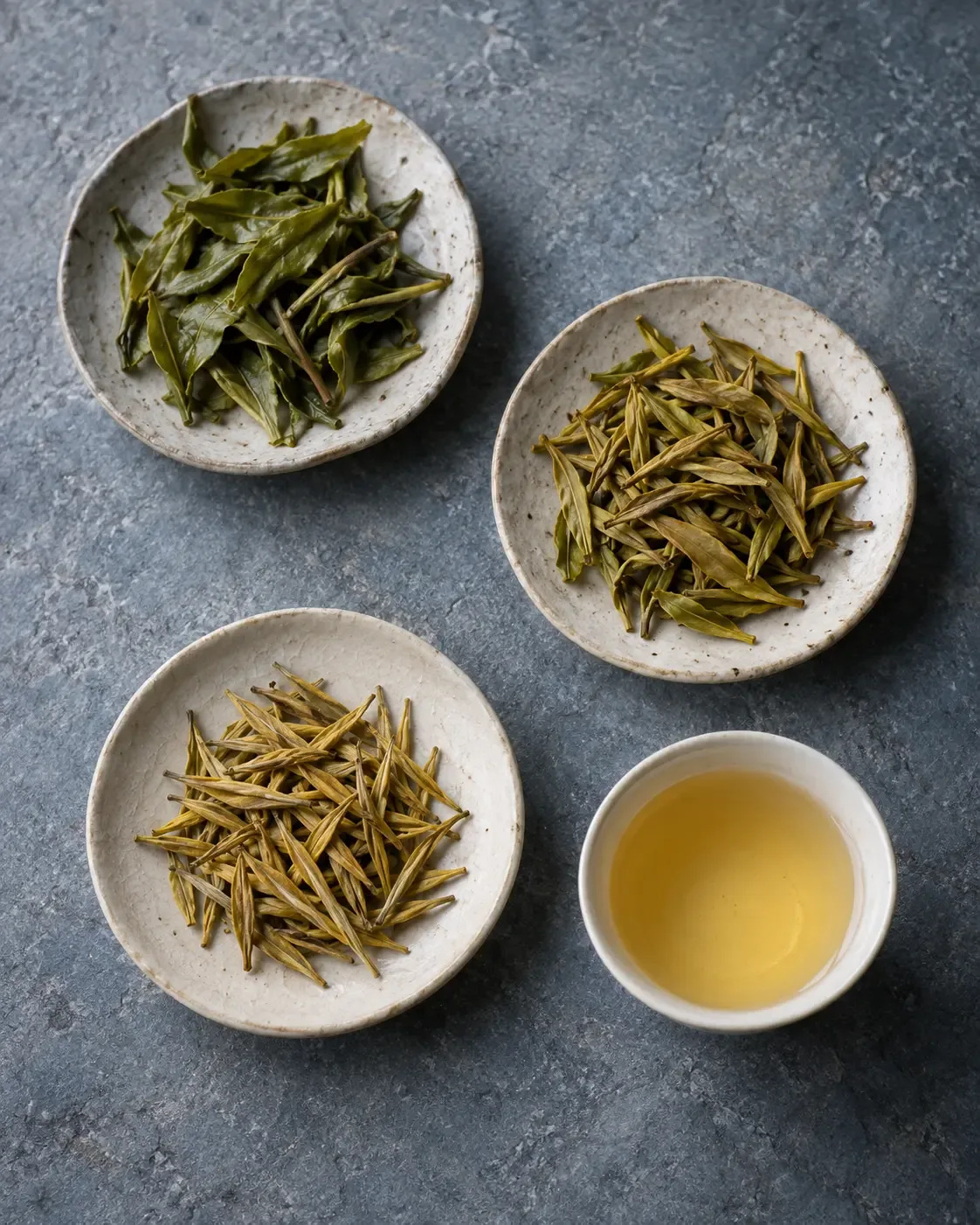
Compare colour distribution, pliability, liquor clarity, aroma and how the infused leaf opens. A softened green edge, a straw-gold cast or a less grassy profile may be consistent with yellow-tea processing. None of these clues alone proves the duration, temperature or exact method of menhuang.
Appearance has strict limits
Roasting, storage, age, cultivar and brewing water also affect colour and flavour. A pale liquor is not proof of gentle processing; a yellow leaf is not proof of yellow tea. Treat observation as a disciplined description, then seek production evidence before assigning a mechanism.
8. Seven questions for a maker or label
- Which named yellow-tea product or standard does this tea follow?
- When and how was fixation performed?
- Did yellowing occur before rolling, after rolling, around drying, or more than once?
- How were warmth, moisture, covering, pile depth and aeration managed?
- Which parts of the description are batch records, and which are general tradition?
- Is “fermentation” being used as trade shorthand, or is a specific mechanism meant?
- What storage and brewing guidance is evidence-based rather than promotional?
9. Precise language makes room for craft
Name the step without pretending it is one recipe
Menhuang is best understood as a family of managed yellowing operations under warm, moist conditions. Naming fixation, rolling, yellowing and drying separately respects both chemistry and regional craft. Continue with drying, moisture and stability, then use our further reading and practice guide to test claims against standards, studies and the tea in front of you.