Chinese Tea Caddies: Storage, Materials and the Traveling Leaf
中国茶叶罐:贮藏、材质与流动的茶叶
A tea caddy stands between the finished leaf and the moment of brewing. Its work is quiet: hold a manageable quantity, close securely, and reduce unnecessary exposure while tea waits on the table. Yet surviving Chinese examples show that storage was never only technical. Shape, lid, material, inscription, decoration and later travel could turn a container into court equipment, a literati object, an export commodity or a prized utensil in another tea culture.
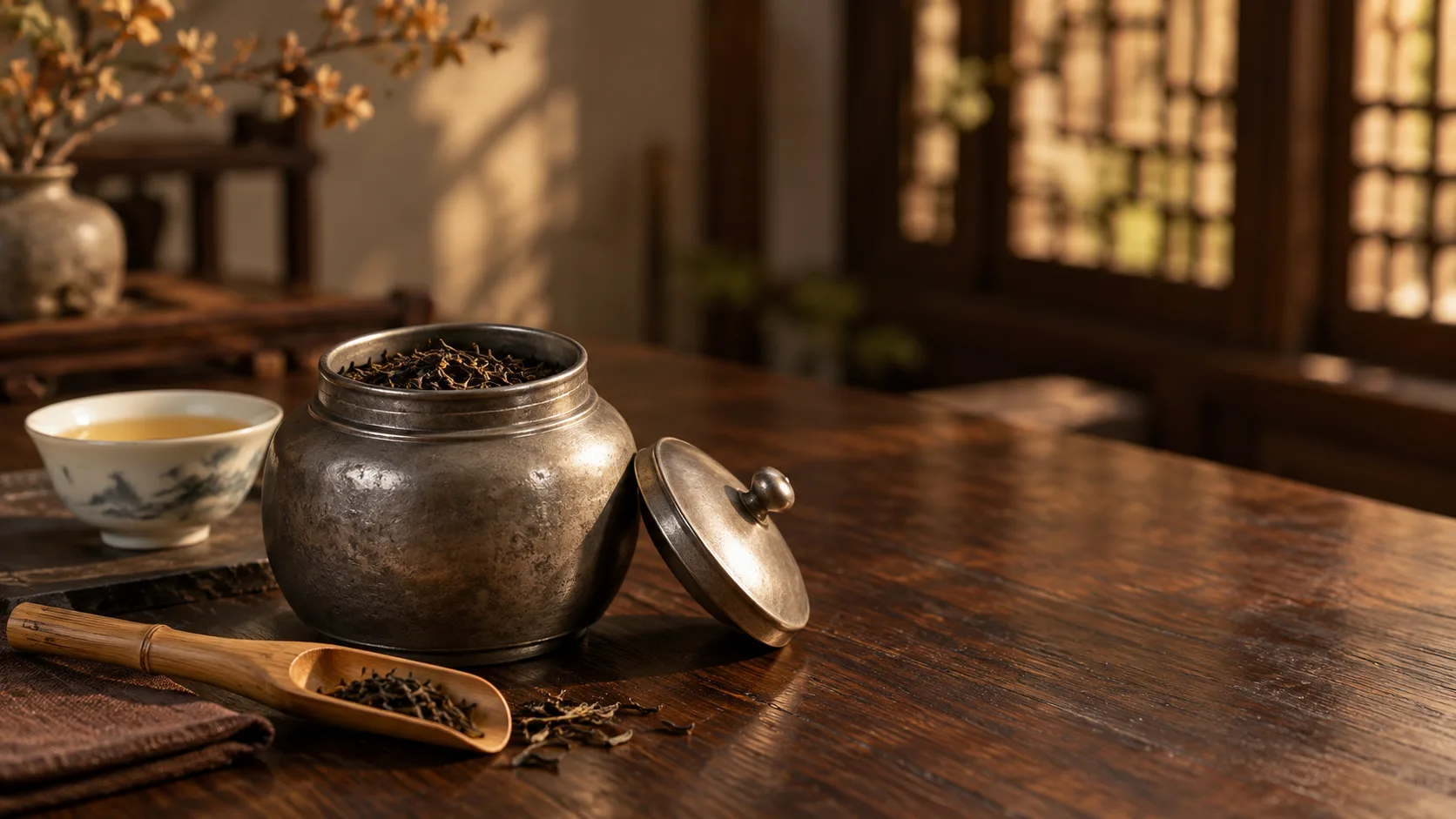
The container before the kettle
What a caddy actually does
A practical caddy creates a small, clean enclosure for tea. The lid, mouth and shoulder matter because they determine how the vessel opens, closes and pours or scoops. Light, moisture, heat, odours and repeated opening can all affect stored tea, but museum objects do not prove that one historical material was universally superior. Read the container first as part of the sequence explained in the six Chinese tea families and gongfu tea utensils: select, measure, brew and return the remaining leaf to storage.
Tea leaf, tea powder and later labels
English catalogues use “tea caddy,” “tea canister,” “tea jar” and “tea container,” sometimes for objects with different contents or later histories. A small covered jar shown in Chinese images may have held powdered tea; a Qing court caddy may name a particular tribute tea; an imported Chinese jar may later be used for powdered tea in Japan. The Palace Museum connects a Longquan-style covered jar form with depictions of containers for powdered tea, while its Qing records document small Yixing caddies made for named teas. A label describes the object as catalogued, not every stage of its life. Palace Museum: covered jar and powdered tea; Palace Museum: Yixing court tea caddy.
Storage belongs to the tea table
The caddy is neither a teapot nor a serving cup. It links household storage to the smaller working quantity brought to a gathering. Its scale and opening should be read beside scoops, bowls, pots and water vessels, but not confused with them. The wider Tea Culture section and guide to Chinese tea ware provide the surrounding forms.
Reading lid, body and material
Start at the closure
Look for a single cover, an inner cap, a nested lid or evidence of a lost replacement. Compare the fit of lid and mouth, the width of the neck and the stability of the base. A narrow mouth may slow exchange with the room but makes access different; a broad mouth makes scooping easy but depends heavily on the cover. These are functional observations, not performance guarantees. Condition matters: dents, warped rims, chips and replacement lids can change how the object closes today.
Pewter, stoneware, porcelain and lacquer
Metal can be hammered, cast, engraved or assembled with close-fitting covers. Yixing stoneware allows small angular or rounded bodies with inscriptions and relief decoration. Porcelain offers a glazed surface and a large field for painted imagery. Lacquered export cases could contain metal compartments. The Metropolitan Museum’s paired seventeenth-century pewter caddies conceal inscriptions on their inner faces; its late eighteenth- to early nineteenth-century porcelain caddy uses enamelled flower decoration. The two records demonstrate possibilities, not a hierarchy of preservation. The Met: paired inscribed pewter caddies; The Met: porcelain caddy with flowers.
Words and pictures need context
Inscriptions may identify a tea, quote poetry, name a maker or record later ownership, but each claim needs its own evidence. The Met attributes its matched pair to the seventeenth-century pewter artist Shen Cunzhou and explains how their poems appear only when the two containers separate. A Palace Museum Yixing caddy belongs to a court group marked with tea names such as “Yu Qian,” “Lianxin” and “Zhulan.” Do not turn a famous name or auspicious motif into automatic proof of maker, date or contents.
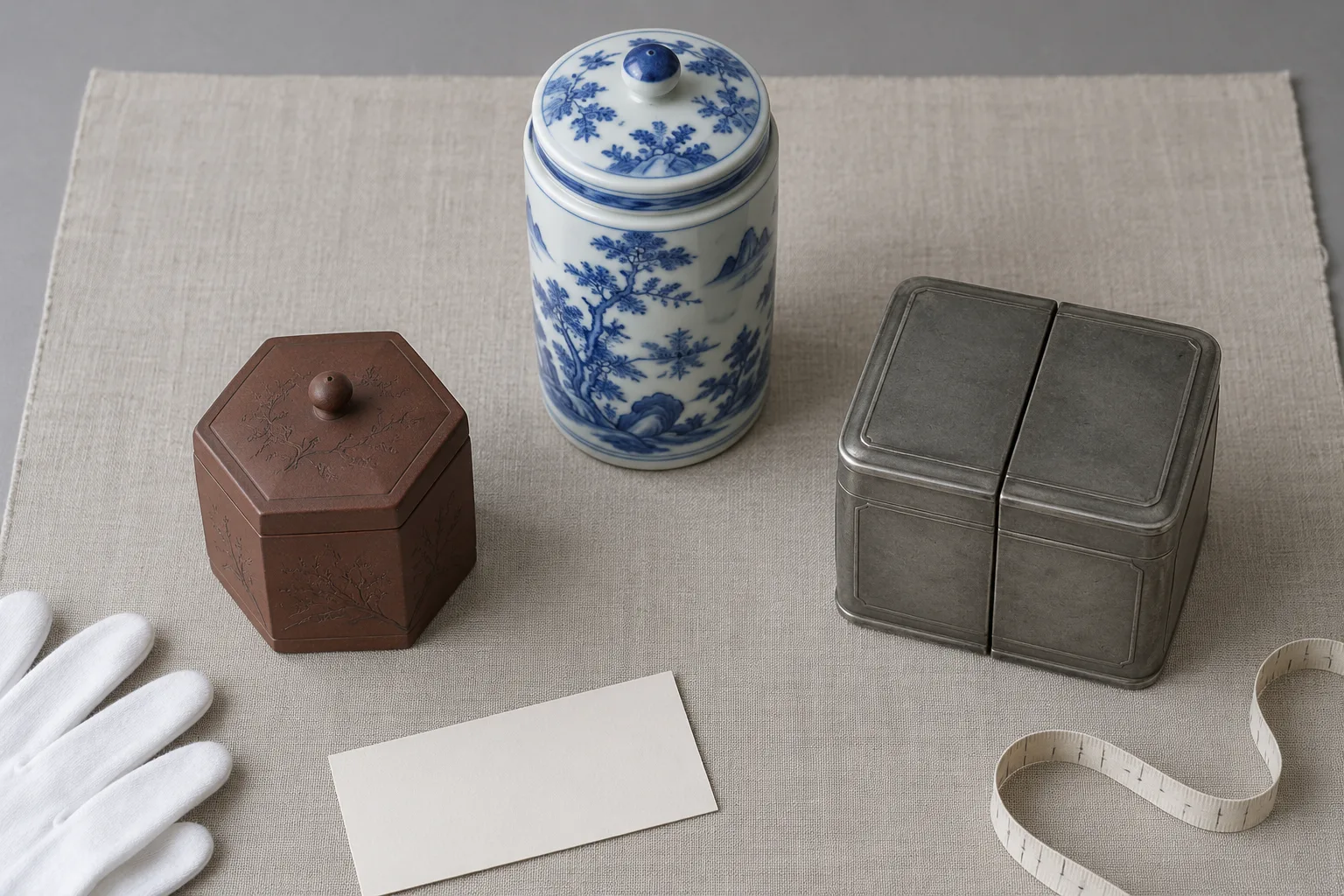
Containers that travelled
Court storage and named teas
Small imperial caddies could organise distinct teas as well as display specialised craft. Palace Museum research on Qing court tea culture records Yixing containers commissioned for tribute teas and individually inscribed with tea names. That evidence supports a particular court context; it should not be projected onto every unglazed jar. Read the exact mark, capacity and provenance before claiming a court function. Palace Museum: tea culture at the Qing court.
Trade, samples and fitted cases
Tea containers also moved through commerce. The British Museum holds a Qing pewter sample set: one blossom-shaped box encloses multiple fitted caddies, apparently for transporting a selection of teas. The Hong Kong Museum of Art documents lacquered Canton-trade caddies with pewter containers among objects made for overseas markets. These ensembles show that package, compartment and transport history can be as important as surface decoration. British Museum: fitted tea-sample caddies; Hong Kong Museum of Art: Canton trade tea caddy.
Chinese objects in other tea cultures
Chinese jars were collected and reclassified abroad. The National Museum of Asian Art catalogues Chinese ceramic caddies through Japanese tea terminology such as karamono, taikai and bunrin, while other Japanese containers consciously adapted Chinese prototypes. Such records reveal an afterlife of selection, naming and use. They do not make every Chinese storage jar a Japanese tea-ceremony object. National Museum of Asian Art: Chinese karamono caddy.
A six-pass method for looking
Read the object in order
- Name the parts. Record body, shoulder, neck, mouth, lid, inner cap, base and any fitted case or compartments.
- Test the stated function. Ask what form, scale and opening make plausible, without using an antique object.
- Identify material and making. Separate pewter, stoneware, porcelain, lacquer and later fittings; note casting, turning, moulding, glazing, painting or engraving.
- Read words and images. Transcribe before interpreting; keep tea names, poems, reign marks, maker attributions and later labels distinct.
- Follow the provenance. Distinguish Chinese manufacture from court use, export, Japanese reuse and modern collecting.
- Mark uncertainty. State what is visible, what the catalogue documents and what remains only possible.
Using a modern caddy
For everyday tea, use a clean, food-safe container with a well-fitting lid, kept dry and away from heat, sunlight and strong odours. Store only an amount you can manage without constant opening, and label the tea and date for your own reference. Do not place food in an antique or museum object: old repairs, corrosion, pigments and previous contents may be unknown. Pair storage practice with suitable water for tea, not with claims that a costly caddy will improve every leaf.
Continue the tea path
Read the caddy as one pause in a longer movement—from processing and trade to storage, measuring, water and hospitality. Continue with the history of Chinese tea culture, attention and hospitality in tea, and further reading and practice. The container matters because it makes the interval before brewing visible.