Rolling Tea Leaves (Rounian): Pressure, Shape and Controlled Cell Disruption
茶叶揉捻:压力、形态与受控细胞破损
Rolling—róuniǎn (揉捻) in Chinese tea manufacture—is a family of actions that press, fold, twist or compress leaves after an earlier stage has changed their moisture and flexibility. It can give a tea its visible form and disturb cells so that their contents move and meet. Those two effects are related, but their balance changes with the tea family and the result a maker intends.
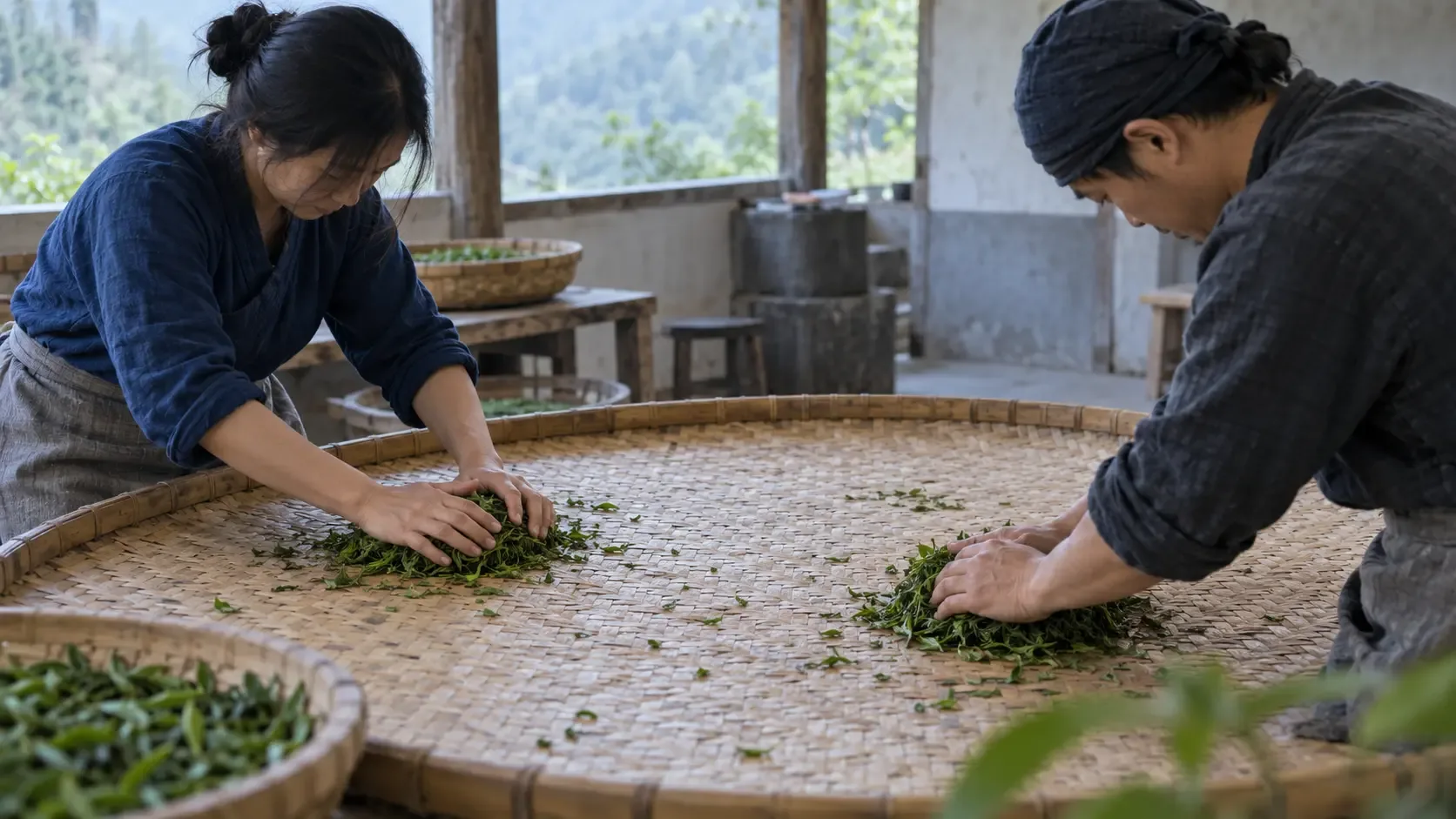
Names describe a family of actions
Rolling, kneading and twisting
English sources use “rolling,” “kneading” and sometimes “twisting” for overlapping forms of rounian. None means that every leaf is rolled into a ball. A broad leaf may be folded, a strip tightened or a mass repeatedly pressed and released. The useful question is what forces act on the leaf, not whether one English verb fits every workshop.
A process word, not a universal recipe
Rolling has no single correct duration, pressure or endpoint outside a defined tea. Leaf maturity, water content, batch size, equipment and the next operation all matter. A number quoted from one standard or experiment should therefore remain attached to that product and method.
Two linked jobs: form and internal change
Making a shape that can survive drying
Pressure and repeated movement rearrange softened leaves. They may become strips, loose twists, pearls, curls or flatter folds before drying stabilises the form. Shape affects appearance, packing and how water reaches the leaf during brewing, but it does not alone identify origin, authenticity or quality.
Opening compartments inside the leaf
Mechanical force can rupture cell membranes and walls to different degrees. Sap and compounds that were separated in intact tissue can spread across torn surfaces and mix with enzymes and oxygen. A review of black-tea manufacture describes this maceration as a bridge between withering and enzyme-driven oxidation, while emphasising that processing conditions alter the chemical and sensory outcome. Read the black-tea processing review.
More breakage is not automatically better
A controlled spectrum, not an on-off switch
Gentle hand work may leave many tissues intact; sustained pressure can create more contact and coating of leaf surfaces. The desirable degree depends on whether the maker seeks a largely whole appearance, rapid oxidation, tight shaping or another result. “Broken” describes physical condition, not a universal defect.
Orthodox rolling and cut-tear-curl are distinct
Whole-leaf or orthodox rollers and cut-tear-curl systems do not produce the same geometry or degree of disintegration. They serve different styles and infusion behaviour. Treating one as merely a stronger version of the other hides meaningful differences in machinery, particle size and process design.
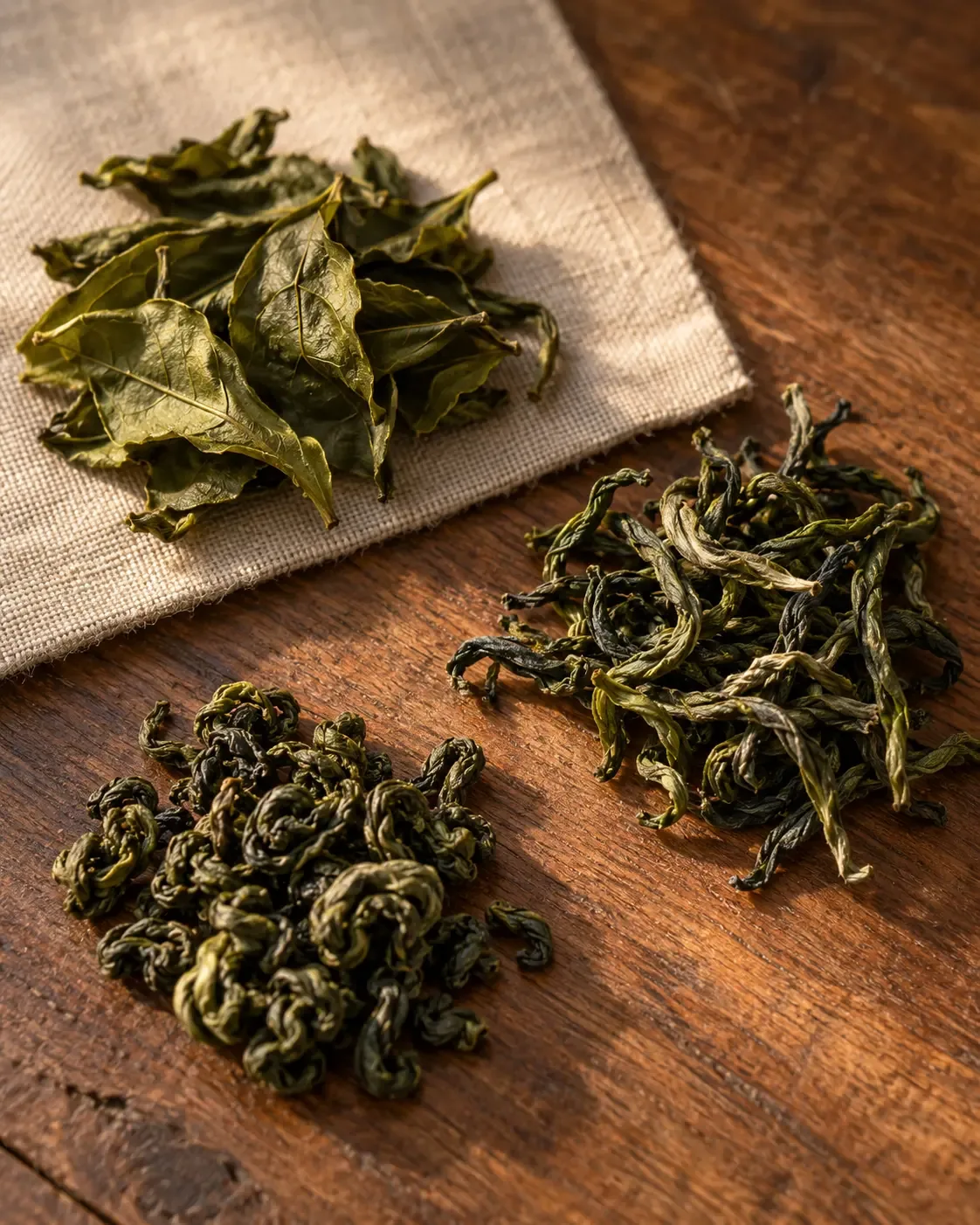
Not every tea follows the same route
The official basic flows reveal the differences
China’s production-licensing rules place rolling after fixation for green tea; after withering for black tea; and after fixation for oolong, yellow and dark tea. The basic white-tea flow names withering and drying without a rolling stage. These are broad regulatory pathways, not every regional variation, but they prevent the claim that all six Chinese tea families use rolling in the same way. Consult the official process flows.
Sequence determines biochemical meaning
The leaf has already been changed by picking, often by withering, and in some families by fixation. Rolling before oxidative enzymes are strongly suppressed can encourage reactions; rolling after fixation works with a different biochemical starting point. The same motion therefore does not have the same purpose everywhere.
Green tea: shaping after fixation
Structure changes after the oxidative pathway is checked
In the basic green-tea flow, fixation comes before rolling. Heat has rapidly reduced the activity of oxidation-related enzymes, so rolling mainly develops form, redistributes leaf materials and prepares the leaf for drying rather than opening a black-tea-style oxidation stage. A 2024 study comparing green-tea storage found that different rolling treatments affected later non-volatile change; its finding about moderate tissue disruption belongs to those teas and conditions, not every green tea. Read the green-tea rolling study.
Black tea: opening the leaf before oxidation
Withered tissue is pressed and exposed
Black tea usually moves from withering into rolling or maceration and then into the stage conventionally called “fermentation,” more precisely dominated by enzyme-driven oxidation. Rolling damages cells, spreads juice across surfaces and increases contact among polyphenols, oxidative enzymes and oxygen. China’s current national black-tea processing standard provides a formal framework for this sequence without making every regional black tea identical. See the black-tea processing standard.
Pressure changes composition and perception
A controlled study of Congou black tea found that rolling pressure altered non-volatile chemistry and sensory characteristics. It supports treating pressure as a consequential variable, not copying one setting: cultivar, withering, load, machine and desired style remain part of the result. Read the rolling-pressure study.
Oolong, yellow and dark tea diverge again
Fixation comes first, but the next stage differs
Oolong’s basic flow places rolling after withering, zuoqing and fixation, then before drying; the national oolong-processing specification supplies the broad technical frame. Yellow tea proceeds from fixation and rolling to yellowing, while dark tea proceeds toward pile fermentation. Rolling is a junction inside each route, not proof that these teas share one transformation. See the oolong-processing standard.
Hands, machines and finished leaf grades
Scale changes control, not the basic questions
Hands can feel resistance and adjust small portions; machines can make force and repetition more consistent at larger scale. Neither label guarantees care or quality. Whole, broken and finely cut leaves also infuse differently, yet liquor strength or speed is not a complete sensory ranking. Read the equipment together with the leaf material, maker’s target and finished tea.
A seven-question method for reading rolling claims
Connect force to the full process
- Which tea family, region, cultivar and picking standard are being discussed?
- What happened before rolling: withering, fixation, zuoqing or something else?
- What are the leaf moisture, temperature, maturity, batch size and loading depth?
- Is the action folding, twisting, compression, orthodox rolling, cutting or a combination?
- How is pressure changed, released or repeated, and what defines the local endpoint?
- What comes next: oxidation, yellowing, piling, shaping, drying or another operation?
- Is a claimed setting a legal standard, a study condition or one maker’s practice?
These questions keep a tactile process connected to tea landscapes and to routes for further reading and practice. Rolling is best understood neither as decorative shaping nor as indiscriminate crushing: it is controlled mechanical work whose meaning comes from the leaf, the degree of disruption and the transformation that follows.