Re-Firing and Roasting Tea: Later Heat, Aroma and the Difference from Drying
茶叶复火与焙火:后段加热、香气及其与干燥的区别
Tea is not always finished when it first becomes dry. Some teas, especially oolongs, receive later heat to adjust moisture, settle aroma or create a deliberately roasted profile. The English words “baking,” “roasting” and “re-firing” overlap, while Chinese terms such as 烘焙 (hōngbèi), 焙火 (bèihuǒ) and 复火 (fùhuǒ) can name related but not identical operations. Precision begins by asking when the heat was applied and why.
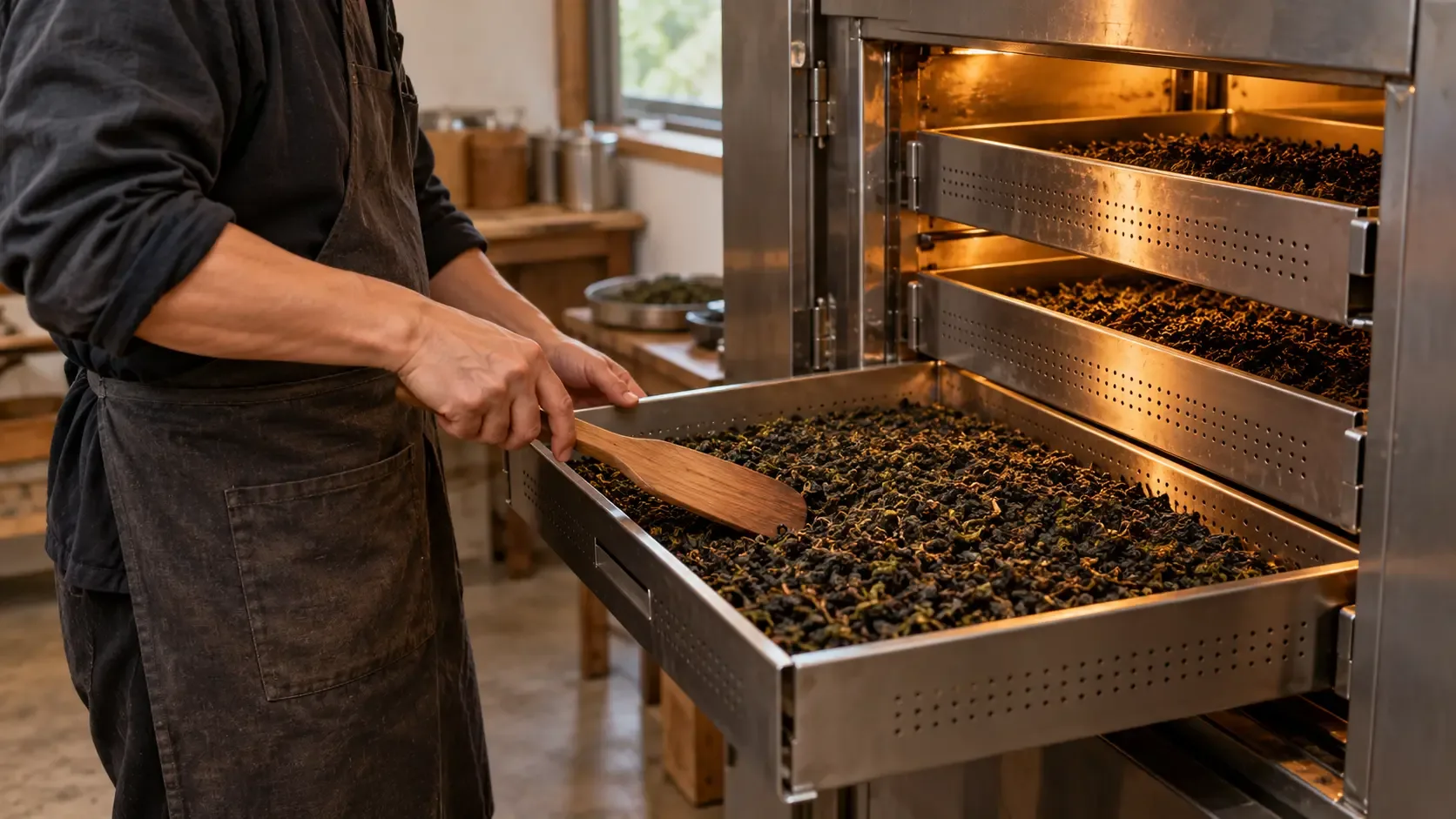
1. Later heat is not one operation
Primary drying completes manufacture
Drying reduces moisture after earlier steps and helps bring a made tea toward a stable condition. It may itself shape aroma, but it belongs to the first manufacturing sequence. Our guide to drying, moisture and stability explains why “dry” is a managed state rather than a simple absence of water.
Baking, roasting and re-firing come later
Later heat may be part of refining, a finishing choice after primary manufacture, or a new treatment after storage. “Re-firing” is most useful when already dried tea is heated again; “baking” or “roasting” often describes heat used to develop a style. China’s current GB/T 40633-2021 tea-processing terminology standard provides a shared vocabulary, but product documents and batch records are needed to identify an exact operation.
2. Where finishing heat sits
Rough manufacture and refining are different stages
Oolong’s first manufacture commonly includes withering, leaf manipulation, fixation, rolling and drying. Refining can include sorting and later baking. The current GB/T 35863-2018 oolong-processing standard is a useful boundary: later baking should not be confused with fixation, the earlier heat step that changes enzyme activity. See fixation, heat and enzymes for that turning point.
Not every tea is roasted or re-fired
A tea may be sold after primary drying, receive a gentle finishing bake, or undergo repeated heat-and-rest cycles. None of these choices creates a seventh tea family. Green, white, yellow, oolong, black and dark teas are organized mainly by processing route; roast level is an additional treatment or style. The broader framework appears in our guide to tea types.
3. A heat profile is a bundle of variables
Temperature alone tells very little
Leaf load, layer thickness, airflow, equipment, starting moisture, heating rate and duration interact. A stated chamber temperature is not necessarily the leaf temperature. Two makers can both say “medium roast” while using different machines, loads, rests and endpoints; the phrase is not a transferable measurement without supporting data.
Resting and repeated cycles matter
Some programs use one pass; others alternate heating and rest so moisture and aroma redistribute before another pass. A controlled Tieguanyin study of chemical changes during roasting shows how non-enzymatic reactions can proceed under one defined set of conditions. Its temperatures and times describe tested samples, not a recipe for every tea.
4. What later heat can do to aroma
Some volatiles leave while others transform
Heat can reduce some low-boiling floral or green volatiles, release compounds from precursors and alter the balance among existing aromas. A survey of 153 roasted and unroasted oolong samples found strong differences in volatile fingerprints and substantial variation within the roasted group. Because the samples spanned products, origins and cultivars, the findings support diversity, not one universal roast signature.
Thermal reactions can add roasted notes
Maillard and Strecker pathways can produce heterocyclic compounds and aldehydes associated with nutty, toasted, caramel-like or baked impressions. These are non-enzymatic heat reactions, not a continuation of the enzymatic oxidation used earlier in some manufacture. Our guide to oxidation and post-fermentation terms separates those mechanisms.
5. Taste, colour and moisture move together
Sensory direction is product-specific
Later heat may deepen dry-leaf and liquor colour, soften fresh green notes, emphasize toast or caramel, and shift bitterness and astringency. A study of Wuyi rock teas at different roasting degrees documented such changes within its materials, while also adjusting process parameters by variety. Stronger roast is therefore not automatically greater quality, and one cultivar’s endpoint cannot stand for another’s.
Lower moisture is not sterilization
Re-firing can reduce moisture that tea has taken up, but it does not make contaminated or moldy tea safe. After heating, the leaf must cool without collecting condensation and return to suitable moisture-protective storage. A tea caddy helps only when the tea was sound before filling and the container is clean, dry and appropriate; see our guide to Chinese tea caddies.
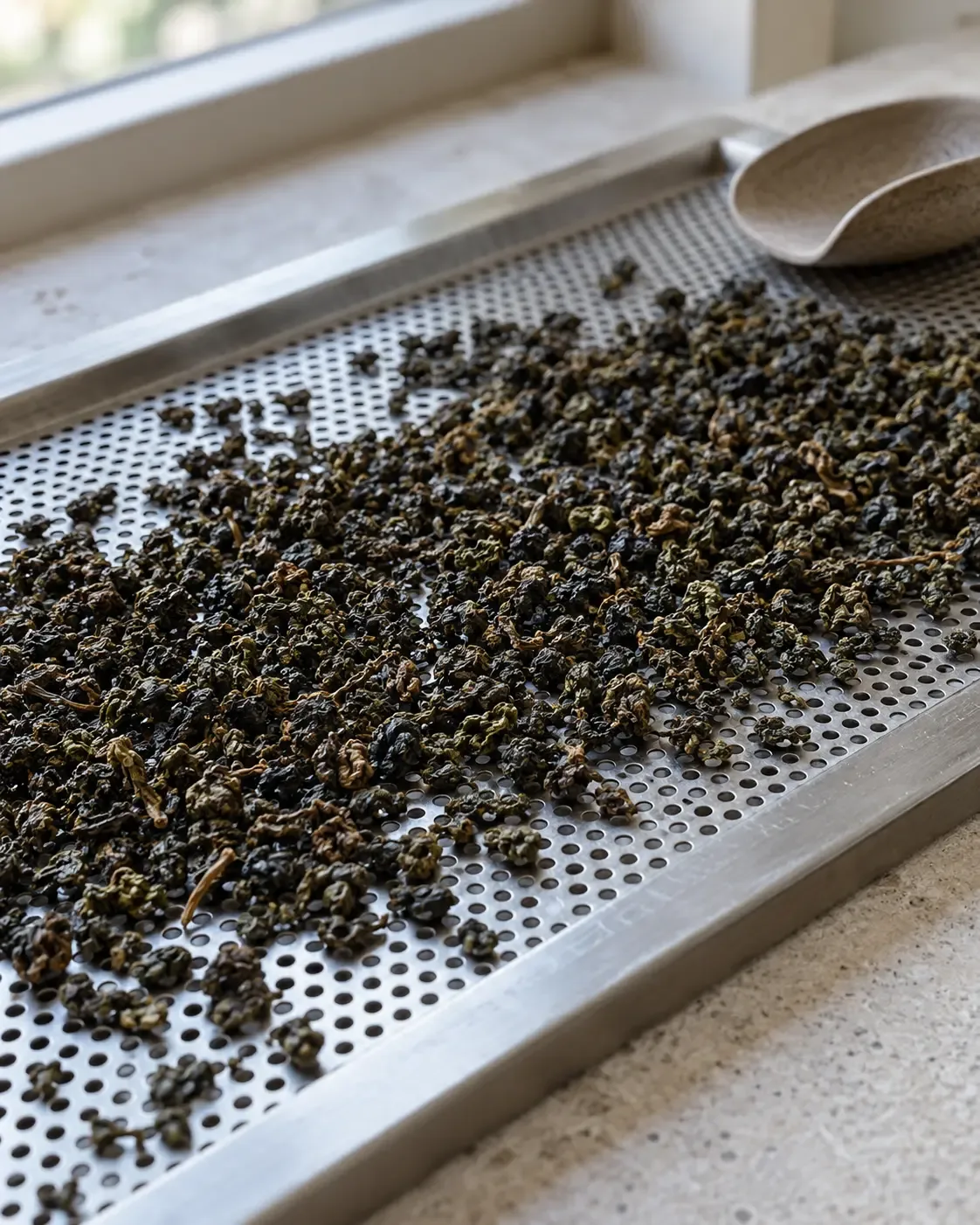
6. Oolong shows why one scale fails
Wuyi, Tieguanyin and Dancong are not one formula
Wuyi rock tea, Tieguanyin, Dong Ding and Fenghuang Dancong are often discussed through roast, yet their cultivars, shapes, first manufacture and intended styles differ. A 2026 study of re-firing in one Fenghuang Dancong material measured changes in moisture and metabolites. It is evidence for that experimental system, not permission to prescribe the same treatment elsewhere.
“Light,” “medium” and “heavy” need context
These descriptors can be meaningful within one maker’s range, where teas share equipment and reference points. Across producers they are ordinal marketing or workshop terms, not calibrated units. A useful description names the tea, approximate process, date and intended sensory result rather than pretending the adjective is universal.
7. Equipment and fuel are not quality guarantees
Charcoal, electric heat and hot air can all be controlled
Different systems transfer heat by different combinations of radiation, conduction and convection. Fuel, chamber design, airflow and operator control work together; the word “charcoal” alone does not prove depth, tradition or superiority. Indirect charcoal heat is also not the same thing as deliberately smoking leaves.
Smoke, soot and scorch are not necessary evidence
A skilled roast need not smell of smoke or display blackened edges. Burnt, ashy or harsh notes may indicate an intended style in rare contexts, but they can also mark uneven or excessive treatment. Sensory evidence should be paired with credible process information before attributing a note to fuel or craft.
8. Seven questions for a maker or label
- Was this heat part of primary drying, later refining, final roasting or re-firing after storage?
- Which term does the producer use, and what operation does it mean for this tea?
- Was the treatment one pass or several heat-and-rest cycles?
- What leaf load, airflow, equipment and starting moisture shaped the result?
- Does “light,” “medium” or “heavy” compare teas within one producer, or claim a wider scale?
- Is “charcoal-roasted” documented as an indirect heat method rather than inferred from smoky flavour?
- Was re-firing routine finishing, moisture correction, or a response to a known storage history?
9. Read the cup and the record together
Describe first; infer second
Notice dry-leaf colour, roast aroma, liquor clarity, sweetness, bitterness, astringency and the way aroma changes across infusions. These observations can suggest later heat, but they cannot reveal an exact temperature, duration, fuel or number of cycles. Roasting is a family of choices made after earlier transformations, not a shortcut around them. Continue with our further reading and practice guide to compare labels, standards, studies and the tea itself.