Jasmine Tea and Scenting: Flowers, Repeated Rounds and How Aroma Enters Tea
茉莉花茶与窨制:鲜花、多次窨香与茶叶如何吸收香气
Jasmine tea is made through a meeting of two materials that have already followed different lives: a finished tea base and freshly harvested jasmine flowers. The tea is not perfumed merely because petals are visible. In traditional fresh-flower scenting, aroma is transferred during carefully managed contact, while moisture and heat must be controlled and spent flowers are usually removed. The result belongs to the world of reprocessed scented teas, not to a seventh tea family.
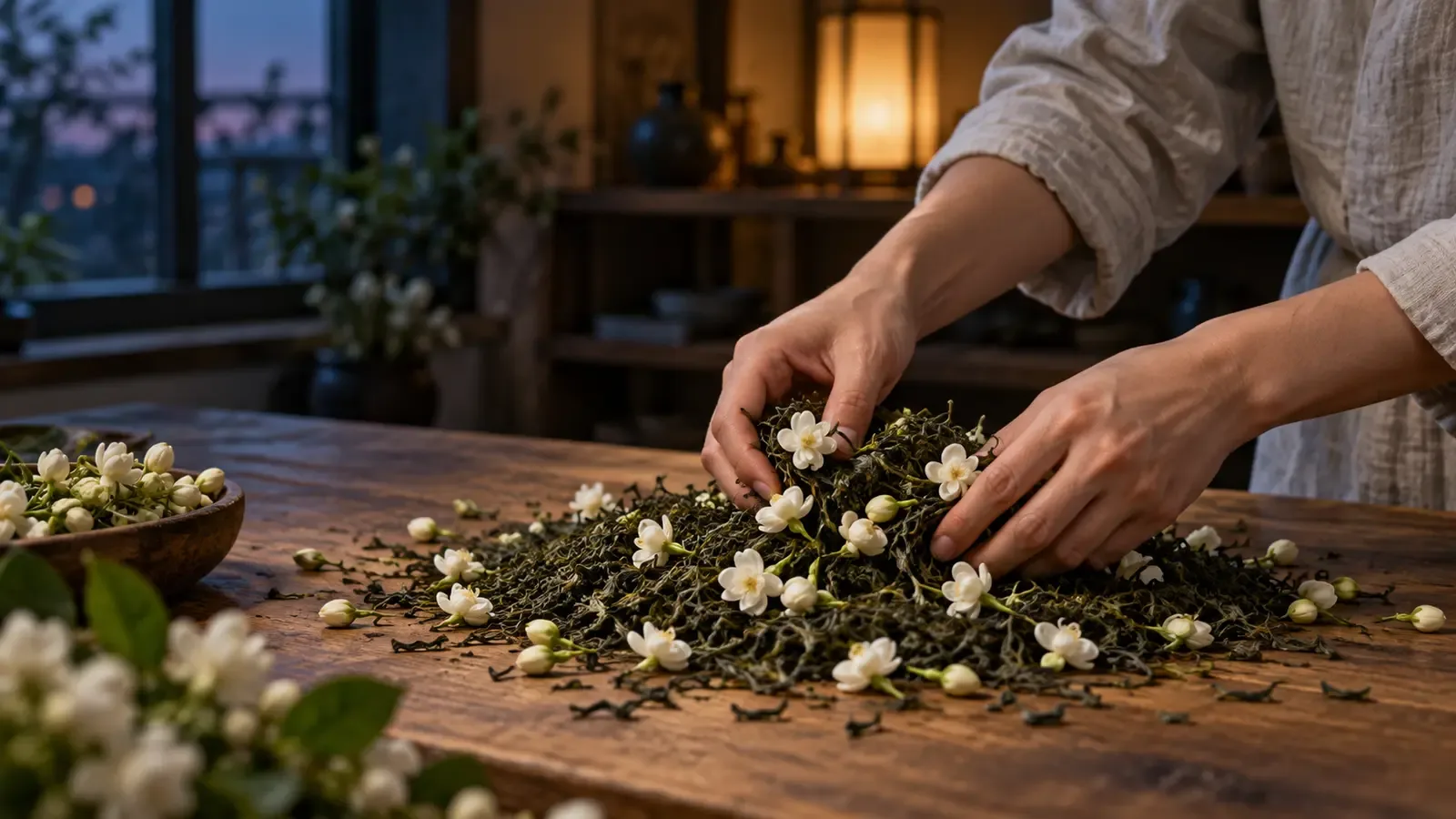
1. A scented tea, not a seventh tea family
Made tea meets fresh flowers
The base has already been manufactured and dried before scenting begins. Green tea is common, but different bases can be used and should be named rather than assumed. China’s current GB/T 22292-2017 jasmine tea standard treats jasmine tea as a product with defined requirements; it does not turn jasmine into a botanical tea variety. Our guide to tea types explains why the base tea’s first processing route still matters.
Not an herbal infusion and not simply a garnish
True tea leaves come from Camellia sinensis; jasmine contributes fragrance during reprocessing. A drink made only from jasmine flowers is therefore an herbal infusion, while tea with a few dried petals may be a visual blend. Neither is automatically the same as tea repeatedly scented with fresh flowers. The useful question is not “Can I see flowers?” but “How was aroma introduced?”
2. Before contact: tea base and flower readiness
The base must be ready to receive aroma
A producer selects, refines and conditions a tea base whose moisture, leaf shape and existing aroma suit the intended style. Excess water threatens stability, while a harsh or unsuitable base will not become fine merely by adding perfume. The relationship between water and finished leaf is covered in our guide to drying, moisture and stability.
Flower care coordinates opening and release
Fresh Jasminum sambac buds continue to open after harvest. Workers manage their holding conditions so a suitable proportion opens and releases fragrance near the planned mixing time. This preparation, often called 养花 (yǎnghuā, flower care), is not a decorative prelude: wilted, unopened or overheated flowers behave differently. There is no universal clock because cultivar, harvest condition, weather and flower temperature vary.
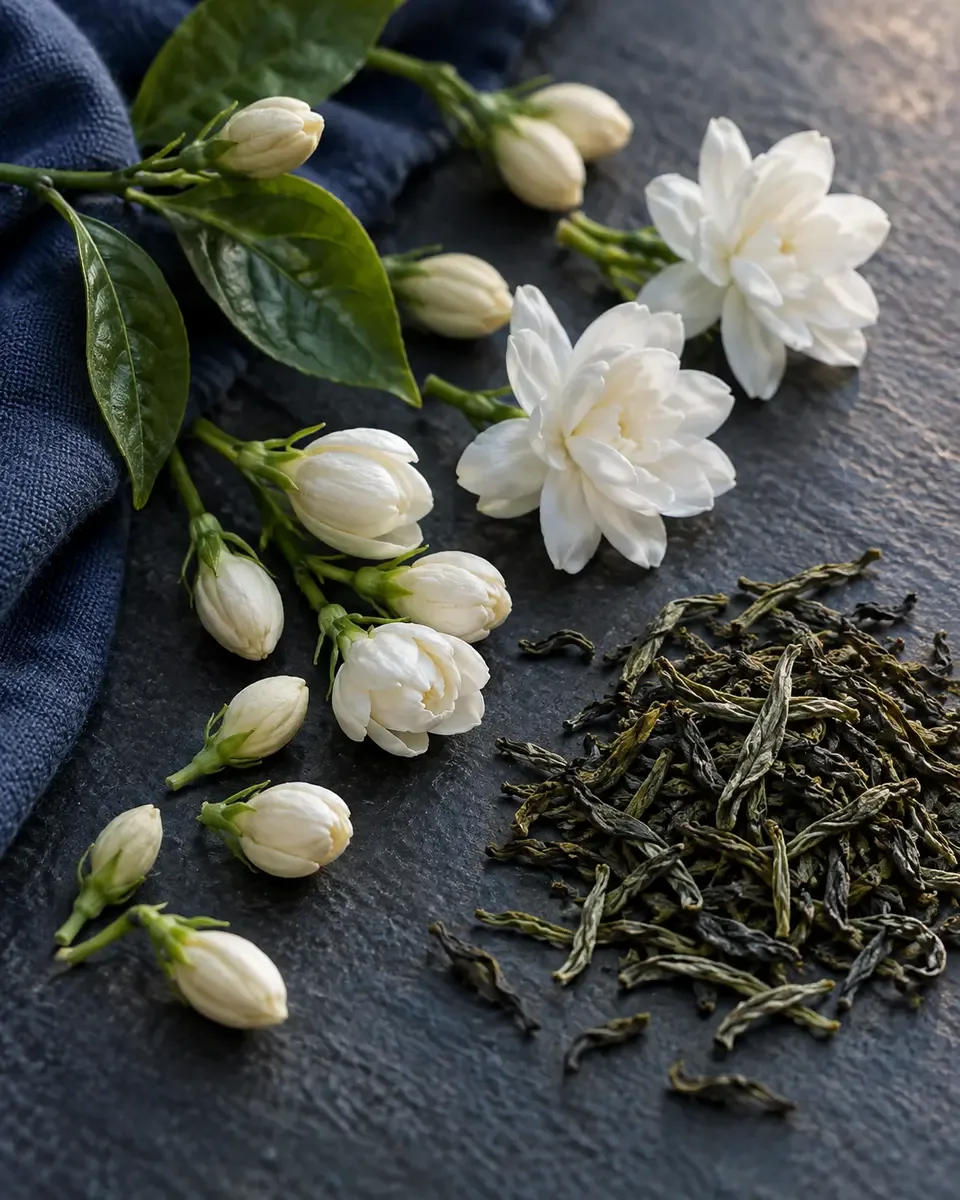
3. What happens in one scenting round
Mixing begins a managed period of contact
Tea and flowers are distributed together so volatile compounds released by opening flowers can reach the dry leaf. Contact may be formed into a layer or pile, but depth, flower proportion and duration are product decisions rather than universal recipes. The current GB/T 34779-2017 jasmine tea processing code defines the technical framework; a producer’s batch records are needed for the exact operation.
Heat release and flower separation close the contact stage
Respiring flowers, moisture movement and the piled material can raise temperature. Producers may loosen or spread the mixture to release heat and then gather it again, a sequence expressed by terms such as 通花散热 (tōnghuā sànrè). At the chosen endpoint, flowers are separated from the tea in 起花 (qǐhuā). Those flowers have already released much of their useful fragrance; leaving them visible is not required proof of scenting.
4. Why drying and cooling return
Fresh flowers also bring water
Scenting is not only an aroma event. Fresh plant material introduces moisture, so the tea may need controlled drying before storage or another round. The goal is to manage water without simply cooking away the fragrance just gained. Exact settings depend on leaf, equipment and moisture measurements and should not be copied from a general article.
This heat is not the same as roast styling
Post-scenting drying stabilizes a reprocessed tea; roasting is a broader finishing choice that may intentionally create toasted or caramel-like notes. Both use heat, but purpose, profile and sensory endpoint differ. Our article on re-firing and roasting helps keep those operations separate. Cooling is equally important because warm tea sealed too early can collect condensation.
5. Aroma transfer is not one molecule moving once
Different volatiles are retained differently
Tea leaf is often compared with a sponge, but the analogy is incomplete. Its dry matrix and surfaces interact differently with compounds of different volatility and polarity. Research following aroma components through jasmine scenting found that the profile changes across process stages rather than being copied intact from flower to leaf. Temperature, moisture and contact conditions influence which compounds arrive, persist or disappear.
Migration, transformation and loss happen together
A recent controlled study of volatile transfer from jasmine flowers to tea described dynamic migration as well as adsorption and chemical change. Such experiments explain mechanisms in their sampled materials; they do not provide a single formula for every factory or tea. The finished aroma is an edited balance, not a preserved photograph of the living flower.
6. Repeated rounds and the final flower lift
More rounds are not a universal grade
A new round generally means new flowers and another managed sequence of contact, heat release, separation and moisture control. Research comparing jasmine teas across scenting rounds found changing key odorants in a defined production series. It does not establish that any advertised number always tastes better: base quality, flower condition, loading, timing and losses can outweigh the count.
提花 is a finishing choice, not flowers left for display
Some processes use a final, often lighter fresh-flower contact called 提花 (tíhuā) to brighten the aroma after earlier rounds. Its meaning and execution belong to a product’s own method. It should not be confused with sprinkling dried blossoms into the finished tea, and the phrase alone does not reveal flower ratio, time or sensory quality.
7. Visible petals, added flavouring and honest description
Petals are weak evidence of process
Separated, fresh-flower-scented tea can contain few visible blossoms; a decorative blend can contain many. Colourful petals may help identify an intentional blend, but they cannot count scenting rounds or prove that the aroma came from fresh flowers. This resembles the wider distinction between formulation and appearance discussed in our guide to tea blending and transparency.
Added aroma is a separate production claim
Flavouring or aromatic preparations can also give tea a jasmine-like note. A lawfully described flavoured tea is not automatically fraudulent, but it is not equivalent to fresh-flower scenting and should not borrow that process story without evidence. Ingredient lists, product category and producer documentation matter more than a romantic name. Clean storage also matters because fragrance is volatile; see our guide to Chinese tea caddies.
8. Seven questions for a label or producer
- What tea base was used, and where was its first manufacture completed?
- Were fresh Jasminum sambac flowers used, or were dried flowers, flavouring or another aromatic material added?
- What does the producer mean by one “scenting round” for this product?
- Were flowers separated after contact, and how was added moisture managed?
- Does a claimed round count come from batch records or only from marketing copy?
- Is a place name describing flower origin, tea origin, processing location or a protected product specification?
- What packing date and moisture-, heat-, light- and odour-protection support the fragrance after production?
9. A cultural landscape and a careful cup
Fuzhou is an important system, not the whole map
FAO designated the Fuzhou jasmine and tea culture system a Globally Important Agricultural Heritage System in 2014, recognizing the relationship among jasmine cultivation, tea growing and post-harvest knowledge. Other places and producers also make jasmine tea, so Fuzhou should be studied specifically rather than used as a synonym for every tradition. In the cup, describe fragrance, clarity, sweetness, bitterness, texture and how aroma changes across infusions; none of these alone can reveal an exact round count. Continue with our further reading and practice guide to compare standards, producer records, research and sensory evidence.