WUDANG TAIJIQUAN · 武当太极拳

Beat the Tiger Left and Right (Zuoyou Dahu Shi) in Wudang Taijiquan: Upper-Lower Double-Fist Framing, Diagonal Bow Stance, and Coiled Peng 武当太极拳「左右打虎势」要诀:上下双拳拳眼相对、斜角弓步与曲蓄浑圆掤劲指南

Learn the classical Wudang Taijiquan posture Beat the Tiger Left and Right (Zuoyou Dahu Shi)—coordinating diagonal stepping, waist-led arc sweeping, upper temple-guarding fist and lower waist-guarding fist with facing Fist-Eyes, and sunk-shoulder Peng elasticity.


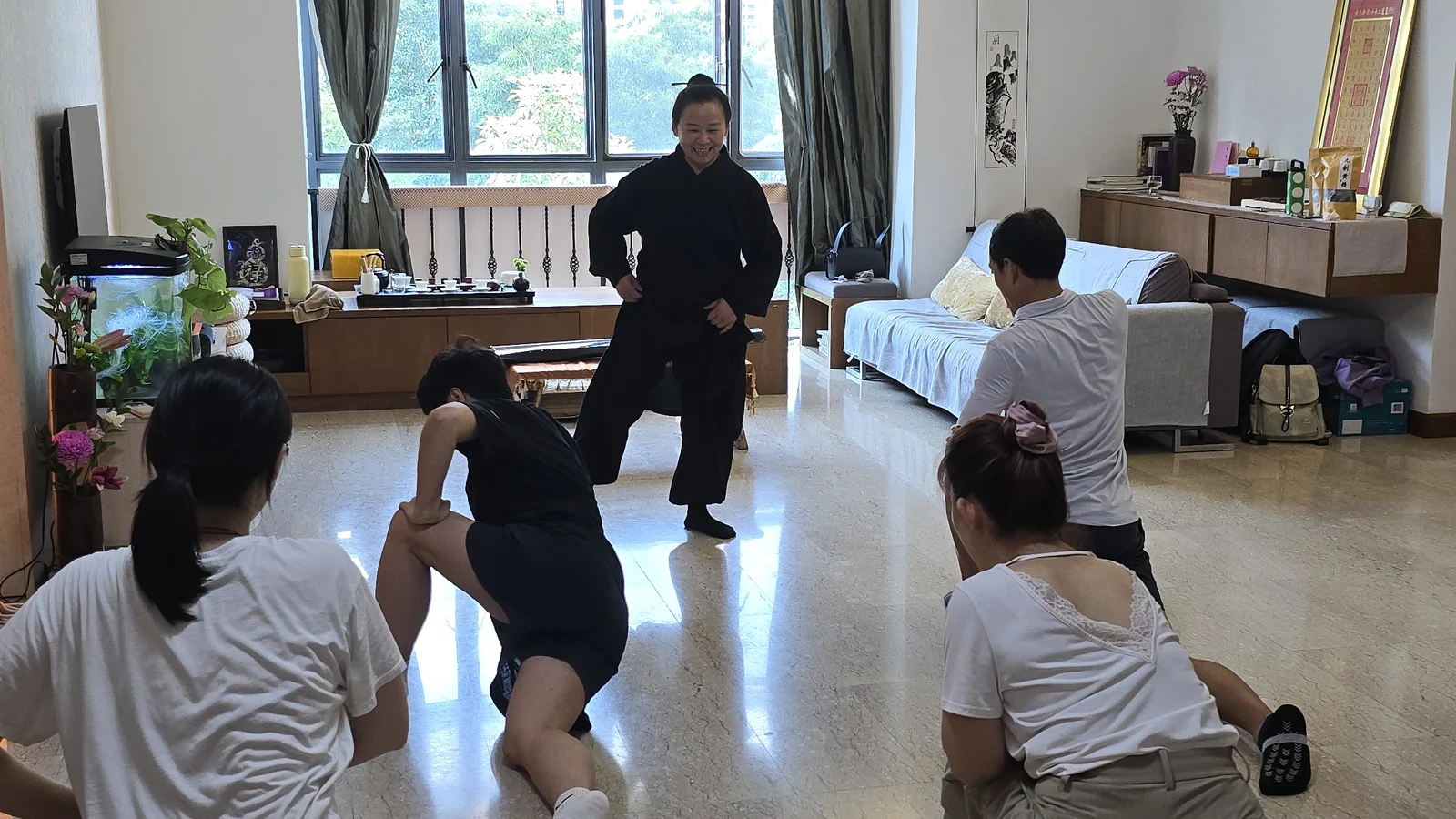
A Wudang taijiquan lesson in a sunlit room: students seen from behind kneel into deep lunges to open the hips while a teacher in black Taoist-style clothing stands in a wide stance, smiling, with an ink-painting scroll on the wall behind.

What Is “Beat the Tiger Left and Right” (Zuoyou Dahu Shi) in Classical Taijiquan?

In Wudang and traditional Taijiquan solo routines, Beat the Tiger Left and Right (Zuoyou Dahu Shi 左右打虎势—also known as Pieshen Dahu or the paired left-and-right tiger-framing postures following Snake Creeps Down and Golden Rooster or preceding Right Heel Kick You Dengjiao 右蹬脚) is one of the most visually striking postures in the form. Stepping diagonally into a full Bow Stance (Gongbu 弓步), the practitioner sweeps both arms in a wide, waist-driven vertical circle so that one arm curves overhead in front of the temple while the other coils across the lower ribs and solar plexus, both hands forming relaxed Hollow Fists (Kongxinquan 空心拳). Far from a stiff muscular pose, Dahu Shi embodies Wu Yuxiang's principle in the Shisanshi Xinggong Xinjie (十三势行功心解): 'Store force through curvature so there is always reserve' (劲以曲蓄而有余).

The Signature Geometry: Two Hollow Fists with Facing Fist-Eyes (Quanyan Xiangdui)

Let us take Left Beat the Tiger (Zuo Dahu Shi 左打虎势, in a left Bow Stance) as our structural model. As the waist settles left-forward into the left Bow Stance, the right arm swings from the rear in an upward-and-inward arc until the right Hollow Fist rests diagonally in front of the right temple (右额前上方), with the palm-side of the fist facing forward-outward and the fist-eye (quanyan 拳眼, thumb-and-index ring) facing inward and slightly downward. Simultaneously, the left arm coils down and across the front of the waist or left ribcage (左胸腹前) with the left Hollow Fist's palm-side facing inward and its fist-eye facing upward toward the right fist. Notice how the upper fist and lower fist face each other along a diagonal meridian—creating a single spherical Peng (掤) hoop anchored by the rounded upper back (babei 拔背).

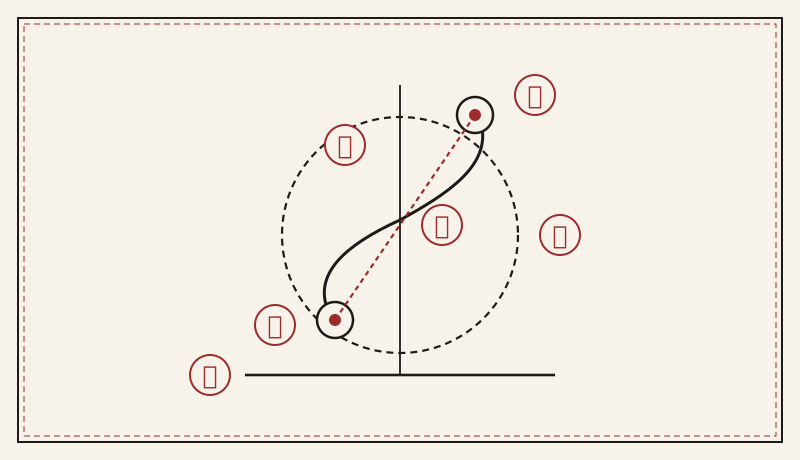
Classical Wudang ink-on-parchment diagram of Beat the Tiger Left and Right (Zuoyou Dahu Shi) showing Diagonal Bow Stance Root (①), Waist-Driven Circular Sweep (②), Upper Temple-Guard Hollow Fist (③), Lower Solar-Plexus Coiled Hollow Fist (④), Vertical Alignment of the Two Fist-Eyes (⑤), and Sunk Scapula and Rounded Back Babei (⑥).

Key — ① Diagonal Bow Stance Base (斜角弓步坐胯, wide stable root with knee aligned over toes); ② Waist-Led Circular Sweep (以腰带臂,弧形转换); ③ Upper Guarding Hollow Fist (上拳护额角, fist-eye facing inward-downward in front of the temple); ④ Lower Coiled Hollow Fist (下拳护胸腹, fist-eye facing upward near the waist/ribs); ⑤ Mutual Facing of the Two Fist-Eyes (上下拳眼相对,合成浑圆掤架); ⑥ Sunk Shoulders and Rounded Upper Back (沉肩坠肘,含胸拔背).

Avoiding the “Lifted-Rib and Shrugged-Shoulder” Trap on the Overhead Arm

Because Dahu Shi raises one fist above head height while turning the torso diagonally, beginners frequently flare the floating ribs (掀肋) and hike the upper shoulder toward the ear. When the ribs lift and the shoulder shrugs, breath gets trapped in the upper chest and the lower stance turns light and unstable. To keep the upper fist rooted: 1. Sink the Scapula First (Chenjian): As the upper fist arcs toward the temple, let the bottom tip of its shoulder blade slide downward toward the opposite hip. 2. Curve the Elbow Forward-Downward (Zhuizhou): Never let the raised elbow point higher than the fist; keep the elbow slightly lower and heavier than the wrist so the forearm forms a protective roof rather than a dead weight. 3. Soften the Sternum (Hanxiong): Exhale into the lower abdomen as the two fists arrive in position simultaneously with the front foot.

Solo Transition Drill: Alternating Left and Right Beat the Tiger

You can practice the left-to-right Dahu Shi transition across a three-meter floor space to build waist-leg unity. From a left Bow Stance in Left Beat the Tiger (right fist high near the right temple, left fist low near the left ribs, gaze directed toward the space beyond the left waist), shift your weight back into the right hip crease, perform a 90-degree Inward Hook Step (Koubu 扣步) with the left foot, shift weight onto the left leg while letting both fists uncoil softly down past the abdomen, and step out with the right foot into a right Bow Stance for Right Beat the Tiger (left fist arcing high in front of the left temple, right fist coiling low in front of the right ribs). Alternate smoothly for 8 to 12 repetitions. Safety note: Keep both wrists straight and unpinched in the Hollow Fist shape, and never twist the supporting knee when pivoting between the left and right diagonals.

Seeker’s Q&A · Frequently Asked Questions

What is the key structural alignment in Beat the Tiger Left and Right (Zuoyou Dahu Shi) in Wudang Taijiquan?

Learn the classical Wudang Taijiquan posture Beat the Tiger Left and Right (Zuoyou Dahu Shi)—coordinating diagonal stepping, waist-led arc sweeping, upper temple-guarding fist and lower waist-guarding fist with facing Fist-Eyes, and sunk-shoulder Peng elasticity.
