WUDANG TAIJIQUAN · 武当太极拳

Wudang Taijiquan Tile-Ridge Palm (Walengzhang) and Hollow Fist (Kongxinquan): Hand-Shape Biomechanics, Seating the Wrist, and Unblocked Force to the Fingers 武当太极拳瓦楞掌与空心拳要诀:坐腕涵空、虎口撑圆与「形于手指」练法

How to form the classical Wudang Taijiquan Tile-Ridge Palm (Walengzhang) and Hollow Fist (Kongxinquan)—exploring Wu Yuxiang's rule that energy manifests in the fingers (Xing Yu Shou Zhi), hollowing the Laogong center, seating the wrist (Zuowan), and avoiding stiff or limp hands.


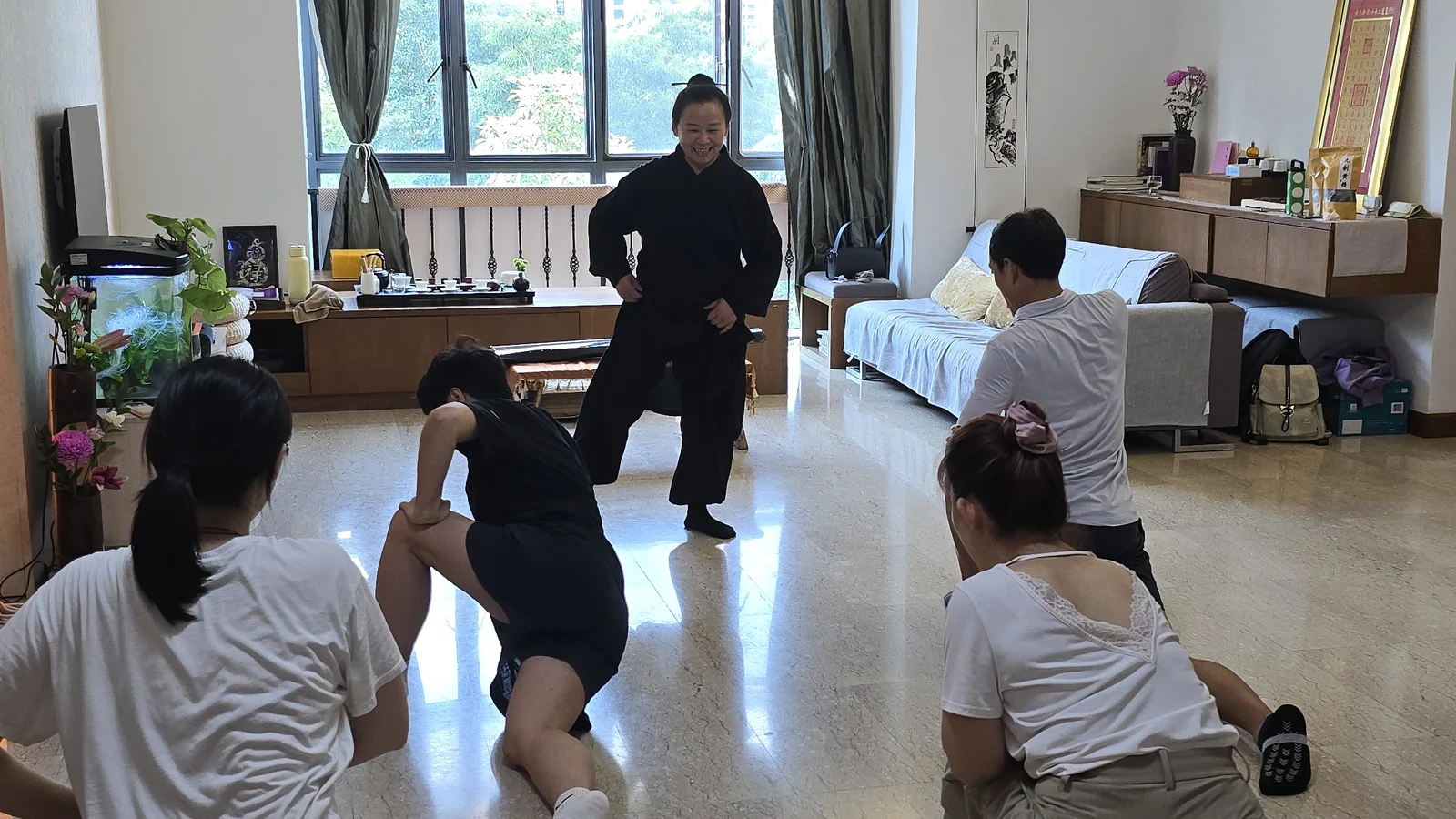
A Wudang taijiquan lesson in a sunlit room: students seen from behind kneel into deep lunges to open the hips while a teacher in black Taoist-style clothing stands in a wide stance, smiling, with an ink-painting scroll on the wall behind.

“Manifesting in the Fingers” (Xing Yu Shou Zhi): Why Hand Shape Matters in Wudang Taijiquan

In Wu Yuxiang's Shisanshi Xinggong Xinjie (十三势行功心解), the transmission path of internal force is summarized in one famous sentence: 'Energy rises from the heels, travels through the legs, is governed by the waist, and manifests in the fingers' (劲起于脚跟,行于腿,主宰于腰,形于手指). Beginners often devote months to stances and waist rotation while leaving the hands either stiffly splayed like wooden paddles or limp like wilted leaves. Yet in Wudang Taijiquan, the hands are the final canopy where the whole body's spiral elasticity (chansijin 缠丝劲) arrives. If the fingers lock or the palm flattens rigidly, the tendons of the forearm contract and block the wave coming up from the feet and waist; if the wrist collapses slackly, the structure loses its buoyant peng (掤) support at the very tip.

The Tile-Ridge Palm (Walengzhang): Concave Center, Rounded Tiger’s Mouth, and Seated Wrist

Classical Wudang Taijiquan shapes the open hand as a Tile-Ridge Palm (Walengzhang 瓦楞掌), named after the curved clay roof tiles (wa 瓦) of traditional Chinese mountain halls. Rather than pressing all cinco fingers flat in a single rigid plane, the five fingers extend naturally with a slight, soft space between them—neither squeezed tightly together nor spread wide to their limit. The middle finger leads subtly as the central axis, while the thumb and little finger curve almost imperceptibly inward toward each other. This gentle curvature naturally hollows the center of the palm (Laogong 劳宫, PC-8), rounds the 'Tiger's Mouth' (Hukou 虎口) between thumb and index finger into a C-shaped arch, and pairs with 'seating the wrist' (zuowan 坐腕)—settling the heel of the palm (zhanggen 掌根) without bending the wrist back at a sharp, pinched 90-degree angle.

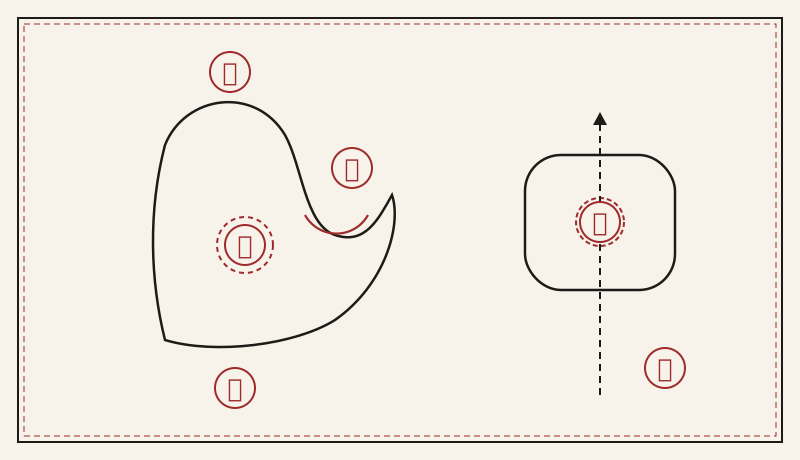
Classical Wudang ink-on-parchment diagram of Tile-Ridge Palm (Walengzhang) and Hollow Fist (Kongxinquan) showing Hollow Laogong Center (①), Rounded Tiger's Mouth Hukou (②), Gently Extended Fingers (③), Seated Wrist Root Zuowan (④), Hollow Fist Core (⑤), and Forearm-to-Fingertip Alignment (⑥).

Key — ① Hollowed Laogong Center (涵空劳宫, gently concave palm center like roof tiles); ② Rounded Tiger's Mouth (虎口撑圆, curved arc between thumb and index finger); ③ Extended Yet Soft Fingers (舒指含劲, neither splayed stiffly nor drooping); ④ Seated Wrist Root (坐腕沉肩, transmitting force through the heel of the palm without pinching the wrist); ⑤ Hollow Fist Core (空心拳, curling fingers as if holding a small sparrow egg); ⑥ Unbroken Line from Elbow to Fingers (形于手指).

The Hollow Fist (Kongxinquan): Holding Fullness Without Crushing

Whenever a Wudang form transitions from open palms into a punch—such as Deflect, Parry, and Punch (Banlanchui 搬拦捶), Fist Under Elbow (Zhoukouchui 肘底看捶), or Turn Body and Chop with Fist (Pieshenchui 撇身捶)—the hand rolls smoothly into a Hollow Fist (Kongxinquan 空心拳). First curl the four fingers segment by segment, then rest the pad of the thumb lightly across the middle phalanges of the index and middle fingers, leaving a small, breathable hollow at the center of the palm—traditionally described as 'holding a small bird's egg without crushing it or letting it slip.' This preserves tendon elasticity through the wrist so the forearm bone aligns cleanly behind the flat striking surface and the 'fist eye' (quanyan 拳眼, the circular ring formed by the thumb and index finger).

A Three-Minute Palm-to-Fist Awakening Drill Before Form Practice

Before stepping into your Taijiquan routine, stand in a relaxed shoulder-width stance with your elbows hanging heavy beside your ribs. Float both forearms to chest height with the palms facing forward at a 45-degree angle. On an inhale, let the wrist joints soften; on a slow exhale, gently settle the heels of the palms (zuowan) and feel the Laogong centers hollow into the curved Tile-Ridge shape (Walengzhang) as warm fullness reaches the fingertips without stiffening a single knuckle. On the next breath, spiral the forearms inward and curl the fingers one joint at a time from little finger to index finger into a relaxed Hollow Fist (Kongxinquan), then uncurl smoothly back into Walengzhang. Repeat eight times slowly. Safety note: Never hyperextend the fingers backward or bend the wrist at an acute angle; a healthy Taijiquan wrist stays spacious, warm, and comfortable.

Seeker’s Q&A · Frequently Asked Questions

What is the key structural alignment in Wudang Taijiquan Tile-Ridge Palm (Walengzhang) and Hollow Fist (Kongxinquan)?

How to form the classical Wudang Taijiquan Tile-Ridge Palm (Walengzhang) and Hollow Fist (Kongxinquan)—exploring Wu Yuxiang's rule that energy manifests in the fingers (Xing Yu Shou Zhi), hollowing the Laogong center, seating the wrist (Zuowan), and avoiding stiff or limp hands.
