
WUDANG TAIJIQUAN · 武当太极拳

Embrace Tiger and Return to Mountain (Baohu Guishan) in Wudang Taijiquan: Diagonal Pivot, Gathering Embrace, and Lu-Ji-An Transition 武当太极拳“抱虎归山”详解:十字手斜隅转身、环抱引化与捋挤按连环要领

Learn the step-by-step footwork and upper-body mechanics of Embrace Tiger and Return to Mountain (Baohu Guishan) in Wudang Taijiquan: pivoting 135 degrees from Cross Hands into the diagonal corner and linking Brush Knee with Roll-Back, Press, and Push.


Forested rocky peaks rising above a sea of clouds at dawn.

1. Opening the Four Diagonal Corners: The Role of Baohu Guishan in the Form

In traditional Wudang and classical Taijiquan solo forms, the first section moves primarily along the cardinal North–South and East–West lines, culminating in Apparent Close-Up (Rufeng Sibi) and Cross Hands (Shizishou). Immediately after Cross Hands, the second section opens with Baohu Guishan (抱虎归山, 'Embrace Tiger and Return to Mountain'), which introduces the four diagonal corners (Si Yu 四隅) of the Thirteen Postures (Shisanshi).

Why is it named 'Embrace Tiger and Return to Mountain'? In Wudang imagery, the 'tiger' represents vigorous, incoming momentum from an oblique angle, while 'returning to the mountain' signifies drawing that energy back into your own stable root and responding with the full cycle of Grasp the Sparrow's Tail (Lanquewei: Peng, Lu, Ji, An).

2. Step-by-Step Footwork: The 135-Degree Pivot from Cross Hands

The most common stumbling block in Baohu Guishan is losing balance during the large turn out of Cross Hands. Begin in Cross Hands facing North with feet shoulder-width apart. First, shift weight quietly onto your left leg and fold the left hip crease (Kua) so your vertical axis is anchored through the left heel. Next, release the right heel and pivot outward to the right as your waist turns 135 degrees toward the Southeast diagonal corner, stepping the right foot softly onto the diagonal line.

Never spin on a locked knee or throw your shoulders ahead of your hips! Because the turn is driven by loosening the left Kua and pivoting while unweighted, your knee joints remain completely free of torsional shear. Once the right heel touches down in the diagonal corner and transitions into a right bow stance, the left hand brushes past the right knee while the right palm presses forward along the diagonal centerline.

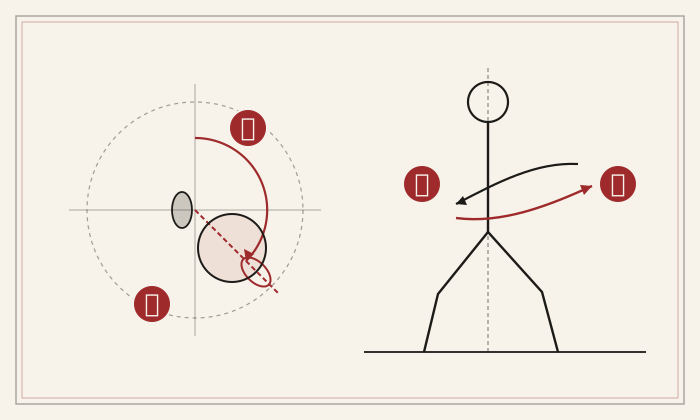
Classical diagram of Wudang Taijiquan Embrace Tiger and Return to Mountain (Baohu Guishan) showing the 135-degree diagonal pivot from Cross Hands, rounded gathering embrace, Lu roll-back folding, and Ji-An return

The four structural phases of Baohu Guishan: 135-degree diagonal pivot, rounded gathering embrace, folding into Lu, and returning through Ji and An.

  1. ① 135-Degree Diagonal Pivot: Turning on the rooted left heel from Cross Hands (Shizishou) to open the rear diagonal corner.
  2. ② Brushing & Gathering Embrace (Baohu): Diagonal brush-and-press transitioning smoothly into a spherical two-arm embrace.
  3. ③ Folding into Roll-Back (Lu): Sitting into the rear hip crease (Kua) to guide incoming force along a tangent arc.
  4. ④ Returning to the Mountain Root (Guishan): Coalescing forearm-to-wrist Press (Ji) and two-palm Push (An) from the rear root.

3. From Diagonal Brush Knee to 'Embracing the Tiger' (Lu, Ji, An)

Unlike a standard forward Brush Knee Twist Step, the diagonal press in Baohu Guishan immediately softens and rounds into a spacious gathering arc—the literal 'Embrace the Tiger' (Baohu) gesture. The right forearm curves horizontally at chest height while the left palm circles beneath the right elbow, cradling an incoming force and leading directly into Lu (Roll-Back) as weight sits back into the left hip.

From the bottom of that rear-weighted Lu, the waist turns back toward the diagonal corner, bringing the left palm to meet the inner right wrist for Ji (Press), followed by separating the hands, drawing back over an imaginary sphere, and settling forward into An (Push). In this single sequence, you unite diagonal stepping with all four cardinal energies (Peng, Lu, Ji, An).

4. Solo Corner-Turn Drill & Knee-Protection Checklist

Practice the transition from Shizishou (Cross Hands) into Baohu Guishan five times slowly on each side so both legs learn the 135-degree diagonal pivot equally. Focus on three checkpoints: first, ensure 100 percent of the weight is settled in the standing leg before pivoting the turning foot; second, step with sufficient lateral width on the diagonal so your feet do not cross on a tightrope; third, keep both armpits hollow and rounded during the 'embrace' phase.

Safety note: if 135 degrees feels tight on your hips or ankles, break the turn into two small micro-pivots of the heel and ball of the foot rather than twisting on a planted sole. This instructional guide is for educational martial arts study; practice within a pain-free range of motion.

Seeker’s Q&A · Frequently Asked Questions

What is the core takeaway of Embrace Tiger and Return to Mountain (Baohu Guishan) in Wudang Taijiquan?

Learn the step-by-step footwork and upper-body mechanics of Embrace Tiger and Return to Mountain (Baohu Guishan) in Wudang Taijiquan: pivoting 135 degrees from Cross Hands into the diagonal corner and linking Brush Knee with Roll-Back, Press, and Push.
