
WUDANG TAIJIQUAN · 武当太极拳

Folding the Waist and Borrowing Force (Zhedie & Jieli) in Wudang Taijiquan: How “Four Ounces Deflect a Thousand Pounds” Works Biomechanically 武当太极拳“折叠”与“借力打力”详解:四两拨千斤的腰胯切线化发机制

Demystify the classical Taijiquan principle of Zhedie (structural folding) and Jieli (borrowing momentum) through rotational tangent physics, hip-crease yielding, and safe solo transitions.

A bundle of dried stalks tied with cord, a lidded bronze jar and an old book on a wooden sill by an open window, with a crescent moon over misty pines outside.

1. Classical Treatise Foundations: “In Going and Returning, There Must Be Folding”

Two famous maxims from the classical Taijiquan Treatise (Taijiquan Lun) and the Song of Pushing Hands (Da Shou Ge) define advanced internal skill in Wudang Taijiquan: first, “In going and returning, there must be folding; in advancing and retreating, there must be transitions” (wang fu xu you zhe die, jin tui xu you zhuan huan 往复须有折叠,进退须有转换); and second, “Draw four ounces to deflect a thousand pounds” (qian dong si liang bo qian jin 牵动四两拨千斤), popularly known as borrowing force (jieli 借力).

Far from mystical levitation, zhedie (折叠, structural folding through the waist, hip creases, and three arm sections) and jieli (借力, redirecting an incoming vector along a circular tangent) are straightforward applications of rotational geometry and timing.

2. The Physics of Borrowing Force: Tangent Redirection instead of Head-On Collision

When a partner pushes straight toward your chest with heavy linear momentum, meeting that line head-on turns the encounter into a contest of raw body mass. In Wudang Taijiquan, “four ounces deflecting a thousand pounds” relies on three linked mechanical steps that convert linear impact into rotational slip:

  1. Non-resistant contact (Tingjin Listening & Peng Frame): Instead of collapsing or stiffening, the forearm maintains a buoyant curved frame (Peng) that senses the exact angle and speed of the incoming force.
  2. Folding the hip crease (Zhedie at the Kua): As the incoming force arrives, the weighted hip crease (kua 胯) and waist fold inward slightly while the opposite side opens—like a revolving door pivoting on a well-oiled central axis (Zhongding).
  3. Guiding along the tangent into empty space (Yinjin Luokong 引进落空): Because the contact point rotates along the circumference of a sphere, the heavy straight push glances off at a tangent into empty space. Once the partner’s momentum overextends past their own front foot, a small continuing spiral from your rooted rear leg (silk-reeling energy) adds naturally to their existing forward velocity—that is genuine “borrowing force” (jieli).
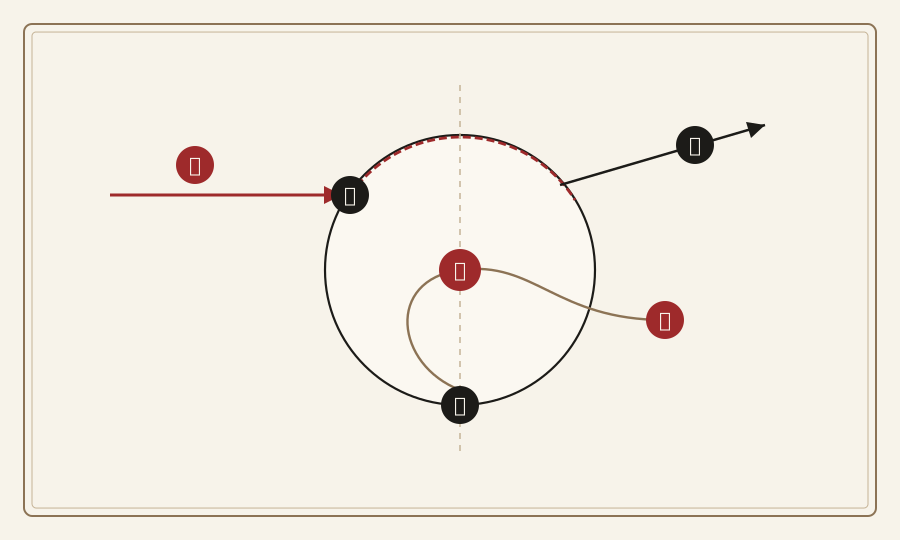
Classical numbers-only diagram of Wudang Taijiquan Zhedie (folding) and Jieli (borrowing force) showing an incoming linear vector (①) met at a spherical tangent (②) around the central waist axis (③) to deflect into empty space (④) and return via the rooted kua spiral (⑤–⑥).

Wudang Taijiquan Zhedie & Jieli (numbers-only SVG key): How hip-crease folding and spherical tangent rotation redirect linear force.

  1. ① Incoming Linear Force Vector: Heavy straight-line push aimed at the practitioner’s centerline.
  2. ② Tangential Contact Point (Tingjin & Peng): Buoyant forearm contact that neither collapses nor collides head-on.
  3. ③ Central Waist & Kua Folding Axis (Zhedie): Yielding one hip crease while turning the waist around the vertical axis.
  4. ④ Deflection into Empty Space (Yinjin Luokong): The straight vector glances harmlessly along the tangent past the body.
  5. ⑤ Rooted Rear-Leg Anchor: Weight settles cleanly into the supporting leg without leaning the spine.
  6. ⑥ Borrowed Return Spiral (Jieli): A continuous waist-led arc that rides the partner’s overextended momentum.

3. Horizontal and Vertical Folding in Solo Form Practice

How do you train zhedie when practicing solo on Wudang Mountain or at home in Singapore? Every transition between Yin (absorbing/closing) and Yang (extending/opening) in the solo form contains a subtle “fold”—never a sharp stop-and-reverse:

  • Chest-Back and Waist-Kua Folding: In transitions such as Rollback to Press (Lu to Ji) or Brush Knee and Twist Step (Louxi Aobu), as the hands draw back in Rollback, the rear hip crease folds gently inward; just before the weight shifts forward into Press, the lower back settles and the waist coils forward along a tiny circular loop so that retraction flows seamlessly into extension.
  • Three-Section Arm Folding: Rather than pulling the hands straight back like a piston, the wrist, elbow, and shoulder fold and unfold sequentially in smooth figure-eight curves, governed by the Six Harmonies (Liuhe).

4. 5-Minute Solo “Rollback-to-Press Folding” Drill & Safety Notes

Practice this five-minute solo drill to feel waist-led folding without a partner: stand in a right bow stance with rounded arms in Ward-Off (Peng). Exhale as you fold the right hip crease back, shifting 70% of the weight toward the left (rear) leg while the waist turns 30 degrees to the left in Rollback (Lu)—imagining you are guiding a heavy push past your left shoulder. Instead of stopping dead at the back, let the tailbone settle and coil the waist smoothly back to the right as you inhale and press forward into Ji.

Repeat ten slow cycles per side, watching that your knees stay aligned with your toes and your spine remains upright without leaning backward. Safety note: keep the stance height moderate to protect the knee joints; if you experience lower-back or knee discomfort, narrow your stance and consult a qualified healthcare professional.

Seeker’s Q&A · Frequently Asked Questions

What do Zhedie (folding) and Jieli (borrowing force) mean in Wudang Taijiquan?

Zhedie (folding) is the smooth spiral transition in the hip creases, waist, and three arm joints between absorbing and extending; Jieli (borrowing force) uses that spherical rotation to deflect an incoming push along a tangent into empty space and ride its momentum.


