WUDANG TAIJIQUAN · 武当太极拳

Diagonal Flying (Xiefeishi) and Raise Hands (Tishou Shangshi) in Wudang Taijiquan: Spiraling Shear Force (Lie Jin) and Empty-Stance Gathering 武当太极拳“斜飞势”与“提手上势”详解:四隅挒劲旋展与虚步合劲要领

A practitioner's biomechanical and classical guide to Diagonal Flying (Xiefeishi) and Raise Hands and Step Up (Tishou Shangshi) in Wudang Taijiquan — examining 45-degree corner stepping, waist-driven splitting energy (Lie Jin), shoulder-stroke integration (Kao), and vertical gathering in Empty Stance.


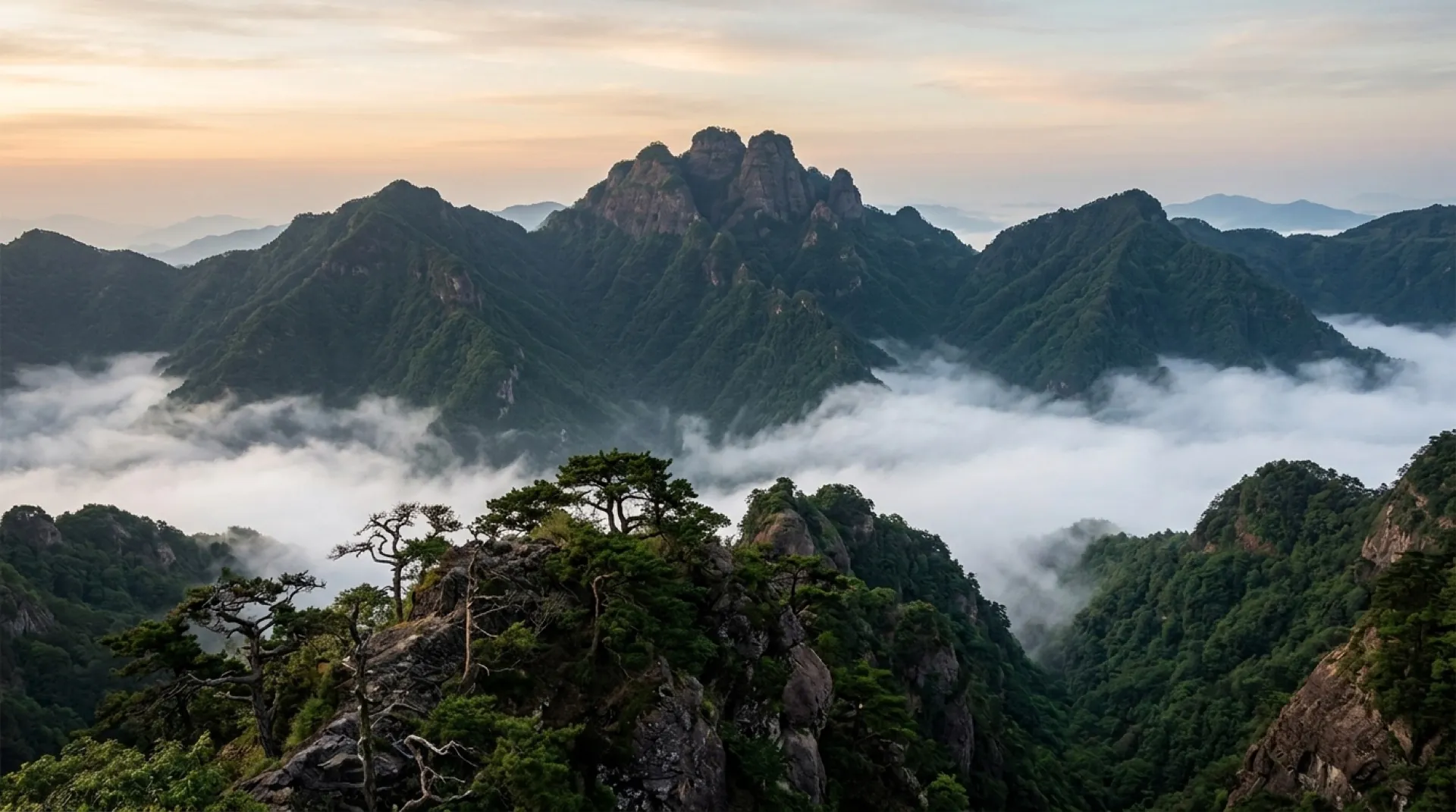
Forested rocky peaks rising above a sea of clouds at dawn.

1. Opening and Gathering the Corners: Why Xiefeishi and Tishou Shangshi Form a Complementary Pair

In traditional Wudang Taijiquan forms, Diagonal Flying (Xiefeishi 斜飞势) and Raise Hands and Step Up (Tishou Shangshi 提手上势) appear as contrasting expressions of opening (kai 开) and closing (he 合) across the cardinal and corner directions. Whereas Parting the Wild Horse's Mane splits forward along a gentle diagonal with a rounded ward-off cradle, Xiefeishi steps boldly into the forty-five-degree corner gate (xiejiao 斜角) and unfolds like the sweeping wing of a crane rising through mountain mist. Immediately afterward — or in transitional sequences alongside White Crane Spreads Its Wings — Tishou Shangshi gathers the expanded frame back into a compact, rooted Empty Stance (Xubu) with both palms converging along the vertical centerline.

Within the framework of the Eight Methods and Five Steps (Shisanshi), Xiefeishi is the primary form posture for studying Lie (挒 — splitting or spiraling shear force) in seamless partnership with Kao (靠 — shoulder/torso stroke) and Cai (采 — plucking downward), while Tishou Shangshi refines upward-and-inward Peng (掤) and Ji (挤) compression along the vertical axis.

2. Biomechanics of Diagonal Flying (Xiefeishi): Holding the Ball, Corner Step, and Spiraling Split

Every clean repetition of Xiefeishi begins with coiled storage (xu 蓄). Shifting weight onto the supporting leg, allow the kua (inguinal fold) to settle and fold the arms into a compact "holding the ball" (baoqiu 抱球) cradle: when stepping to the right diagonal, the right forearm rests low in front of the lower dantian with the palm facing upward, while the left palm hovers near the right chest or shoulder facing downward. Keep the crown suspended (xuling dingjin 虚领顶劲) and let the empty right foot step out toward the forty-five-degree corner without throwing the upper torso prematurely.

As weight transfers smoothly into the right Bow Stance (Gongbu 弓步), turn the waist (yao 腰) to the right so that both arms divide simultaneously along opposite Silk-Reeling (Chansijin) trajectories: the right arm sweeps diagonally upward and outward to shoulder-to-brow height with the palm turned obliquely upward, while the left palm spirals downward and settles beside the left hip with the palm pressing lightly down. The two hands must arrive together with the settling of the front knee (shangxia xiangsui 上下相随). Because the left hand sinks and anchors the rear hip as the right wing expands, the spine remains upright and centered rather than tipping sideways.

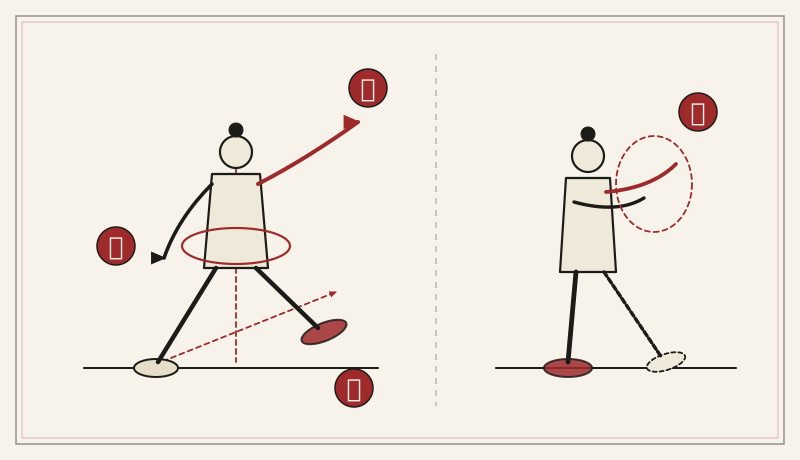
Classical ink-and-cinnabar biomechanical diagram of Wudang Taijiquan Diagonal Flying (Xiefeishi) and Raise Hands (Tishou Shangshi) with four numbered markers (①–④).

Figure 1: Diagonal Flying (Xiefeishi) and Raise Hands and Step Up (Tishou Shangshi) — ① 45-degree corner stepping into a rooted Bow Stance (Xiebu Gongbu); ② Waist-driven spiraling shear around the central axis (Yao Dai Lie Jin); ③ Counter-balanced diagonal wing expansion and hip-level sinking hand (Youzhan Zuochen); ④ Gathering transition into Raise Hands in Empty Stance (Tishou Shangshi · Xubu Hejin).

  1. ① Corner-Stepping Bow Stance (Xiebu Gongbu 斜步弓步): Stepping along the 45-degree diagonal corner gate while keeping hip-width lateral stability.
  2. ② Waist-Driven Splitting Shear (Yao Dai Lie Jin 腰带挒劲): Rotating the lumbar-pelvic hub so the two arms divide along opposite spiral vectors.
  3. ③ Rising Wing and Sinking Anchor Hand (Youzhan Zuochen 右展左沉): The outward-sweeping forearm rises to shoulder-to-brow height while the opposite palm settles near the hip to anchor the root.
  4. ④ Raise Hands and Step Up in Empty Stance (Tishou Shangshi 提手上势): Drawing the front heel lightly to touch the ground (20–30% weight) while both hands converge vertically in a protective Peng-He frame.

3. Raise Hands and Step Up (Tishou Shangshi): Vertical Compression in Empty Stance

To transition into Raise Hands and Step Up (Tishou Shangshi 提手上势), shift weight securely onto the supporting leg, fold the supporting kua, and draw the front foot in to touch the ground lightly with the heel (an Empty Heel Stance carrying roughly 20–30 percent of the weight, keeping 70–80 percent rooted in the rear leg). Simultaneously, bring both arms inward along a gentle upward arc in front of the centerline as if gently lifting and compressing a large wooden cylinder between the forearms.

At completion, the lead hand (matching the front empty foot) rises to the level of the brow or nose with the thumb side facing upward and fingers pointing forward, while the rear palm settles slightly lower near the inner elbow or chest midline, guarding the center. Relax the shoulders and let the elbows hang heavy (chenjian zhuizhou 沉肩坠肘) so the ribcage stays soft and the breath sinks naturally to the lower abdomen, in harmony with Natural Abdominal Breathing.

4. Common Alignment Faults and Self-Correction Drills

Practitioners trained in the traditional halls of Wudang Mountain and in our Singapore classes check three common faults in Xiefeishi and Tishou Shangshi: 1) Over-flinging the rising arm behind the shoulder plane — swinging the right arm too far backward in Xiefeishi pinches the rear shoulder blade and breaks the connected bow of the upper back (hanxiong baba 含胸拔背); keep the rising wrist within your peripheral field of vision; 2) Forgetting the lower anchor hand — if the left hand goes slack by the hip in Xiefeishi, the upper body feels top-heavy; feel an equal fifty-fifty opposition between the rising right forearm and the sinking left palm; 3) Shrugging the shoulders in Tishou Shangshi — lifting the hands by contracting the upper trapezius traps breath in the chest; initiate the upward lift of the palms by sinking the rear hip and lengthening the spine.

Practice linking Xiefeishi → Tishou Shangshi → White Crane Spreads Its Wings slowly for five minutes on both the right and left sides, coordinating inhalations with the coiled gathering phases and exhalations with the diagonal opening and vertical settling phases. Traditional Wudang Taijiquan cultivates balance, joint mobility, and calm focus and is not a substitute for clinical medical care.

Seeker’s Q&A · Frequently Asked Questions

What is the core takeaway of Diagonal Flying (Xiefeishi) and Raise Hands (Tishou Shangshi) in Wudang Taijiquan?

A practitioner's biomechanical and classical guide to Diagonal Flying (Xiefeishi) and Raise Hands and Step Up (Tishou Shangshi) in Wudang Taijiquan — examining 45-degree corner stepping, waist-driven splitting energy (Lie Jin), shoulder-stroke integration (Kao), and vertical gathering in Empty Stance.
