WUDANG TAIJIQUAN · 武当太极拳

Threading Palm (Chuanzhang) and Upward Coiling Transitions in Wudang Taijiquan: Guiding the Fingertips Along the Forearm Without Raising the Shoulders 武当太极拳「穿掌」与起伏转换要诀:贴腕抽丝、沉肩坠肘与下势接金鸡独立练法

Master the classical Wudang Taijiquan Threading Palm (Chuanzhang)—learning how the fingertips glide along the inner forearm track from Snake Creeps Down (Xiashi) into Golden Rooster Stands on One Leg (Jinji Duli) while keeping the shoulders sunk and elbows heavy.


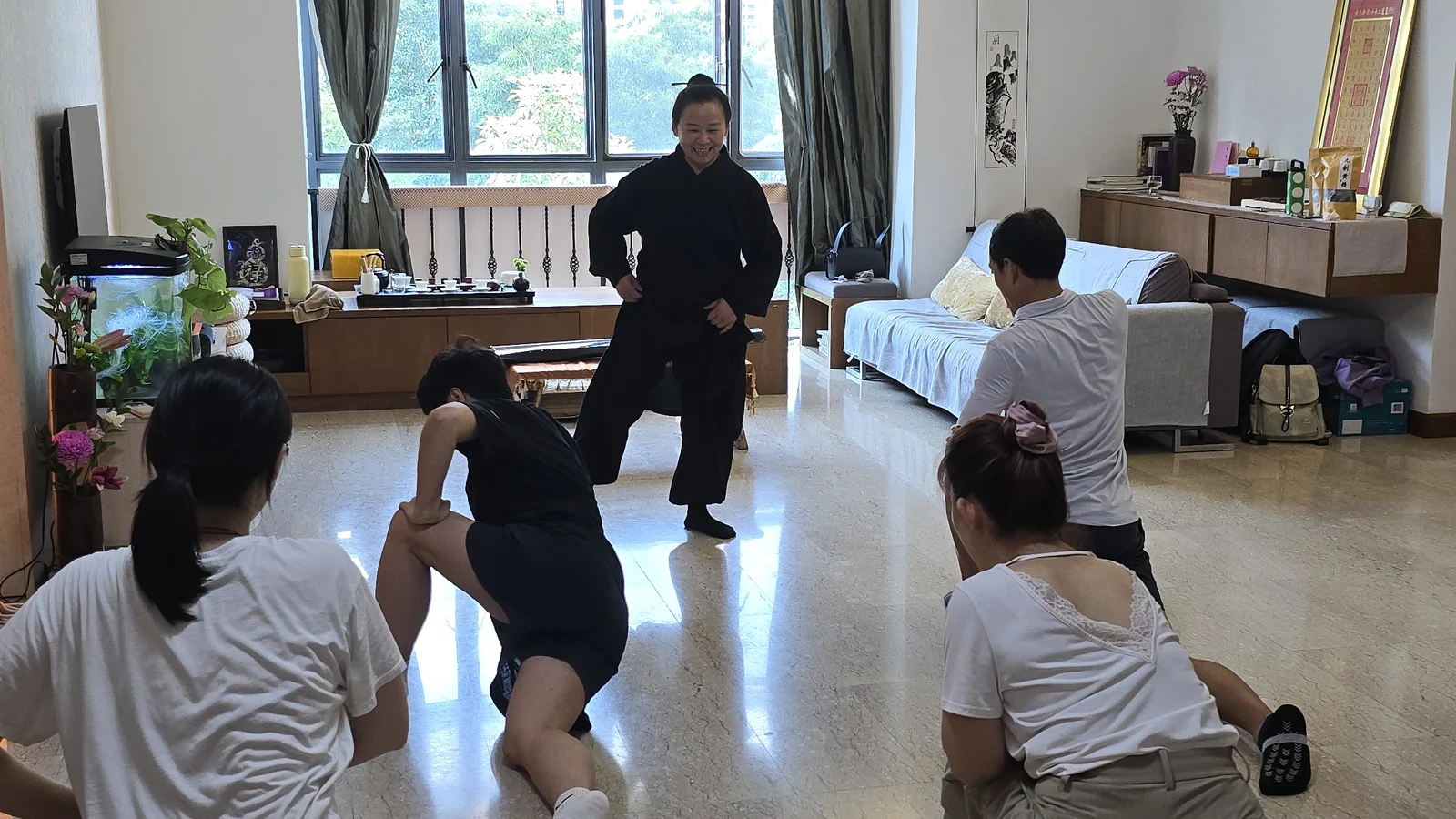
A Wudang taijiquan lesson in a sunlit room: students seen from behind kneel into deep lunges to open the hips while a teacher in black Taoist-style clothing stands in a wide stance, smiling, with an ink-painting scroll on the wall behind.

What Is Threading Palm (Chuanzhang) in Wudang Taijiquan?

Across Wudang Taijiquan, Liangyi, and internal palm routines, Threading Palm (Chuanzhang 穿掌) is the signature method for extending a hand smoothly through a narrow gap along the centerline—most famously when rising out of the low crouch of Snake Creeps Down (Xiashi 下势) into Golden Rooster Stands on One Leg (Jinji Duli 金鸡独立), or when threading the lead hand upward through the guard arm in Fair Lady Works at Shuttles (Yunü Chuansuo 玉女穿梭) and White Snake Spits Its Tongue (Baishe Tuxin 白蛇吐信). Rather than swinging the arm outward like a club or lifting the whole shoulder girdle, Chuanzhang sends the fingertips gliding cleanly along the inside of the opposite wrist and forearm—like a needle drawing silk thread through a loom (运劲如抽丝, in Wu Yuxiang's Shisanshi Xinggong Xinjie 十三势行功心解).

Why Beginners Shrug the Shoulders During Upward Threading—and How Chenjian Zhuizhou Solves It

Whenever a posture asks the hand to travel upward past chest or throat height, the untrained habit is to contract the upper trapezius and lift the shoulder toward the ear. The moment the shoulder rises, breath floats upward into the chest, the elbow loses its downward root, and the practitioner's balance becomes top-heavy. In Wudang Taijiquan, upward Chuanzhang relies on a counter-directional pairing: the fingertips extend upward while the shoulder blade and elbow sink downward (chenjian zhuizhou 沉肩坠肘). Think of a pulley or a well-sweep: it is precisely the heavy dropping of the elbow and the downward rooting of the supporting leg into the floor that causes the fingertips of the threading palm to float effortlessly upward along the centerline.

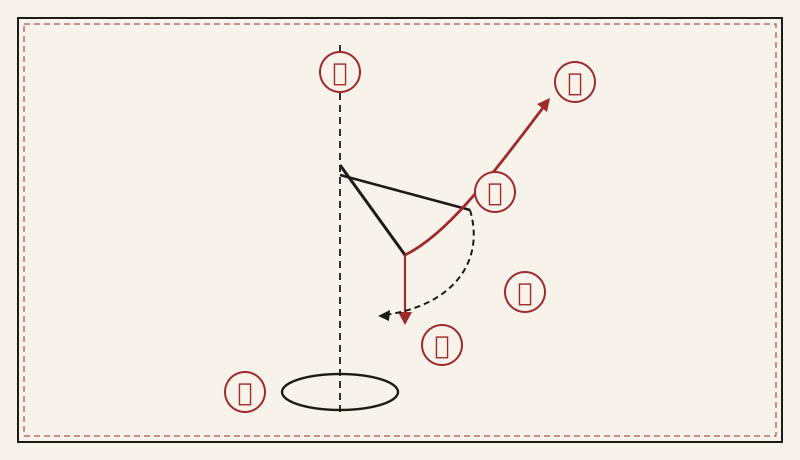
Classical Wudang ink-on-parchment diagram of Threading Palm (Chuanzhang) showing Rooted Rear Kua to Lead Leg Shift (①), Guard Wrist Track (②), Upward Spiraling Threading Palm Path (③), Sunk Shoulder and Dropped Elbow Anchor (④), Mutual Opening and Closing of the Two Hands (⑤), and Crown-to-Heel Vertical Axis (⑥).

Key — ① Rooted Leg Drive (劲起于脚跟, pushing the ground softly to initiate upward coiling); ② Guard Hand Forearm Track (护手贴腕, the quiet reference rail near the centerline); ③ Threading Palm Spiral Path (穿掌如抽丝, fingertips gliding close along the inner forearm); ④ Sunk Shoulder and Heavy Elbow (沉肩坠肘, preventing shoulder shrugging as the hand rises); ⑤ Mutual Opening-Closing Exchange (阴阳相济,动分静合); ⑥ Crown-to-Supporting-Heel Plumb Line (虚领顶劲,独立中正).

The Two-Hand Track: How the Guard Hand Protects the Gate While the Threading Hand Spirals Out

A clean Chuanzhang is never a one-armed action; it fulfills Wang Zongyue's principle in the Taijiquan Lun (太极拳论) that 'in motion all parts separate, in stillness all parts unite, and upper and lower follow one another' (动之则分,静之则合;上下相随). As the threading hand begins its path from the waist or hip crease, its fingertips stay lightly aligned with the inner forearm of the lead guard hand. As the waist turns and the threading palm extends forward or upward with a subtle supinating or pronating spiral, the former lead hand draws gently downward toward the hip or ribcage to cover the lower gate. Because the two wrists pass within a few finger-widths of each other along the centerline, the central gate (zhongmen 中门) is never left unguarded.

A Four-Minute Stationary and Stepping Chuanzhang Solo Drill

You can isolate and polish Chuanzhang before practicing low-to-high form transitions. Stand in a moderate Bow Stance (Gongbu 弓步) with your left hand extended forward at chest height in a relaxed Tile-Ridge Palm (Walengzhang 瓦楞掌) and your right palm resting lightly near your left elbow crease. On a slow inhale, shift 60 percent of your weight back into the rear hip crease while turning the waist slightly right; on a long exhale, shift forward into the front leg, let your right shoulder and elbow sink heavy, and thread your right fingertips smoothly forward and slightly upward along the inside of your left forearm until the right hand becomes the new lead palm while the left hand draws softly back to the right elbow or ribside. Alternate left and right for 12 repetitions per side. Safety note: Keep the neck long and jaw relaxed; if you feel your upper shoulders tightening as the hand rises, lower the target height of the threading palm to breastbone level until the shoulder stays completely soft.

Seeker’s Q&A · Frequently Asked Questions

What is the key structural alignment in Threading Palm (Chuanzhang) and Upward Coiling Transitions in Wudang Taijiquan?

Master the classical Wudang Taijiquan Threading Palm (Chuanzhang)—learning how the fingertips glide along the inner forearm track from Snake Creeps Down (Xiashi) into Golden Rooster Stands on One Leg (Jinji Duli) while keeping the shoulders sunk and elbows heavy.
