WUDANG TAIJIQUAN · 武当太极拳

Fist Under Elbow (Zhoudi Kanchui) and Follow-Step (Genbu) in Wudang Taijiquan: Guarding the Centerline, Empty-Step Root, and Stored Reserve 武当太极拳「肘底看捶」与跟步虚步要诀:肘底藏蓄、护守中门与衔接倒卷肱练法

How to practice Fist Under Elbow (Zhoudi Kanchui) and the Half-Step Follow (Genbu) in Wudang Taijiquan—coordinating waist-led stepping, heel-touch Empty Stance (Xubu), lead-palm Peng-Lu deflection, and the reserve Hollow Fist tucked beneath the elbow.


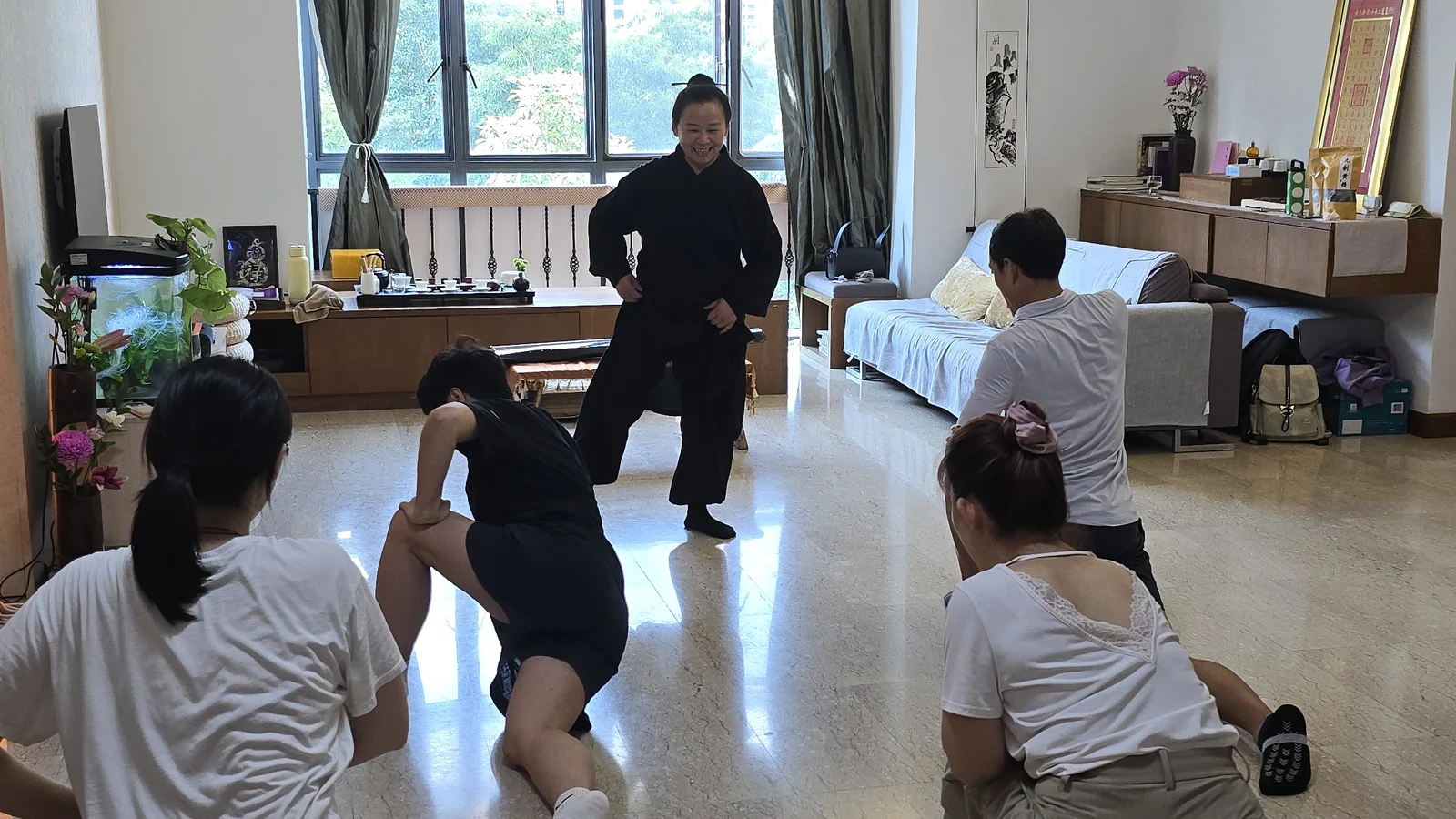
A Wudang taijiquan lesson in a sunlit room: students seen from behind kneel into deep lunges to open the hips while a teacher in black Taoist-style clothing stands in a wide stance, smiling, with an ink-painting scroll on the wall behind.

What Does “Fist Under Elbow” (Zhoudi Kanchui) Mean in Classical Taijiquan?

In Wudang and traditional Taijiquan solo forms, Fist Under Elbow (Zhoudi Kanchui 肘底看捶—literally 'Guarding/Watching the Fist Beneath the Elbow') appears at a pivotal moment of transition, typically following Step Up, Deflect, Parry, and Punch (Shangbu Banlanchui 上步搬拦捶) or Apparent Close-Up (Rufeng Sibi 如封似闭) and immediately preceding Retreat to Repulse the Monkey (Daojuanhong 倒卷肱). The posture's name captures both its geometry and its tactical principle: the lead (left) forearm stands softly along the centerline in a vertical Tile-Ridge Palm (Walengzhang 瓦楞掌), while the rear (right) hand forms a relaxed Hollow Fist (Kongxinquan 空心拳) with the 'fist eye' (quanyan 拳眼) facing upward, tucked quietly two to three finger-widths beneath the left elbow. Rather than exposing all one's intention on the surface, Zhoudi Kanchui embodies Wu Yuxiang's maxim in the Shisanshi Xinggong Xinjie (十三势行功心解): 'Store energy like drawing a bow' (蓄劲如开弓)—the lead palm listens and deflects while the fist beneath the elbow holds unspent reserve.

Mastering the Half-Step Follow (Genbu): Compacting the Stance Without Rising

To enter Zhoudi Kanchui from a wider Bow Stance, the practitioner uses a foundational footwork technique called the Follow-Step or Half-Step (Genbu 跟步). When turning and drawing the rear foot half a step forward behind the lead foot, beginners frequently push up with the legs, causing the head to bob upward like a cork. To keep the crown level (立如平准), initiate Genbu by sinking first into the front supporting hip crease (songkua 松胯), peel the rear foot lightly off the ground, and draw it half a step forward along the floor before transferring weight smoothly onto that newly placed rear foot. Once the rear leg receives 70 to 80 percent of the weight, the front (left) foot advances half a step and touches down lightly on its heel (脚跟着地) into a poised Empty Stance (Xubu 虚步).

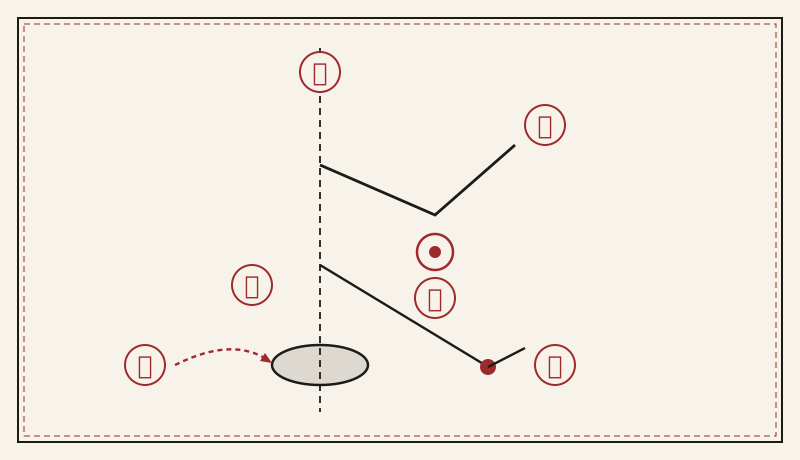
Classical Wudang ink-on-parchment diagram of Fist Under Elbow (Zhoudi Kanchui) showing Half-Step Follow Genbu (①), Lead Heel-Touch Empty Step Xubu (②), Lead Tile-Ridge Guard Palm on Centerline (③), Reserve Hollow Fist Under Elbow (④), Sunk Rear Kua Support (⑤), and Crown-to-Rear-Heel Plumb Line (⑥).

Key — ① Half-Step Follow (跟步, drawing the rear foot half a step forward to compact the base without bobbing); ② Heel-Touch Empty Stance (虚步点跟, front heel resting lightly with 70–80% weight on the rear leg); ③ Lead Centerline Guard Palm (前掌立护中门, side-facing Walengzhang aligned with the nose); ④ Fist Stored Under Elbow (肘底藏捶, right hollow fist resting Fist-Eye up below the left elbow); ⑤ Sunk Rear Hip Crease (实腿松胯坐根); ⑥ Vertical Plumb Axis (虚领顶劲).

Upper-Body Geometry: The Protective Triangle of Lead Palm, Elbow, and Stored Fist

In the finished posture of Zhoudi Kanchui, the upper limbs form a resilient, rounded frame in front of the chest without cramping the armpits. The left palm stands obliquely forward on the centerline with the fingers at nose or throat height and the palm facing rightward; the left elbow drops heavy (zhuizhou 坠肘) with at least one fist-width of open space beneath the armpit. Directly beneath the left elbow sits the right Hollow Fist, fist-eye facing upward and thumb-side toward the chest. The gaze looks calmly past the outer edge of the left wrist (眼看前手腕外侧), uniting spirit (shen), breath, and structure along a single forward vector while the rear hip stays deeply rooted.

Why Zhoudi Kanchui Is the Launchpad for Repulse the Monkey (Daojuanhong)

Notice how Zhoudi Kanchui sets up the next posture in the sequence: Retreat to Repulse the Monkey (Daojuanhong 倒卷肱). Because 70 to 80 percent of your weight is already settled into the rear leg and your right fist is already coiled beneath your left elbow, transitioning into the first retreat step requires zero wasted motion—As the waist turns right, the stored right hand simply spirals open downward and backward into its rear arc while the left palm extends gently forward. Safety note: When settling into the Empty Stance (Xubu) of Zhoudi Kanchui, ensure your rear supporting knee points directly over the rear toes rather than collapsing inward, and keep the front heel resting softly on the ground without locking the front knee joint.

Seeker’s Q&A · Frequently Asked Questions

What is the key structural alignment in Fist Under Elbow (Zhoudi Kanchui) and Follow-Step (Genbu) in Wudang Taijiquan?

How to practice Fist Under Elbow (Zhoudi Kanchui) and the Half-Step Follow (Genbu) in Wudang Taijiquan—coordinating waist-led stepping, heel-touch Empty Stance (Xubu), lead-palm Peng-Lu deflection, and the reserve Hollow Fist tucked beneath the elbow.
