WUDANG TAIJIQUAN · 武当太极拳

White Crane Spreads Its Wings (Baihe Liangchi) and Brush Knee Twist Step (Louxi Aobu) in Wudang Taijiquan: Empty-Step Buoyancy and Up-Down Coordination 武当太极拳“白鹤亮翅”与“搂膝拗步”详解:虚步轻灵、弓步沉稳与上下相随身法

How Wudang Taijiquan pairs the vertical wing-like opening of the Empty Step (Xubu) with the rooted cross-body drive of Brush Knee and Twist Step—training seamless transitions from light to heavy.

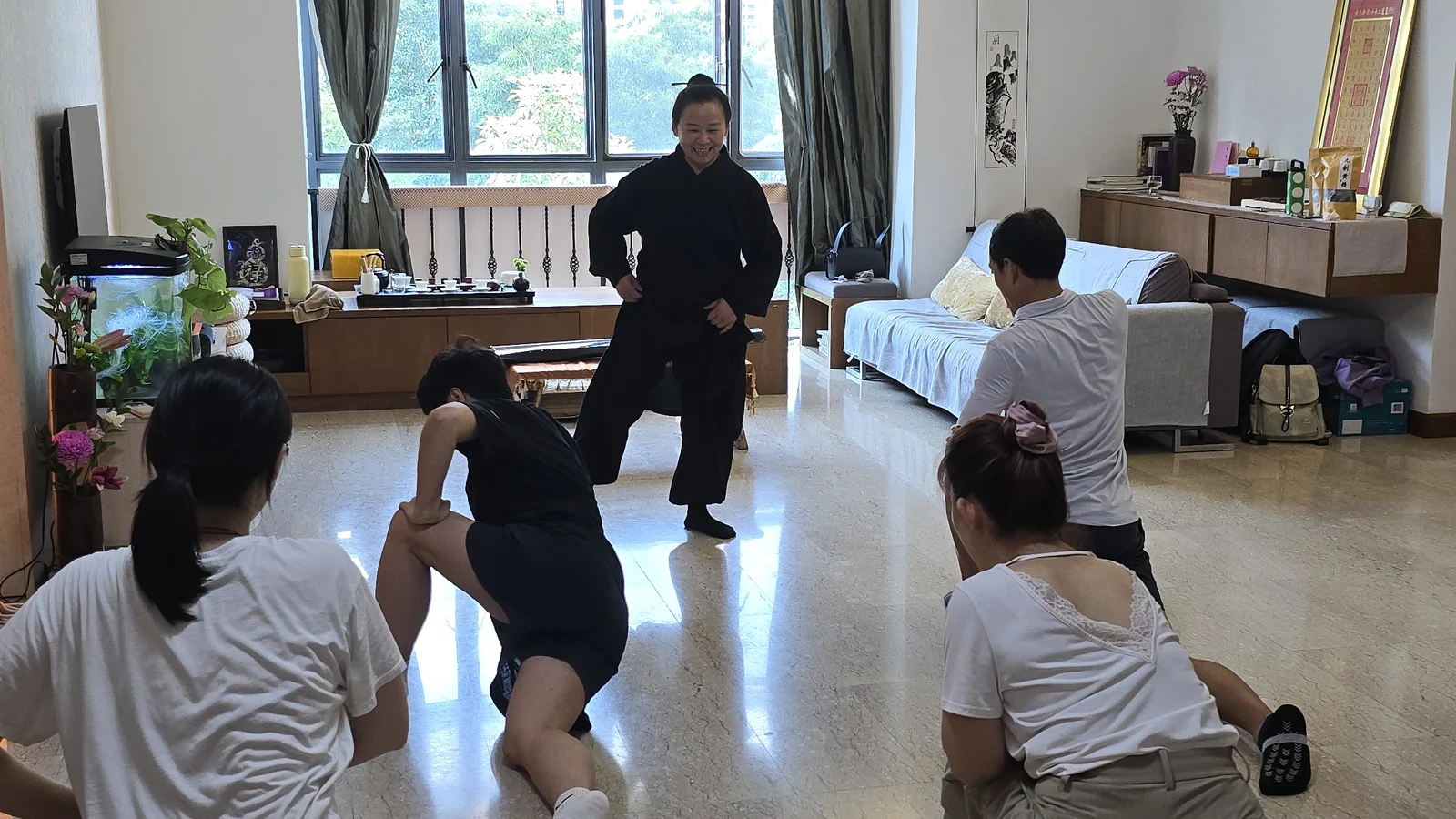
A Wudang taijiquan lesson in a sunlit room: students seen from behind kneel into deep lunges to open the hips while a teacher in black Taoist-style clothing stands in a wide stance, smiling, with an ink-painting scroll on the wall behind.

Right after the horizontal expansion of Single Whip (Danbian) and the spiral loops of Grasp the Sparrow’s Tail (Lanquewei), every practitioner of Wudang Taijiquan encounters one of the most iconic visual pairs in internal martial arts: “White Crane Spreads Its Wings” (白鹤亮翅, Baihe Liangchi) followed immediately by “Brush Knee and Twist Step” (搂膝拗步, Louxi Aobu).

Why are these two postures almost always linked together in traditional forms (see also our Everyday Wudang study notes on Baihe Liangchi)? Because White Crane Spreads Its Wings trains vertical elongation and poised Empty-Step (虚步, Xubu) buoyancy, while Brush Knee and Twist Step channels that stored vertical potential into a grounded, cross-body Bow Stance (拗弓步)—embodying the classical principle of “above and below follow each other” (上下相随) in The Six Harmonies (Liuhe).

1. Anatomy of “White Crane Spreads Its Wings” (白鹤亮翅): Rooted Below, Light Above

When performed carelessly, White Crane Spreads Its Wings turns into leaning backward on a locked supporting knee while throwing the arms wide open—which hollows the chest and floats the breath. In authentic Wudang structure, the posture is a calm vertical stretch suspended from the crown:

  • The Empty Step (虚步, Xubu) Base: Roughly 85–90% of your weight settles into the rear leg by folding the rear hip crease (song kua 松胯, see Zhan Zhuang Posture Troubleshooting). The front foot steps in half a pace and touches the flagstones lightly with the ball or toes—like a white crane testing the depth of shallow water (Crane-Step Walking Qigong)—so you could lift the front foot at any instant without your torso swaying a millimetre.
  • Two Wings Opening Along a Diagonal Arc: Driven by a subtle turn of the waist, the right hand rises in an inward Silk-Reeling arc to rest beside the right temple (palm facing inward-and-obliquely, elbow dropped), while the left hand settles downward beside the left hip. Together with the suspended crown and sinking tailbone, the two arms form a spacious diagonal canopy that gently opens the ribs and intercostal breathing (Natural Abdominal Breathing).

2. How “White Crane” Unfolds into “Brush Knee and Twist Step” (搂膝拗步)

From the poised stillness of White Crane, how do you step forward into the driving power of Brush Knee without lurching?

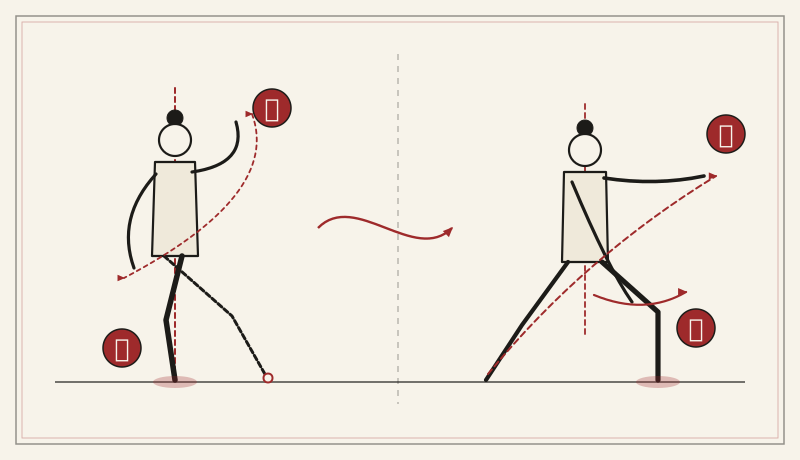
Classical ink-and-cinnabar diagram comparing Wudang Taijiquan White Crane Spreads Its Wings (Baihe Liangchi) on the left with Brush Knee and Twist Step (Louxi Aobu) on the right, showing the rear-weighted empty step, diagonal wing expansion, protective knee-brushing arc, and waist-driven forward palm

Structural transition from White Crane Spreads Its Wings (白鹤亮翅 · 虚步开翼) to Brush Knee and Twist Step (搂膝拗步 · 上下相随).

  1. Rooted Rear Pillar & Light Empty Step (坐胯虚步 · 九一分明): in White Crane, 85–90% of weight roots through the rear hip and heel while the front foot touches lightly without bearing load (Distinguishing Empty and Full)
  2. Diagonal Wing Expansion (两翼斜开 · 含胸拔背): the upper palm guards near the temple and the lower palm settles by the hip with both elbows heavy (Chenjian Zhuizhou)
  3. Protective Brushing Arc Past the Knee (落手搂膝 · 护下引化): as you step into the bow stance, the lead hand sweeps in a protective horizontal arc across the front knee to clear low incoming force
  4. Cross-Body Bow Stance & Waist-Driven Palm (拗步推掌 · 节节贯串): why is it called a “Twist Step” (拗步, Aobu)? Because when the left leg steps forward, the right palm issues forward at chest height—creating a balanced diagonal spiral across the spine

3. Three Keys to Practising the Pair Smoothly

  • What makes a “Twist Step” (拗步, Aobu) different from a “Same-Side Step” (顺步, Shunbu)? In postures like Ward-Off (Peng) or Single Whip, the left hand leads when the left foot is forward (Shunbu). In Louxi Aobu, the left foot is forward while the right palm presses forward and the left hand brushes past the left knee. To keep this cross-body spiral stable, step on two shoulder-width parallel tracks (川字步) rather than walking on a tightrope.
  • Never bend at the waist to “reach” your knee: When brushing the knee (搂膝), your torso remains upright; the hand passes four to six inches above the kneecap solely because your hips have settled into the bow stance and your shoulder is relaxed.
  • Finish simultaneously: As Chapter 2 of the Tao Te Ching (Dao De Jing) reminds us that high and low complete each other (高下相倾), the front foot settling, the brushing hand arriving beside the thigh, and the rear palm extending forward should all finish on the same quiet exhalation (“neither too loose nor too tight”).
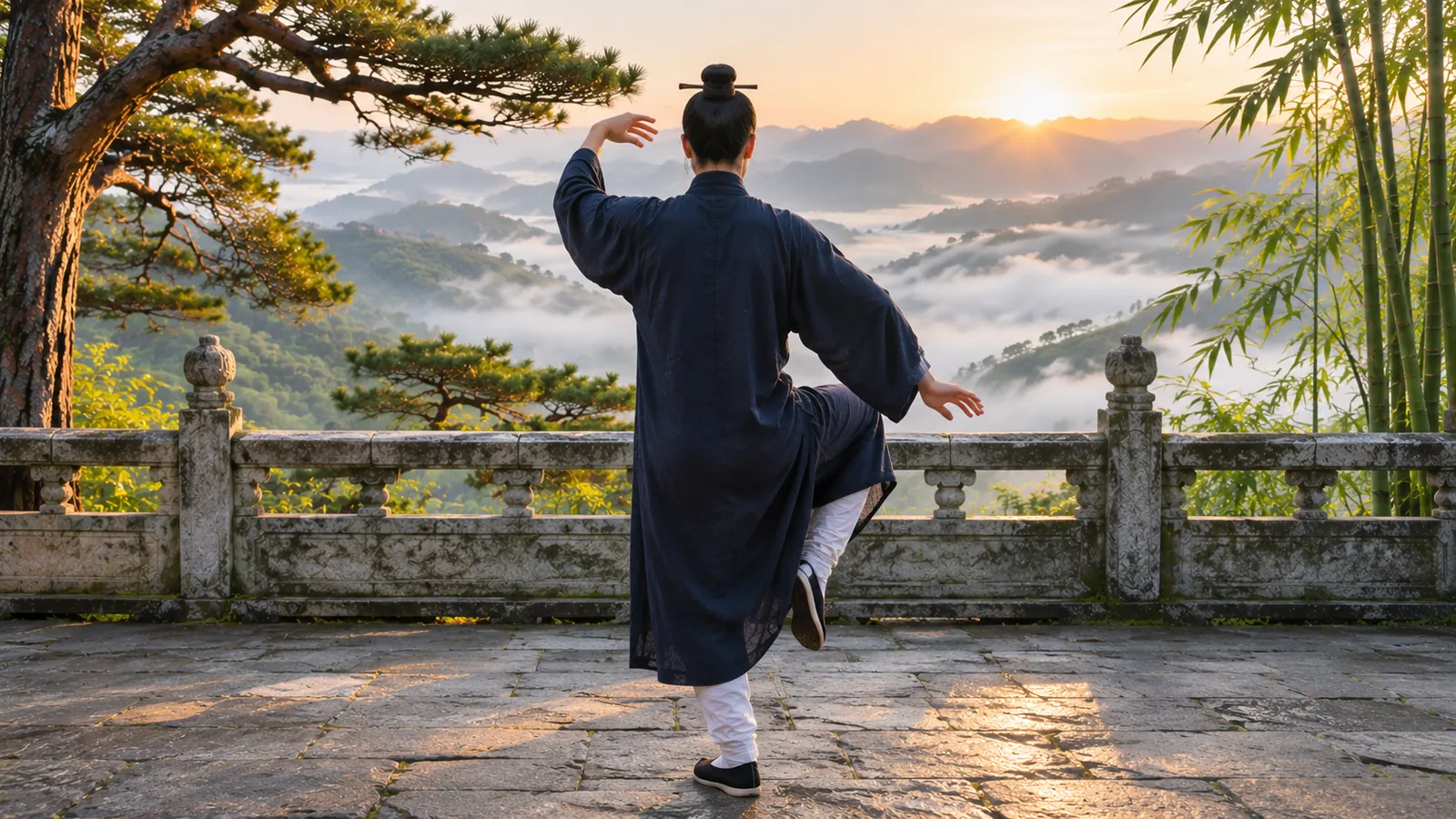
A practitioner in dark indigo Taoist robes and white cotton leg wraps seen from behind in a poised Wudang Taijiquan White Crane Spreads Its Wings (Baihe Liangchi) empty-step stance on a stone mountain terrace above morning clouds.

White Crane Spreads Its Wings (Baihe Liangchi) at dawn: the rear leg roots into the flagstones while the front foot touches lightly like a crane testing shallow water.

4. Training Between Wudang Mountain and Singapore

Connecting the living martial heritage near Wudang Mountain’s UNESCO World Heritage ancient Taoist temples with our regular classes in Singapore, Wudang.Org guides students through the complete foundational curriculum. Start with Wudang Tai Chi for Beginners, explore Start Here, or join our Singapore Tai Chi Retreat Camp.

Safety note: During the rear-weighted Empty Step in White Crane, fold the rear hip crease so the supporting kneecap tracks directly over the toes without twisting inward; traditional martial training does not replace medical advice.

Seeker’s Q&A · Frequently Asked Questions

How is weight distributed in “White Crane Spreads Its Wings” (Baihe Liangchi 白鹤亮翅)?

About 85–90% of your weight settles into the rear supporting leg by folding the rear hip crease (kua), while the front foot rests lightly on the ball or toes in an Empty Step (Xubu) with only 10–15% contact so it can step out effortlessly.


What does “Twist Step” (Aobu 拗步) mean in “Brush Knee and Twist Step” (Louxi Aobu)?

In a Same-Side Step (Shunbu), the left hand leads when the left foot is forward. In a Twist Step (Aobu), the opposite hand leads—when the left foot steps into a bow stance, the left hand brushes past the knee while the right palm presses forward, creating a balanced cross-body spiral.

Why shouldn’t I bend forward at the waist when brushing the knee in Louxi Aobu?

Bending the spine forward breaks your central equilibrium (Zhongding) and shifts weight onto your front kneecap. Keep the spine upright; let the brushing hand pass comfortably four to six inches above the knee by settling the hips and dropping the shoulder.
