WUDANG TAIJIQUAN · 武当太极拳

Separation of Feet (Zuoyou Fenjiao) and Heel Kick (Dengjiao) in Wudang Taijiquan: Single-Leg Rooting and Opposite-Arm Expansion 武当太极拳“左右分脚”与“蹬脚”详解:独立落根、十字提膝与手足相随要领

Learn the classical biomechanics of Separation of Right and Left Feet (Zuoyou Fenjiao) and Heel Kick (Dengjiao) in Wudang Taijiquan — cross-hands knee chambering, standing-leg root stability, dorsiflexed heel press vs. instep extension, and opposite-palm counterbalance.


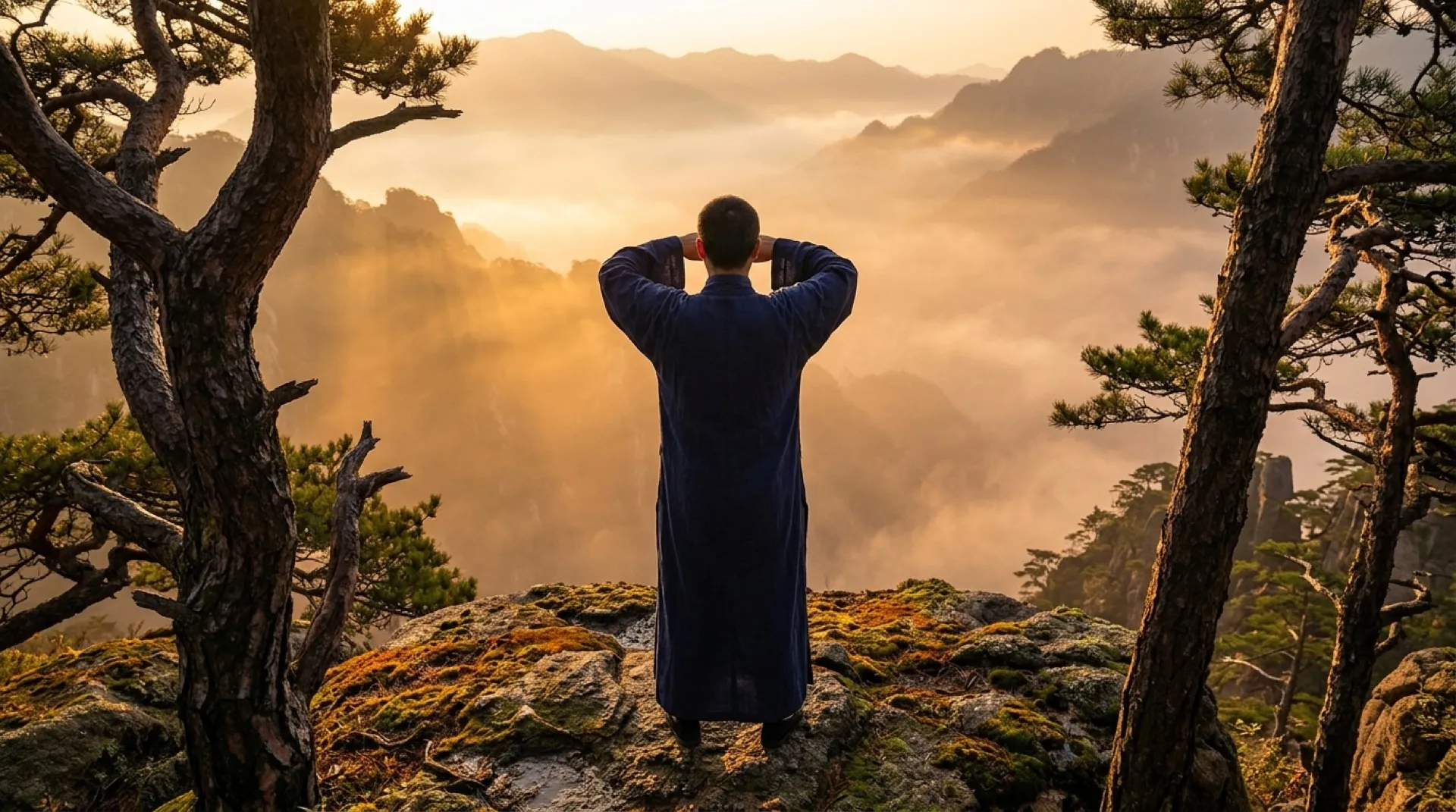
A figure in a long dark robe, seen from behind, standing with both hands clasped behind the head on a rock outcrop between pines, facing a valley of golden mist.

1. Kicking Without Losing the Root: The Role of Fenjiao and Dengjiao in Wudang Taijiquan

In traditional Wudang Taijiquan forms, high kicks are never executed by throwing the torso backward or snapping the knee with disconnected momentum. Instead, the two primary kicking postures — Separation of Right and Left Feet (Zuoyou Fenjiao 左右分脚) and Right and Left Heel Kick (Zuoyou Dengjiao 左右蹬脚) — grow directly out of the single-leg equilibrium trained in Golden Rooster Stands on One Leg and the clear weight separation of Empty and Full Stepping (Xu-Shi).

Following expansive corner postures such as Diagonal Flying (Xiefeishi) or High Pat on Horse (Gaotanma), Fenjiao and Dengjiao train the practitioner to gather all four limbs toward the centerline (he 合) on one rooted leg and then unfold the kicking leg and both arms simultaneously (kai 开) in fulfillment of the Six Harmonies (Liuhe): shoulder harmonizing with hip, elbow with knee, and hand with foot.

2. Fenjiao vs. Dengjiao: Instep Extension vs. Dorsiflexed Heel Press

Although both postures share the same preparatory gathering and two-arm opening, classical manuals distinguish their foot alignments and martial intentions clearly:

  • Separation of Feet (Fenjiao 分脚): As the lifted knee unfolds forward or along the forty-five-degree diagonal, the ankle extends naturally so the instep and toes point forward (bengjiao 绷脚), delivering a smooth, whipping arc directed toward the opponent's wrist, forearm, or mid-section.
  • Heel Kick (Dengjiao 蹬脚): As the lifted knee unfolds, the toes flex firmly back toward the shin (goujiao 勾脚) so the heel (jiaogen 脚跟) presses steadily outward like a structural timber beam pushing open a heavy gate, channeling rooted ground force from the standing foot through the pelvis and out the heel.

In both variations, the standing knee remains micro-bent rather than locked, and the height of the kick is governed strictly by hip mobility and vertical spine alignment: a waist-high kick with a calm, upright torso and settled dantian is far superior to a chest-high kick that rounds the lower back or lifts the standing heel.

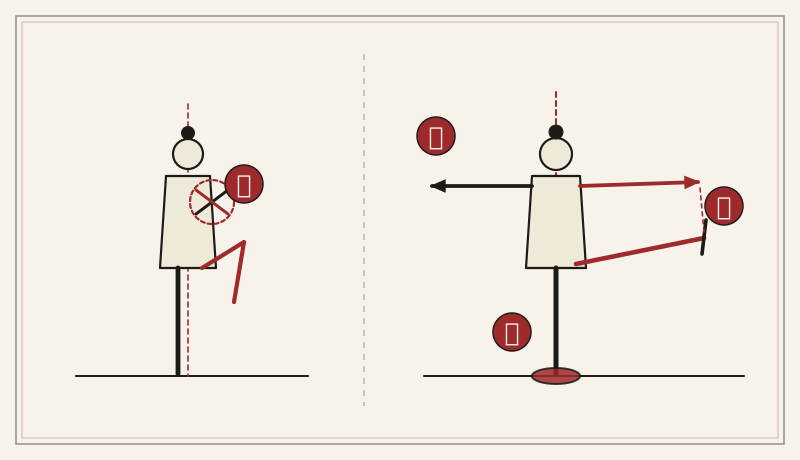
Classical ink-and-cinnabar biomechanical diagram of Wudang Taijiquan Heel Kick (Dengjiao) and Separation of Feet (Fenjiao) with four numbered alignment markers (①–④).

Figure 1: Separation of Feet (Fenjiao) and Heel Kick (Dengjiao) Mechanics — ① Single-leg vertical plumb line from suspended crown through standing foot (Duli Luogen); ② Cross-wrists gathering and knee chambering (Shizishou Tixi); ③ Synchronized heel kick and lead palm extension along the same line (Dengjiao Fenzhang); ④ Counter-balancing rear palm and sinking standing kua (Houbi Duila · Songkua).

  1. ① Single-Leg Plumb Axis (Duli Luogen · Xuling Dingjin 独立落根 · 虚领顶劲): The standing leg stays softly unlocked while the crown suspends vertically over the center of the foot.
  2. ② Cross-Wrists Gathering & Knee Lift (Shizishou Tixi 十字手提膝): Coiling both wrists in front of the chest while lifting the kicking knee to store elastic Peng energy.
  3. ③ Synchronized Heel Kick & Lead Palm (Dengjiao Fenzhang 蹬脚分掌): Pressing the heel outward with toes flexed back in exact harmony with the lead open palm.
  4. ④ Counter-Balancing Rear Arm (Houbi Duila 后臂对拉): Extending the opposite palm rearward at shoulder height so the torso never leans backward.

3. The Four-Phase Sequence: Shift, Cross and Chamber, Unfold, and Settle

Practice breaking every Fenjiao or Dengjiao into four unhurried phases: 1) Shift and Root — Pour 100 percent of your weight into the standing foot, feeling the tripod of the sole (big-toe mound, little-toe mound, and heel) grip the ground lightly while the standing kua (hip fold) settles; 2) Cross Wrists and Chamber the Knee (Shizishou Tixi 十字手提膝) — Circle both hands inward to cross at the wrists in front of the chest (for a right kick, the right wrist rests outside the left wrist, palms facing inward) while lifting the right knee smoothly toward chest or waist level.

3) Synchronized Opening (Fenzhang Dengjiao 分掌蹬脚) — On a calm exhalation, separate both palms outward to shoulder height with the wrists gently seated (lizhang 立掌) while simultaneously extending the right foot forward along the exact same line as the right arm; 4) Controlled Retraction and Step — After a brief, poised pause at full extension, fold the kicking knee back in smoothly before stepping down into the next posture (such as Brush Knee and Twist Step or Turn Body and Chop with Fist) without crashing onto the floor.

4. Common Balance Faults and Progressive Height Drills

In the traditional courtyards of Wudang Mountain and our Singapore classes, we check three frequent faults in Fenjiao and Dengjiao: 1) Leaning the upper torso away from the kick — tipping the head and shoulders backward to raise the foot higher breaks the central axis (zhongding 中定); keep the crown suspended vertically above the standing ankle; 2) Neglecting the rear counter-balancing arm — if you focus only on the kicking foot and front hand, you will fall forward; feel the rear arm and front arm opening fifty-fifty in opposite directions like a balanced carrying pole; 3) Dropping the leg like a stone after the kick — always re-chamber the knee slightly before placing the foot down empty (xubu).

For safe daily conditioning, practice three slow repetitions of Dengjiao on each leg at knee-to-hip height, holding the chambered phase for one breath and the extended phase for one breath. Traditional Wudang Taijiquan strengthens single-leg balance, hip flexors, and calm focus and never replaces professional medical care.

Seeker’s Q&A · Frequently Asked Questions

What is the core takeaway of Separation of Feet (Zuoyou Fenjiao) and Heel Kick (Dengjiao) in Wudang Taijiquan?

Learn the classical biomechanics of Separation of Right and Left Feet (Zuoyou Fenjiao) and Heel Kick (Dengjiao) in Wudang Taijiquan — cross-hands knee chambering, standing-leg root stability, dorsiflexed heel press vs. instep extension, and opposite-palm counterbalance.
