WUDANG TAIJIQUAN · 武当太极拳

Swinging Lotus Kick (Shuang Bailian) in Wudang Taijiquan: Outward Crescent Sweep and Double-Palm Counter-Rotation 武当太极拳“双摆莲(摆莲脚)”详解:独立旋胯外摆与双掌相错迎拍要领

Learn the classical biomechanics of the Swinging Lotus Kick (Shuang Bailian / Bailian Jiao) in Wudang Taijiquan — single-leg pivot alignment, outward crescent sweep from the hip socket, opposite-direction double-palm slap, and coiled landing into Bend the Bow to Shoot the Tiger.


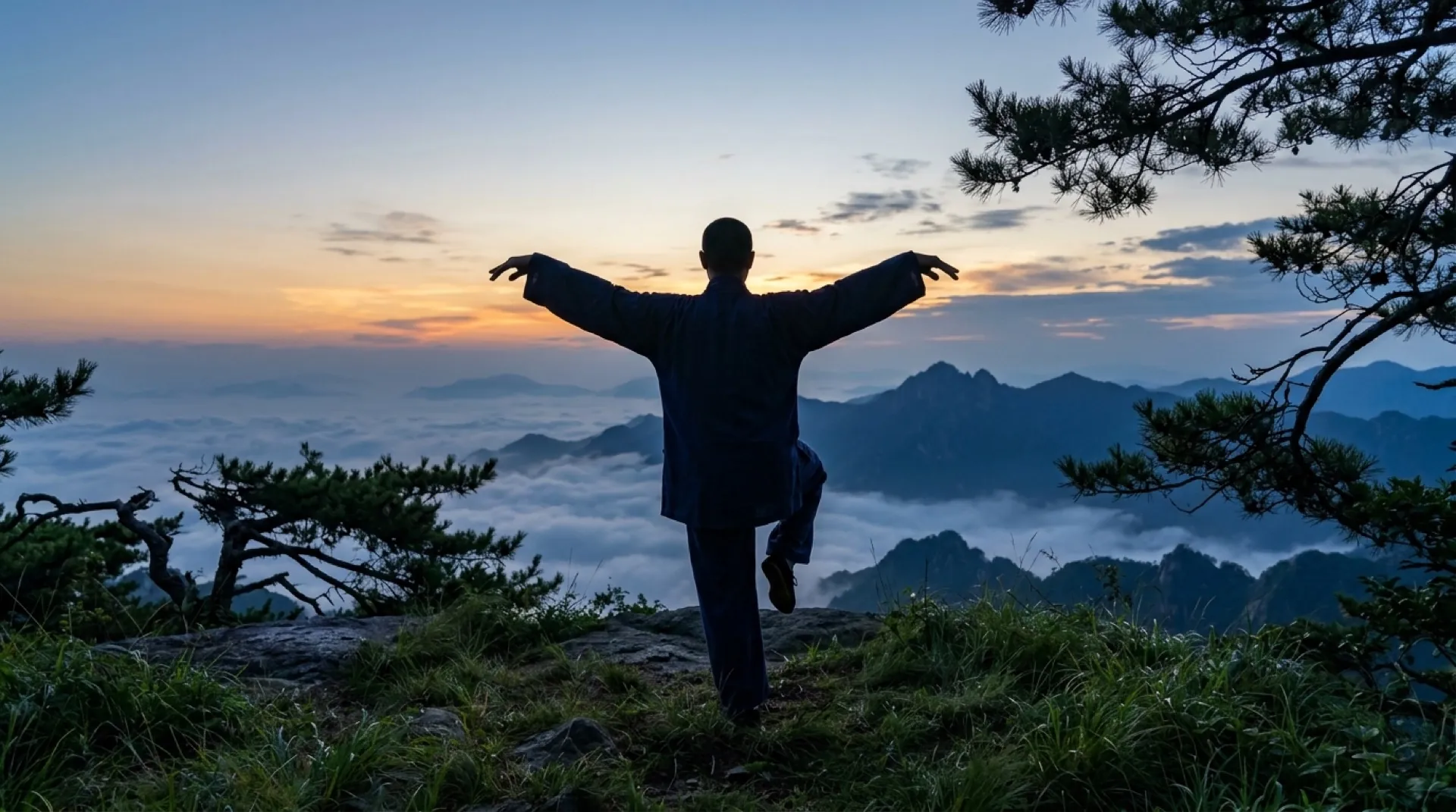
A practitioner seen from behind, standing on one leg with both arms spread wide like wings on a grassy summit among pines, above a sea of clouds at dawn.

1. Where Swinging Lotus Kick (Shuang Bailian) Fits in the Classical Wudang Form

In traditional Wudang Taijiquan routines, after building single-leg linear extension in Separation of Feet (Fenjiao) and Heel Kick (Dengjiao) and practicing the compact transitions of Step Up to Seven Stars and Retreat to Ride the Tiger, the practitioner encounters the circular kicking posture known as Swinging Lotus Kick (Shuang Bailian 双摆莲, or Bailian Jiao 摆莲脚), which leads directly into Bend the Bow to Shoot the Tiger (Wangong Shehu).

Why is it called "Swinging Lotus" (Bailian) and "Double Swinging Lotus" (Shuang Bailian)? Because the sweeping leg traces a rounded horizontal petal arc across the front of the body while both open palms (shuangzhang 双掌) brush across the top of the foot in the opposite direction — one palm after the other in quick succession — creating a scissoring rotational shear (Lie 挒 and Cai 采) that neutralizes and sweeps aside incoming grabs or low obstacles without ever sacrificing vertical poise.

2. Protecting the Standing Knee during the Turn-Body Entry

Because Shuang Bailian is almost always preceded by a turn of the body (zhuanshen 转身) from Retreat to Ride the Tiger (Tuibu Kuahu 退步跨虎), the single most important biomechanical rule is aligning the standing foot before lifting the kicking leg. Just as in Turn Body and Chop with Fist (Zhuanshen Piechui), never spin on a loaded, twisted knee. First shift weight briefly, pivot the left foot cleanly so its toes point toward the new front corner, and settle your weight into the full sole of the left foot with the left kua (inguinal fold) relaxed and sunken.

Once the standing left leg is rooted like a temple pillar and the crown is suspended (xuling dingjin 虚领顶劲), turn the waist slightly to the left as both hands rise to the right-front side at chest height. This preliminary waist coil stores the elastic Silk-Reeling (Chansijin) torsion that will power the outward crescent kick and inward double-palm sweep simultaneously.

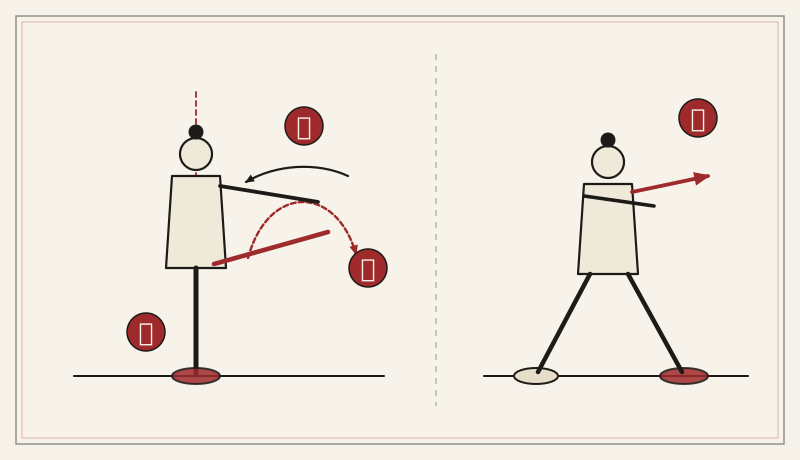
Classical ink-and-cinnabar biomechanical diagram of Wudang Taijiquan Swinging Lotus Kick (Shuang Bailian) with four numbered alignment markers (①–④).

Figure 1: Swinging Lotus Kick (Shuang Bailian) Mechanics — ① Rooted standing-leg vertical axis and hip-turn preparation (Duli Koubu · Songkua); ② Outward left-to-right crescent arc of the sweeping right foot (Bailian Waihua); ③ Opposite-direction right-to-left brush of both open palms across the instep (Shuangzhang Xiangcuo); ④ Controlled landing and coiled transition into Bend the Bow to Shoot the Tiger (Luobu Wangong Shehu).

  1. ① Standing-Leg Root & Hip-Socket Pivot (Duli Koubu · Songkua 独立扣步 · 松胯立轴): The standing foot anchors firmly with the knee softly bent so the crescent sweep rotates around a stable vertical spine.
  2. ② Outward Crescent Sweep of the Foot (Bailian Waihua 摆莲外摆弧线): The lifted leg arcs smoothly from the inside across to the outside at waist height with the foot flat or ligeramente flexed.
  3. ③ Counter-Rotating Double-Palm Brush (Shuangzhang Xiangcuo 双掌相错迎拍): Both open palms sweep across from the outside toward the inside to meet the outer edge of the foot in a scissoring spiral.
  4. ④ Coiled Landing into Bend the Bow (Luobu Wangong Shehu 落步弯弓射虎): Lowering the sweeping foot with control to enter the Bow Stance of Bend the Bow to Shoot the Tiger.

3. The Scissoring Arc: Foot Sweeping Left-to-Right, Palms Sweeping Right-to-Left

To execute the right Swinging Lotus Kick, lift the right leg from the hip and sweep the foot upward and across from left (inside) to right (outside) in a smooth fan-shaped arc at knee-to-waist height. Simultaneously, sweep both open palms horizontally from right to left across the front of the chest so the left palm first and the right palm immediately second brush lightly across the outer instep of the right foot at the apex of its arc (hence the name Shuang Bailian — two palms meeting the lotus).

Notice the self-balancing geometry: because the right leg sweeps from left to right while the two arms sweep from right to left, their angular momenta cancel each other around the central vertical spine! You do not need to twist the standing left ankle or wrench the lower back. For practitioners who also encounter the athletic Double Jump Kick (Erqijiao 二起脚) in martial sequences, Wudang internal pedagogy recommends mastering the grounded single-leg Fenjiao and Bailian first so the pelvis and dantian never lose their root for the sake of acrobatic height.

4. Controlled Landing into Bend the Bow to Shoot the Tiger

In the courtyard training on Wudang Mountain and in our Singapore classes, teachers judge the quality of Shuang Bailian not by how loud the palms slap the shoe, but by how quietly the foot lands afterward. Never strain the lower back or lean the head forward trying to slap a stiff leg; if your hamstrings are tight, sweep the foot at knee height and let the palms pass through the air along the same counter-rotating path five inches above the shin — the internal waist-shear mechanics are identical.

After the right foot completes its outward crescent, keep the standing left knee softly bent so the right foot steps down lightly to the right-rear diagonal, transitioning without a tremor into Bend the Bow to Shoot the Tiger (Wangong Shehu). Practice linking Tuibu Kuahu → Shuang Bailian → Wangong Shehu five times slowly on each side. Traditional Wudang Taijiquan develops hip mobility, rotational balance, and calm coordination and never replaces professional medical care.

Seeker’s Q&A · Frequently Asked Questions

What is the core takeaway of Swinging Lotus Kick (Shuang Bailian) in Wudang Taijiquan?

Learn the classical biomechanics of the Swinging Lotus Kick (Shuang Bailian / Bailian Jiao) in Wudang Taijiquan — single-leg pivot alignment, outward crescent sweep from the hip socket, opposite-direction double-palm slap, and coiled landing into Bend the Bow to Shoot the Tiger.
