WUDANG TAIJIQUAN · 武当太极拳

The Five Phases of Stepping (Wuxingbu): Jinbu, Tuibu, Zuogu, Youpan, and Zhongding in Wudang Taijiquan 太极十三势之五行步(进步、退步、左顾、右盼、中定):武当太极拳的步法根基与中土枢轴详解

Completing the Thirteen Postures (十三势) trilogy, this guide examines the Five Phases of Stepping (五行步)—Advance (进步), Retreat (退步), Look Left (左顾), Gaze Right (右盼), and Central Equilibrium (中定)—in traditional Wudang Taijiquan.


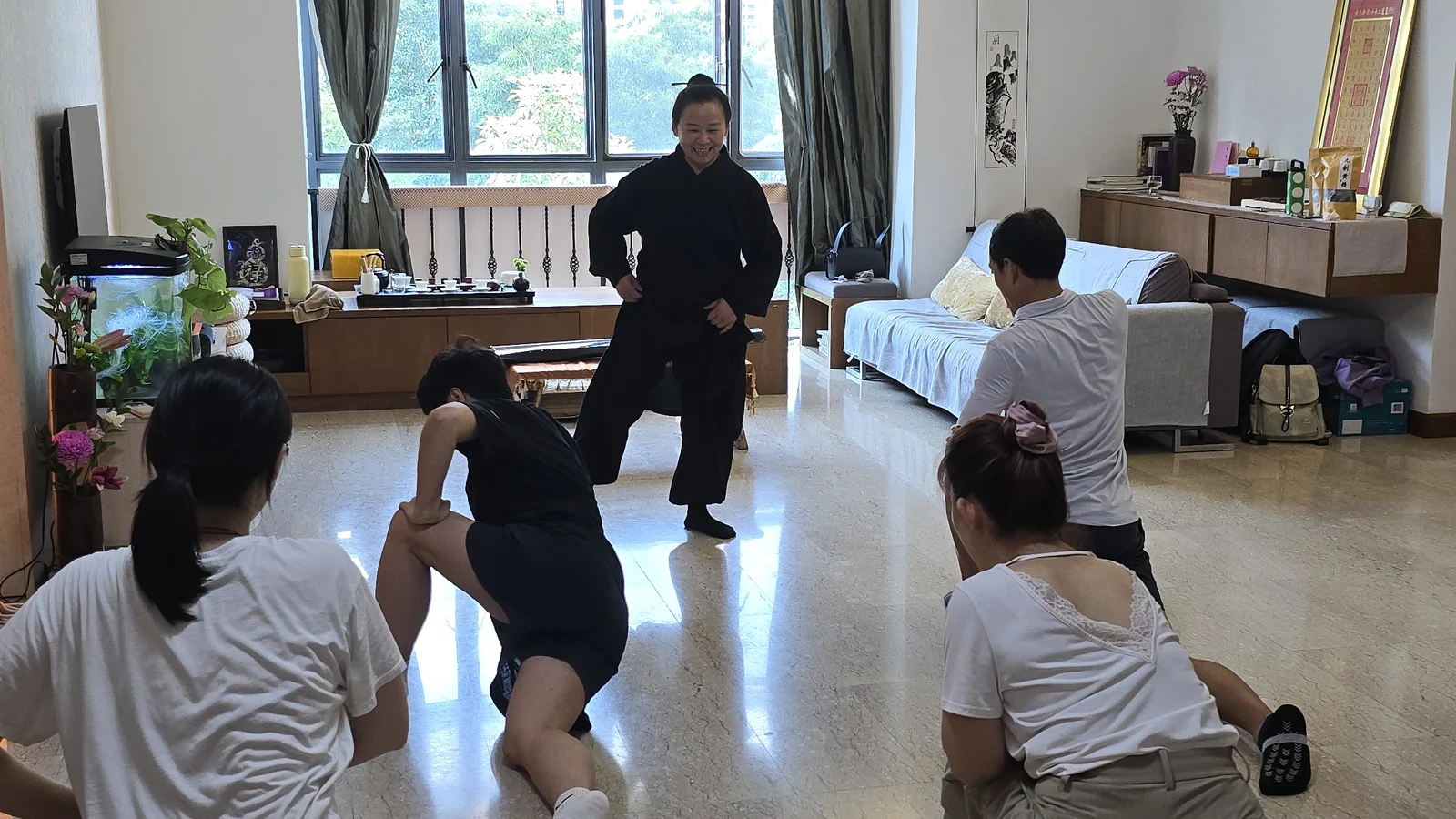
A Wudang taijiquan lesson in a sunlit room: students seen from behind kneel into deep lunges to open the hips while a teacher in black Taoist-style clothing stands in a wide stance, smiling, with an ink-painting scroll on the wall behind.

Eight Trigrams in the Hands, Five Phases in the Feet: Completing the Thirteen Postures

In classical Wudang Taijiquan and Wang Zongyue's Taijiquan Lun (太极拳论, studied under Taoist & Martial Classics), the Thirteen Postures (Shisanshi, 十三势) are defined by a concise formula: 'The thirteen postures are Peng, Lu, Ji, An, Cai, Lie, Zhou, Kao—these correspond to the Eight Trigrams; Jinbu (Advance), Tuibu (Retreat), Zuogu (Look Left), Youpan (Gaze Right), and Zhongding (Central Equilibrium)—these correspond to the Five Phases (Wuxing: Metal, Wood, Water, Fire, Earth)' (十三势者,掤、捋、挤、按、采、挒、肘、靠,此八卦也;进步、退步、左顾、右盼、中定,此五行也). Having examined the Four Cardinal Energies in Grasping the Sparrow's Tail (Lanquewei) and the Four Corner Energies in Cai, Lie, Zhou, and Kao, this guide completes the Thirteen Postures by examining the Five Phases of Stepping (Wuxingbu, 五行步)—for without rooted footwork, the eight upper-limb energies have no foundation.

Jinbu (进步) and Tuibu (退步): Cat-Stepping and Clearly Separating Empty from Full

In Wudang Taijiquan, Jinbu (进步, Advancing Step) and Tuibu (退步, Retreating Step) never involve lunging or falling into the moving foot. As the Taijiquan Lun states, 'Power is rooted in the feet, generated through the legs, governed by the waist, and expressed in the fingers.' Before the advancing foot leaves the ground, the supporting leg must first sit solidly by folding its inguinal crease (Kwa, 胯). The empty foot then peels off the stone floor and extends like a cat testing thin ice—touching heel-first in forward bow-stance transitions (or ball-first in empty stances and retreats) before a single ounce of weight transfers. In Tuibu, the front foot pushes nothing; instead, the rear hip folds to draw the empty foot smoothly backward along a curved path, preserving complete composure.

The Five Phases of Stepping (Wuxingbu): Jinbu, Tuibu, Zuogu, Youpan, and Zhongding in Wudang Taijiquan

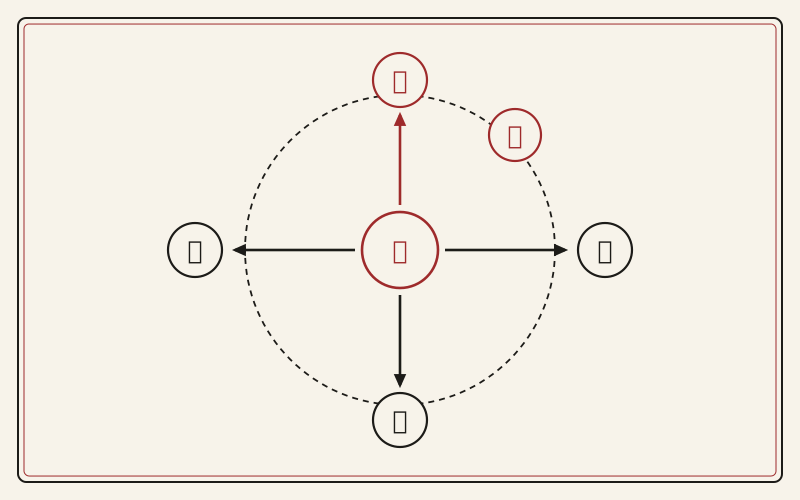
Spatial and Five-Phase (Wuxing) structure of Wuxingbu (Five Phases of Stepping) in Wudang Taijiquan: ① Central Equilibrium (Zhongding / Earth Phase — the vertical plumb line from Baihui through Mingmen to Yongquan that governs all movement), ② Advance Step (Jinbu / Fire or Metal directional correlation — cat-like empty foot extension from a rooted rear leg), ③ Retreat Step (Tuibu / Water Phase — yielding backward transfer without losing the central axis), ④ Look Left / Left-Ward Awareness (Zuogu / Wood Phase — opening the left inguinal crease and perceptual field), ⑤ Gaze Right / Right-Ward Awareness (Youpan / Metal Phase — opening the right inguinal crease and perceptual field), and ⑥ Unbroken Yin-Yang weight separation (Fen Qing Xu Shi) connecting all five phases.

Zuogu (左顾) and Youpan (右盼): Whole-Body Perceptual and Pelvic Orientation

Beginners often translate Zuogu (左顾, Look Left) and Youpan (右盼, Gaze Right) as merely turning the eyeballs or neck to the left and right. In traditional Wudang Mountain transmission, however, Gu (顾, 'attending to') and Pan (盼, 'observing') refer to the integrated rotational opening and closing of the left and right hips, ribs, and perceptual fields—paired with circular footwork (Hooking Step Koubu and Swinging Step Baibu). Whenever the left hip folds to absorb or step laterally, spirit and listening awareness encompass the entire left hemisphere (Zuogu, Wood Phase); whenever the right hip opens or pivots, awareness encompasses the right hemisphere (Youpan, Metal Phase).

Zhongding (中定): The Earth Phase Pivot That Commands All Four Directions

At the center of Advance, Retreat, Look Left, and Gaze Right stands the fifth and most vital phase: Zhongding (中定, Central Equilibrium—corresponding to Central Earth, 中央土). Just as Earth nourishes and anchors Metal, Wood, Water, and Fire, Zhongding is not a static freeze between steps, but the continuous vertical plumb line from Baihui through Mingmen that remains undisturbed inside every advance, retreat, and turn. Embodying the uncontrived simplicity and 'Great Accord' (Da Shun, 大顺) of Tao Te Ching Chapter 65 (and practiced from day one in Start Here), a practitioner who guards Zhongding stands centered like a mountain axis (轴) no matter how rapidly the footsteps change.

Seeker’s Q&A · Frequently Asked Questions

What is the key structural alignment in The Five Phases of Stepping (Wuxingbu)?

Completing the Thirteen Postures (十三势) trilogy, this guide examines the Five Phases of Stepping (五行步)—Advance (进步), Retreat (退步), Look Left (左顾), Gaze Right (右盼), and Central Equilibrium (中定)—in traditional Wudang Taijiquan.
