WUDANG TAIJIQUAN · 武当太极拳

Double Peaks Pierce the Ears (Shuangfeng Guan’er) in Wudang Taijiquan: Knee-Brushing Gather, Twin-Arc Pincer Fists & Rounded Upper Back 武当太极拳“双峰贯耳”详解:收膝下捋、双拳弧形贯击与含胸拔背要领

How to transition from a Heel Kick into a grounded Bow Stance while sweeping both fists along two wide mountain-peak arcs that converge at temple height without shrugging the shoulders.

Layered mountain ridges fading into golden mist at sunrise, with pines in the foreground.

In the second section of the traditional Wudang Taijiquan form, right after you balance on one leg to issue a Heel Kick (You Dengjiao 右蹬脚), your lifted leg folds back and steps down into a deep Bow Stance while both hands sweep down past the knee and arc upward like twin mountain peaks converging toward an opponent’s temples: “Double Peaks Pierce the Ears” (双峰贯耳, Shuangfeng Guan’er).

Why is this striking posture named after two mountain peaks (Shuangfeng 双峰, evoking the twin crags around Wudang’s Golden Summit) rather than simply “Double Temple Punch”? Because the two fists do not jab straight from the shoulders; they rise along two wide, grounded, circular arcs backed by the entire mountain of your upper back (Jiaji 夹脊).

1. Biomechanical Anatomy of Double Peaks Pierce the Ears (双峰贯耳)

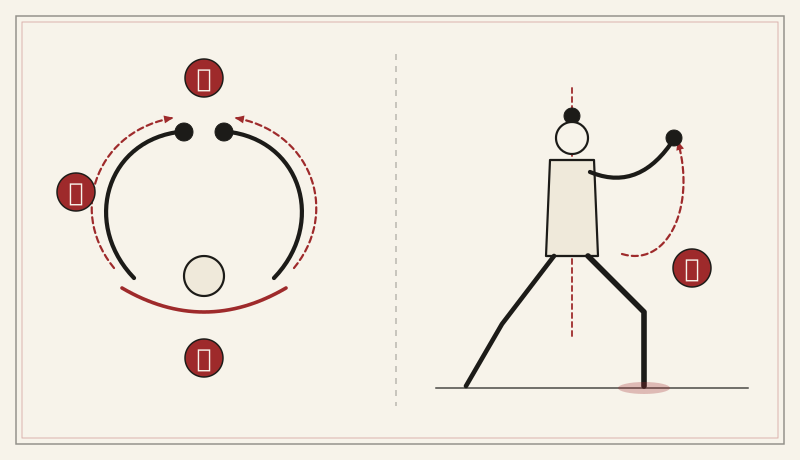
Classical ink-and-cinnabar diagram of Wudang Taijiquan Double Peaks Pierce the Ears (Shuangfeng Guan'er) showing the overhead twin-arc pincer geometry and rounded upper back on the left, and the side-view knee-brushing gather rising into the Bow Stance on the right

Overhead and side-view mechanics of Double Peaks Pierce the Ears (武当太极拳“双峰贯耳”四维图解).

  1. Downward Knee-Brushing Gather After the Kick (收腿落步 · 双掌下捋护膝): as the kicking leg folds back, both open palms sweep downward past the sides of the front knee—clearing any attempt by an opponent to grab your kicking foot or push your knee
  2. Rounding the Upper Back as the Hub (含胸拔背 · 力由脊发): as you step forward into the Bow Stance, the space between the shoulder blades (Jiaji) expands backward and outward, uniting both arms into a single dorsal bow (Shen Gong)
  3. Twin-Arc Pincer Trajectory (双臂弧形环抱 · 曲中求直): both palms curl into hollow fists at the hips and travel outward-upward-and-inward along two smooth circular arcs (Chansijin)
  4. Twin Peaks Converging at Temple Height (双峰相对 · 沉肩坠肘): the two fists arrive at temple height with knuckles facing obliquely downward-and-inward about a fist-width apart, while the elbows point downward (Chenjian Zhuizhou)

2. Why You Must “Brush Down Past the Knee” Before Raising the Fists

Echoing Chapter 22 of the Tao Te Ching (Dao De Jing)—“Bend and become whole” (Qu ze Quan)—Shuangfeng Guan’er teaches seamless transition from a high kick to a close-range embrace:

  • When you kick at chest height and your opponent parries your heel downward or lunges in as your foot descends, sweeping both palms down to your front knee protects your lower gate and deflects their hands downward.
  • Because their hands are now pinned low by your downward brush, their upper gate (both temples and ears) is left wide open for your twin fists to arc up from the outside and close like calipers.

3. Three Keys to Keeping Your Shoulders Soft When Raising Both Fists

  • Let the elbows hang below the wrists: Even though the two fists finish at temple height, the elbows must stay lower than the fists and slightly wider than the shoulders—never flapping up like chicken wings.
  • Maintain a rounded embrace (怀抱太极球): Imagine hugging a large pine trunk between your chest and forearms (just as in Cross Hands and Hunyuan Standing Post).
  • Exhale as the Bow Stance and Twin Fists arrive together (Six Harmonies).

4. Training Authentic Wudang Form Between Wudang Mountain and Singapore

Connecting the living martial heritage near Wudang Mountain’s UNESCO World Heritage ancient Taoist temples with our regular classes in Singapore, Wudang.Org guides students through the complete traditional form. Begin with Wudang Tai Chi for Beginners, visit Start Here, or join our Singapore Tai Chi Retreat Camp.

Safety note: After the heel kick, bend the standing knee softly to lower the kicking foot to the floor with control rather than dropping heavily onto the front heel; traditional martial training does not replace medical care.

Seeker’s Q&A · Frequently Asked Questions

Why do both hands brush downward past the front knee before rising in Double Peaks Pierce the Ears (Shuangfeng Guan’er)?

Both martially and biomechanically, brushing down past the knee clears an opponent’s grab or parry on your kicking leg while coiling the waist and upper back so the two fists can rise along a full upward arc.


Which way should the palms of the fists (Quanzin 拳心) face at the end of Double Peaks Pierce the Ears?

The two hollow fists pause at temple height about a fist-width apart with the Tiger’s Mouths (thumb-index web) facing obliquely inward-and-downward and the inner palm-sides of the fists facing obliquely forward-and-downward.

How do I keep my shoulders from shrugging when raising both fists to temple height?

Keep the elbows hanging slightly lower than the wrists and widen the space between your shoulder blades (Hanxiong Babei) so the fists are supported from the upper back rather than lifted by the neck muscles.
