
WUDANG TAIJIQUAN · 武当太极拳

Step Up to Seven Stars (Shangbu Qixing) and Retreat to Ride the Tiger (Tuibu Kuahu) in Wudang Taijiquan: Crossed-Wrist Peng Guard, Empty-Step Buoyancy, and Single-Leg Balance 武当太极拳“上步七星”与“退步跨虎”详解:十字掤架、虚步灵猫与进退转换身法

Master the classical advance-and-retreat pair of Step Up to Seven Stars (Shangbu Qixing) and Retreat to Ride the Tiger (Tuibu Kuahu)—training single-leg root, seven-point structural alignment, and effortless retreating transitions.

The seven stars of the Northern Dipper and the Milky Way in a night sky above silhouetted pines, rocky peaks and a sea of clouds.

1. Advancing into Compact Guard, Retreating into Spacious Readiness

In the closing quarter of traditional Wudang Taijiquan routines—immediately following a deep low posture such as Snake Creeps Down (Xiashi) and Golden Rooster Stands on One Leg—two agile empty-step postures appear back-to-back: Step Up to Seven Stars (Shangbu Qixing 上步七星) and Retreat to Ride the Tiger (Tuibu Kuahu 退步跨虎). Where many sequences pair an empty step with a bow stance, this pair links an advancing empty step directly to a retreating empty step, testing whether your root in the supporting leg is truly independent of forward momentum.

Why is the first posture named “Seven Stars” (Qixing 七星)? In Wudang martial lore—echoing the Northern Dipper venerated on Wudang Mountain and the Seven-Star Sword stepping method—“Seven Stars” refers both to the seven structural nodes of the body (head, shoulders, elbows, hands, hips, knees, and feet) uniting into a single defensive sphere and to the compact Big-Dipper triangle formed by the crossed wrists and empty lead foot.

2. Step Up to Seven Stars (Shangbu Qixing): Crossed-Wrist Peng Sphere and Empty-Toe Touch

From a low forward bow stance, the rear (right) foot steps lightly forward to touch on the ball of the foot in a right Empty Step (Xubu) while both hands rise in hollow fists to cross at the wrists at chest-to-chin height. Three mechanical checkpoints keep Shangbu Qixing buoyant rather than top-heavy:

  1. 90/10 Weight Distribution with a Folded Supporting Hip: Even though you step forward, 85–90% of your weight stays settled in the rear (left) leg with the left hip crease (kua) folded back. The advancing right foot touches down as lightly as a cat testing thin ice—ready to kick or withdraw instantly.
  2. Crossed-Wrist Ward-Off (Peng) Frame: The two hollow fists cross at the wrists (right fist outside when the right foot leads) a full rounded forearm’s distance in front of the collarbone. Keep the armpits hollow and elbows sunk so the crossed wrists form a resilient structural arch rather than pressing against the chest.
  3. Rounding the Upper Back (Hanxiong Babei): The crossed fists are supported from the thoracic spine between the shoulder blades, protecting the centerline from chin to solar plexus.
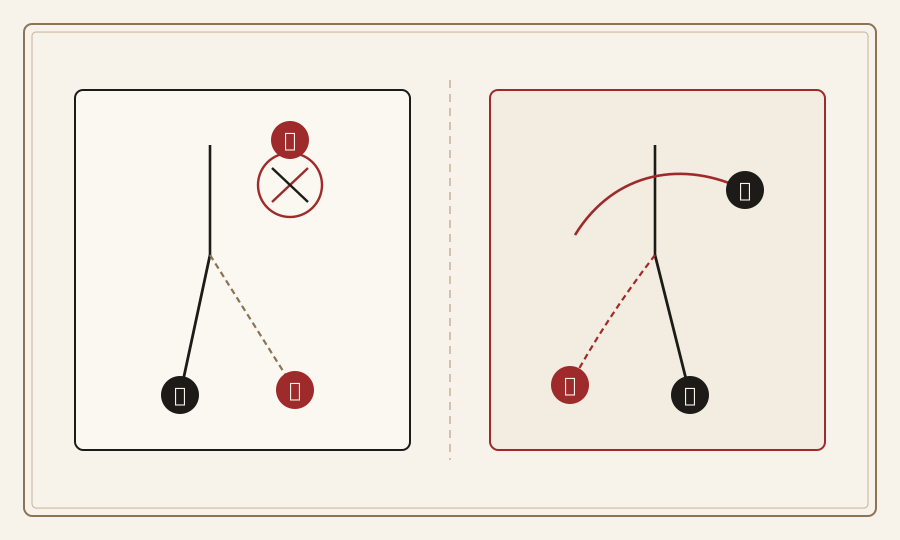
Classical numbers-only diagram comparing Step Up to Seven Stars on the left (① rooted rear leg, ② light advancing empty toe touch, ③ crossed-wrist Seven-Star Peng guard) with Retreat to Ride the Tiger on the right (④ retreated rear supporting leg, ⑤ buoyant cat-like empty lead foot, ⑥ diagonal embracing and overhead framing palms).

Wudang Taijiquan Shangbu Qixing & Tuibu Kuahu (numbers-only SVG key): Advancing crossed-wrist Peng guard flowing into retreating diagonal open wings.

  1. ① Rooted Rear Supporting Leg (Shangbu Qixing): Bearing 85–90% of body weight with a folded hip crease and upright spine.
  2. ② Advancing Empty-Step Toe Touch: The right foot steps up lightly on the ball of the foot without transferring heavy weight.
  3. ③ Crossed-Wrist Seven-Star Guard: Hollow fists crossed at shoulder height supported by rounded dorsal Peng energy.
  4. ④ Retreated Rear Supporting Leg (Tuibu Kuahu): The right foot steps back and receives the full root smoothly.
  5. ⑤ Buoyant Tiger-Riding Empty Foot: The front (left) foot pivots onto the ball of the foot, poised and weightless.
  6. ⑥ Diagonal Open Wings (Tuibu Kuahu): The wrists uncross into a spacious diagonal split frame ready for Turn-Body Sweep Lotus.

3. Retreat to Ride the Tiger (Tuibu Kuahu): Uncrossing the Wings While Shifting Rearward

From Shangbu Qixing, because the front (right) foot carries almost no weight, it can lift effortlessly and step backward behind the body. As your weight shifts smoothly onto that retreated right leg, the left foot becomes the new empty front foot (touching lightly on the ball of the foot, resembling a rider straddling a tiger’s back), while the two crossed fists open into palms and separate diagonally—the right palm arcing upward to frame above the right temple while the left palm sweeps downward and outward beside the left hip.

This retreating expansion accomplishes two things at once: it neutralizes an incoming press by yielding backward along a spiral arc, and it winds the waist and hips like a mainspring to prepare for the turning sweep of Turn Body and Sweep Lotus (Zhuanshen Bailian).

4. 5-Minute Advance-and-Retreat Empty-Step Drill & Knee Safety Notes

Practice this five-minute balance drill on Wudang Mountain or in a small room in Singapore: stand on a rooted left leg, step the right foot half a pace forward onto the ball of the foot, and cross your hollow fists at chest height in Shangbu Qixing (pause for one breath and check that you can lift the right toe one centimeter off the floor without swaying). Next, step that right foot backward, shift 90% of your weight onto the right leg, let the left foot rest lightly on its ball, and open both palms diagonally in Tuibu Kuahu. Repeat six slow cycles on each side.

Safety note: keep the supporting knee aligned directly over the middle of the supporting foot—never let the knee cave inward during the weight shift. If your quadriceps fatigue quickly, practice in a higher stance and consult a healthcare professional if you have knee or ankle pain.

Seeker’s Q&A · Frequently Asked Questions

Why is the posture called “Step Up to Seven Stars” (Shangbu Qixing) in Wudang Taijiquan?

In Wudang martial arts, “Seven Stars” (Qixing) refers both to uniting the seven key structural points of the body (head, shoulders, elbows, hands, hips, knees, and feet) into one integrated guard and to the Big-Dipper geometric triangle formed by the crossed wrists and empty lead foot.

